

How does the application process of stainless steel black coatings impact their durability and performance in industrial settings?
The application process directly affects how well a stainless steel black coating adheres, cures and protects the component in industrial service. Thorough preparation, controlled application and correct curing help produce a uniform finish with improved resistance to wear, corrosion, chemicals and handling damage.
The durability and performance of a stainless steel black coating depend on how accurately each application stage is controlled. The result is affected not only by the powder or liquid coating selected, but also by the condition of the stainless steel, the way the component is positioned and coated, the achieved film build, and the curing conditions used after application.
Surface condition determines the quality of the coating interface. Stainless steel has a naturally passive surface that helps resist corrosion, but residues such as oil, polishing compound, fingerprints, dust and fabrication debris can prevent consistent bonding. Weld areas, heat-affected zones, cut edges and areas that have been handled during fabrication may require particular attention. If these contaminants remain, the coating may show local adhesion failure, blistering, pinholing or early corrosion beneath damaged areas.
Preparation therefore needs to be appropriate to the grade and condition of the stainless steel. Cleaning removes organic contamination, while suitable abrasion or surface treatment creates a consistent key without introducing damaging residues. The prepared surface must also be dry and protected from recontamination before coating. This is especially important for components with a decorative black finish, because uneven preparation can become visible through variations in gloss, texture or colour.
Component geometry influences coating coverage. Recesses, internal corners, drilled holes, sharp edges, brackets and enclosed sections do not receive coating in the same way as broad, accessible faces. Powder can be less readily attracted to recessed areas, while edges can receive a different film build from adjacent surfaces. Correct racking and part orientation help expose the required faces and reduce shadowing. Suitable masking is also necessary where threads, mating faces, electrical contact points or close-tolerance areas must remain free from coating.
Application equipment and operator control affect how evenly the black coating is deposited. Spray settings, gun distance, air movement, part position and electrical grounding must be suited to the component. Inconsistent settings can produce thin areas, excessive build, roughness, back-ionisation or uneven appearance. A controlled application is particularly important where several parts must match, such as panels, frames, covers or repeat-manufactured assemblies.
Film thickness has to be controlled rather than simply maximised. A coating that is too thin may provide incomplete coverage and reduced protection at vulnerable points. Excessive build can affect edge definition, assembly tolerances, surface texture and curing behaviour. The correct target depends on the coating system, component design and intended service conditions. Measurements taken from representative areas can confirm that the applied film is within the specified range and can identify variations that may not be obvious during visual inspection.
Curing changes the deposited coating from a powder layer into a continuous, bonded film. The important factor is the temperature reached by the metal itself for the required time, rather than the oven air temperature alone. Component mass, thickness, shape, loading pattern and oven circulation can all affect heat penetration. Under-curing may leave the finish insufficiently developed, while excessive heat exposure can alter colour, gloss or coating properties. Establishing a suitable cure profile for the actual component helps maintain consistency between different production batches.
The application process also affects the coating’s ability to tolerate industrial handling and exposure. A continuous, correctly cured film is better placed to resist abrasion from contact, cleaning processes, moisture and commonly encountered industrial contaminants. However, the coating should still be selected with the service environment in mind. Chemical exposure, outdoor weathering, elevated temperatures, impact, abrasion and contact with dissimilar materials may require different coating specifications or additional design controls.
Stainless steel components can experience localised problems at welds, joints and interfaces even when the visible faces appear satisfactory. Coating coverage around these areas should be reviewed alongside drainage, crevices and points where water or contaminants could collect. Design features that trap moisture can undermine long-term performance by concentrating exposure at a defect or uncoated interface. Application planning is therefore most effective when it considers the finished component, its assembly and its operating environment together.
Inspection verifies whether the application has produced the intended result. A practical inspection may include:
- visual checks for pinholes, runs, inclusions, bare areas, colour variation and surface defects;
- film-thickness measurements across accessible and vulnerable locations;
- checks on masked areas, threads, holes and mating surfaces;
- adhesion assessment where required by the specification; and
- confirmation that the finish has been cured in accordance with the coating manufacturer’s requirements.
These checks are useful because appearance alone cannot confirm cure, adhesion or uniform film build. Records of the coating specification, preparation method, application settings and inspection results also make it easier to investigate variation and reproduce an acceptable finish on later batches.
In industrial work, durability is therefore an application-system outcome rather than a property of black colour alone. Careful preparation, appropriate coverage of complex geometry, controlled film build, correct curing and proportionate inspection work together to determine whether a stainless steel black coating remains functional and visually consistent during service.
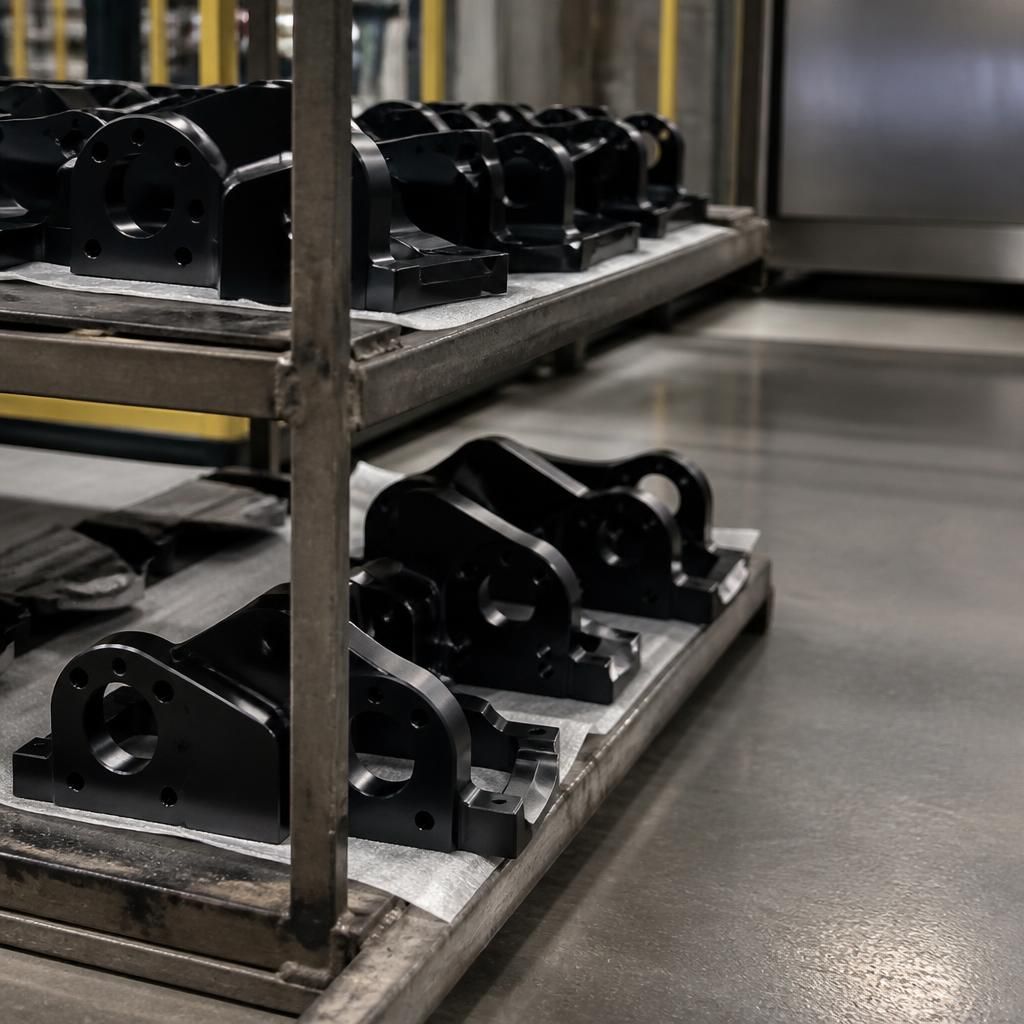
Post-cure handling is an important part of how a stainless steel black coating performs in service. A coating may have completed its oven cycle but still be vulnerable to marking, pressure points or contamination while it cools and reaches its final handling condition.
Components should therefore be handled with clean, suitable supports and prevented from rubbing against one another during cooling, transfer and packing. Careful separation is especially relevant for visible black finishes, as contact damage can expose the stainless steel or create weak points where moisture and industrial contaminants may reach the coating interface. Protecting the finish at this stage helps preserve the continuity and appearance established during application.
Discuss Your Stainless Steel Black Coating Requirements
Discuss your stainless steel component drawings, material grade, geometry and service conditions with the coating team to establish suitable preparation, application and inspection requirements. Providing these details helps define a specification suited to the required black finish and industrial use.