

What is the durability of a shiny black powder coat finish compared to traditional paint?
A properly applied shiny black powder coat is generally more resistant than traditional liquid paint to scratching, chipping, abrasion and corrosion because it forms a tough, chemically bonded finish on the metal. Its durability still depends on surface preparation, coating specification, curing and the component’s service conditions, while traditional paint may be simpler to repair locally.
A shiny black powder coat usually provides the more durable finish for metal components than conventional liquid paint, particularly where the surface is exposed to handling, abrasion, moisture or routine industrial use. The comparison is not simply about colour or gloss: durability depends on the coating system, the metal, the component’s design and the conditions it will face.
One important difference is film formation. Powder coating is applied as a dry powder and heated so that the particles melt and form a continuous film. This produces a consistent surface without the solvent evaporation associated with liquid paint. A correctly specified coating can resist everyday scuffing and wear more effectively than many general-purpose paints, while retaining a smooth, uniform appearance.
Gloss black can make surface damage more visible than a lower-sheen finish. Fine scratches, dust, water marks and fingerprints may show clearly when light reflects from the surface. This does not necessarily indicate coating failure, but it can affect perceived appearance. For components where visual consistency matters, handling, packaging and installation methods are therefore part of the overall durability strategy.
Resistance to impact is also specification-dependent. A powder-coated surface can withstand ordinary knocks, but a sharp impact may chip the film, particularly at an exposed edge or corner. If damage reaches the metal, moisture can gain access beneath the coating. Component geometry matters because sharp edges, recesses, joints and concealed faces can be more difficult to coat evenly than broad, accessible surfaces.
Outdoor exposure introduces additional considerations. Sunlight can gradually alter the gloss and colour of a black finish, while industrial atmospheres, road contaminants, cleaning chemicals and standing moisture can affect the coating or the metal beneath it. A finish intended for internal equipment should not automatically be treated as suitable for prolonged external exposure. The required level of weathering and corrosion resistance should be agreed before the coating system is selected.
Traditional paint remains useful where frequent colour changes, small-area touch-ups or on-site repairs are important. Liquid paint systems also vary considerably: a basic decorative paint is not a fair comparison with a purpose-designed industrial system. Paint may be the practical choice for a substrate or component that cannot be heated, or where the application process requires a very thin or easily blended repair layer.
For a meaningful comparison, assess the two finishes against the component’s actual service conditions:
- Mechanical exposure: consider rubbing, sliding contact, impact, loading, handling and contact with tools or other parts.
- Environmental exposure: identify whether the component will be indoors, outdoors, near moisture, or in contact with oils, solvents, detergents or industrial contaminants.
- Appearance requirements: decide whether a high-gloss black surface is appropriate when marks and surface variation need to be minimised.
- Component design: review edges, apertures, welded areas, recesses and fixing points that may be vulnerable to damage or difficult to coat consistently.
- Maintenance and repair: establish whether the part can be removed for recoating or whether any future repair must be carried out in place.
In practical terms, shiny black powder coat is often the stronger option for repeatable industrial production and metal parts that need a hard-wearing decorative and protective surface. Traditional paint can be preferable where flexibility of repair, low-temperature application or on-site application outweighs maximum resistance to routine wear. The correct decision comes from matching the coating specification to the component’s use rather than assuming that either finish is universally more durable.
For Midlands manufacturers, fabricators, construction firms and automotive businesses, a coating assessment should include the metal type, component dimensions, expected handling, exposure conditions and required appearance. Those details allow the proposed finish to be judged on service performance as well as initial appearance, with collection and delivery options available for businesses across the Midlands and surrounding areas.
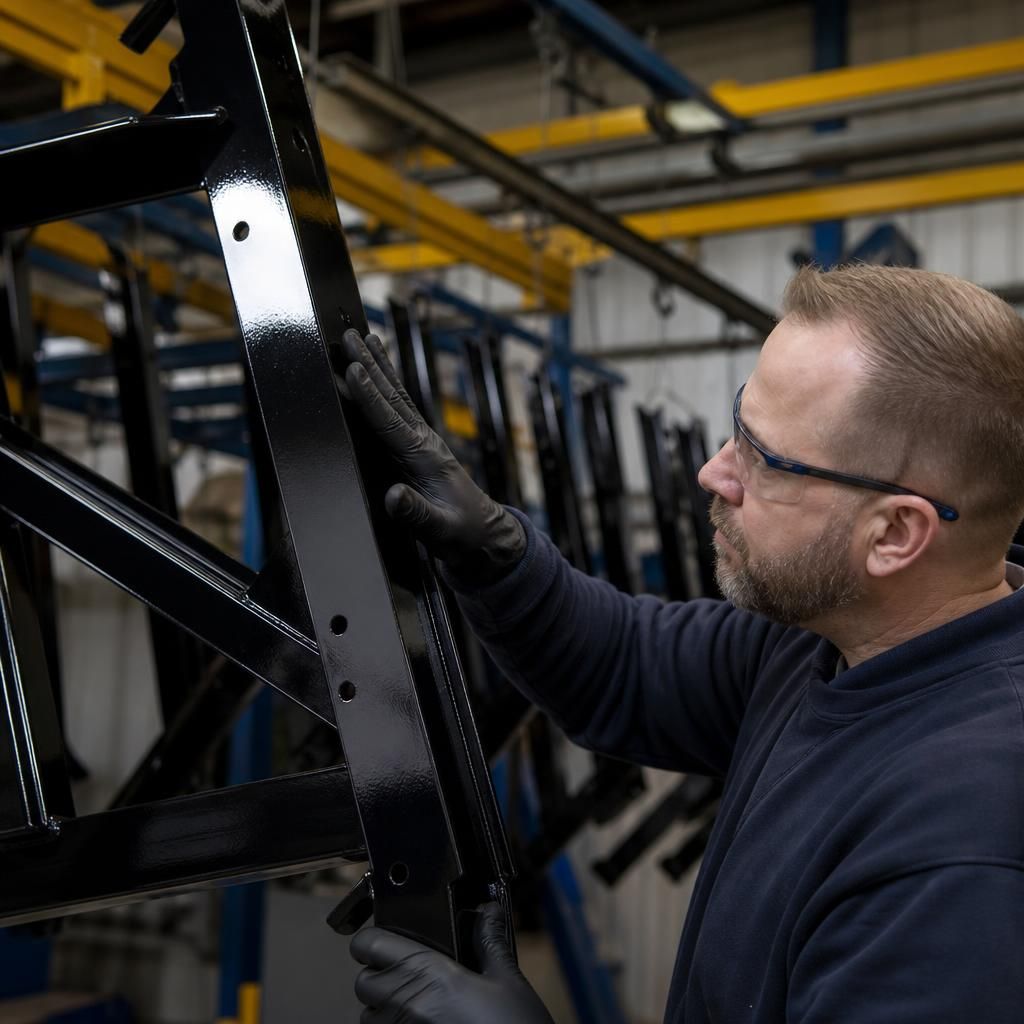
Durability should be assessed by whether the coating continues to protect the metal, not solely by whether the shiny surface remains visually flawless. A light scuff or reduction in gloss may be cosmetic, whereas a deep chip, exposed substrate or spreading corrosion indicates a more significant coating failure. This distinction is useful when comparing powder coating with traditional paint, because the visible condition of a high-gloss black finish can change before its protective function is lost.
For industrial components, inspection should focus on exposed edges, fixing points and areas subject to repeated contact. Any damage that reaches the metal should be dealt with promptly, using a repair method suitable for the coating system and the component’s service conditions. This approach provides a more accurate view of long-term performance than judging durability from initial appearance alone.