

How is a shiny black powder coat finish applied to complex metal shapes?
A shiny black powder coat is applied to a complex metal shape by cleaning and preparing the surface, spraying charged powder so it adheres evenly, then heating the component to cure the coating into a smooth finish. Careful masking, racking and spray-gun positioning help reach recessed areas, edges and intricate profiles while controlling thickness and avoiding bare spots or powder build-up.
Complex metal shapes need more than a standard spray application: the coating process must account for recesses, internal corners, narrow sections, welds, apertures and areas that may be difficult to access. The aim is to achieve consistent coverage and correct film build without obstructing moving parts, closing holes or creating excessive powder at edges.
Before coating, the component is assessed as a three-dimensional part rather than simply as a flat surface. Its geometry, material, welds, drainage points, handling requirements and specified finish are considered when deciding how it should be supported and presented during application. This planning helps the coater identify potential shadowed areas and determine which faces should be treated first.
Electrical conductivity has a significant effect on the result. Powder is attracted to the metal by an electrostatic charge, but deep recesses and enclosed corners can behave like a Faraday cage, reducing powder penetration. The operator may therefore adjust the gun angle, distance, voltage and powder flow, while rotating or repositioning the component where practical. These adjustments help control coverage in difficult areas rather than relying on a single spray direction.
Preparation also needs to suit the shape of the component. Contamination, oxides, residues and handling marks can interfere with adhesion, so the surface must be suitably clean and prepared before powder is applied. Welded fabrications and castings require particular attention because joints, pores and surface irregularities can affect appearance. Cast or porous parts may also release trapped air or gases during heating, causing pinholes or blistering if the risk is not considered in advance.
Masking is used where coating must not be deposited. Typical examples include threaded holes, bearing seats, electrical contact points, precision bores and mating faces. Masking materials must tolerate the curing cycle and be fitted accurately, since excess coating on a critical interface can affect assembly or alter a component’s dimensions. Parts may also need specially designed plugs, caps or hooks to maintain clean contact points for electrical grounding.
The chosen powder and curing schedule must match the metal, service conditions and required appearance. Curing is governed by the temperature reached by the component and the time it remains at that temperature, not simply by the oven’s displayed air temperature. Unevenly sized or heavily fabricated parts can heat at different rates, so the schedule needs to be suitable for the thickest and most thermally demanding sections. Insufficient curing can affect performance, while excessive heat can damage the finish or the substrate.
After curing, the component is checked for more than its gloss level. Inspection can include:
- coverage in recesses, corners and other difficult-to-reach areas;
- uniformity of colour, sheen and texture across adjoining faces;
- visible defects such as runs, inclusions, pinholes or exposed metal;
- cleanliness of masked holes, threads and contact points;
- film build where dimensional tolerances or assembly clearances matter; and
- the condition of edges, hooks and handling points that may need attention.
Complex fabrications should be presented with clear coating requirements before processing. Drawings or marked-up photographs can identify no-coat zones, cosmetic faces, contact points and areas where a particular film thickness is important. It is also useful to disclose castings, sealed cavities, trapped moisture, welded closures and any components that will later be assembled or exposed to demanding conditions.
For manufacturers and fabricators, repeatability depends on keeping the part design, racking method, powder specification and curing requirements consistent between batches. Where a design is especially intricate, a sample or first-off assessment can help reveal access, masking or outgassing issues before the complete batch is processed. Powder-coating specialists serving industrial customers can advise on these practical considerations and arrange collection and delivery for suitable metal components.
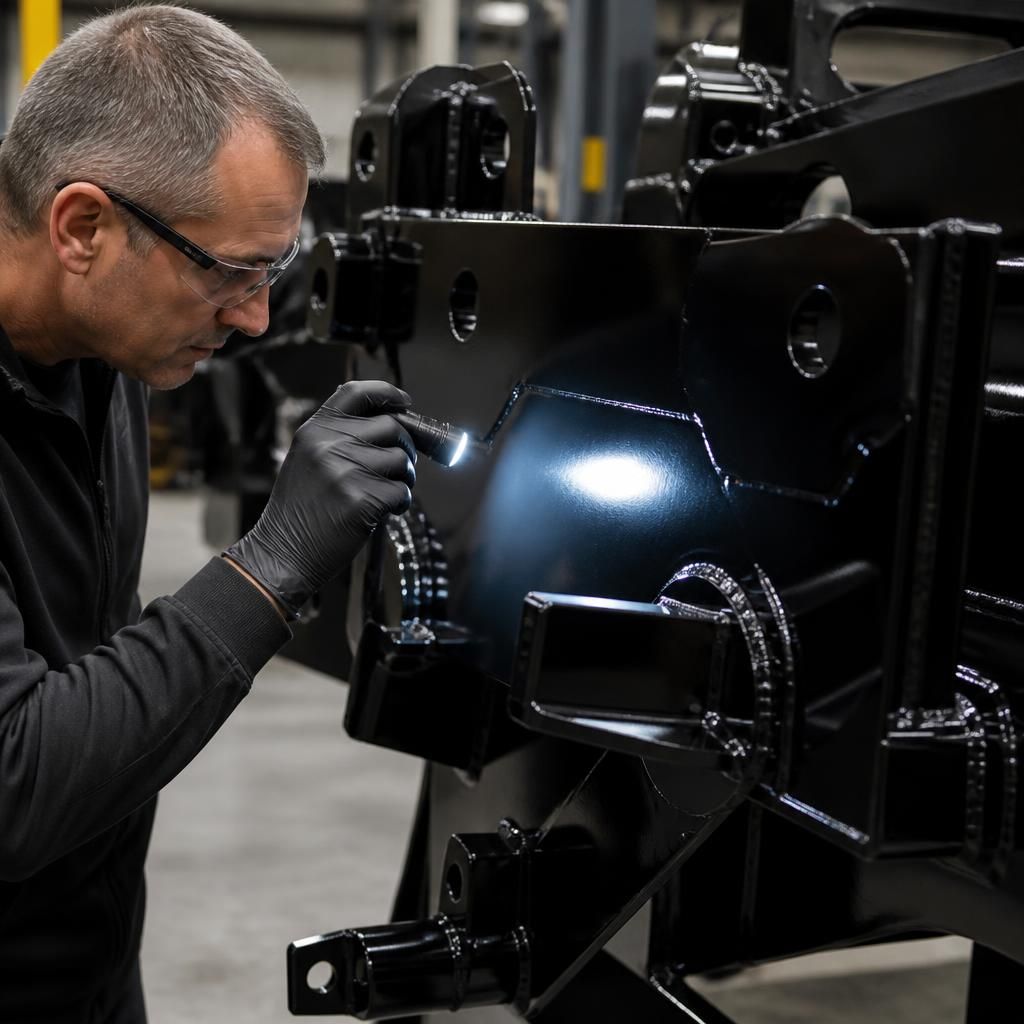
A shiny black finish makes surface irregularities particularly visible because reflected light highlights dents, weld distortion, grinding marks and uneven edges. Powder coating covers and protects the metal, but it does not level substantial changes in the underlying profile. For this reason, cosmetic faces may need a suitable standard of fabrication and finishing before the component enters the coating process.
Inspection should assess the part from several angles rather than relying on a single view. Changes in reflection can reveal inconsistent texture, local powder build-up or surface defects that may be less obvious under flat lighting. This is especially relevant where adjoining faces must present a continuous appearance after coating.