

How does the application process for a shiny black powder coat finish impact its durability and performance?
The application process directly affects the durability and performance of a shiny black powder coat finish. Thorough surface preparation, even powder application and accurate curing create a consistent coating that adheres properly and provides reliable protection against wear, corrosion and environmental exposure.
The application process affects a shiny black powder coat finish by determining the coating’s film integrity, adhesion, coverage, gloss and resistance to service conditions. The powder formulation is important, but the way it is deposited, controlled around the component and handled after coating also determines whether the finished surface performs consistently in use.
Film thickness and coverage
A powder coat must form a continuous film that is thick enough to provide protection without becoming excessively heavy. Insufficient coverage can leave weak areas, particularly on edges, corners, recesses and weld profiles. Excessive build can affect appearance, create runs or surface texture and may interfere with the fit of assembled parts. Application settings therefore need to suit the component’s shape, the powder being used and the required finish.
Complex components require particular attention because the electric field used during electrostatic application does not reach every area equally. Recesses and internal corners can receive less powder, while prominent edges may attract more. Skilled application helps control these differences through gun position, travel speed, spraying angle and the treatment of difficult areas. This is especially relevant where a uniform high-gloss black appearance is required across both visible and less accessible surfaces.
Electrostatic transfer and grounding
During powder coating, charged powder particles are attracted to the earthed metal component. Effective grounding supports reliable transfer and helps the powder settle on the intended surface rather than being lost or deposited unevenly. Poor electrical contact can contribute to inconsistent deposition, patchy coverage and greater powder waste. Contact points also need to be planned so that they do not leave unacceptable uncoated marks on important faces.
The application environment has an effect as well. Moisture, contamination in the spray area or unsuitable powder storage conditions can alter how the material flows and transfers. Powder should be kept in suitable conditions and handled in a way that avoids introducing foreign particles into the finish. Contamination is particularly visible in shiny black coatings because the reflective surface makes specks, pinholes and texture variations easier to see.
Geometry, masking and component preparation
Parts may need masking where coating is not wanted, such as threaded holes, bearing seats, electrical contact points or mating faces. Correct masking protects dimensional accuracy and reduces the need for post-coating removal. Poorly positioned masking can create sharp transitions, exposed metal or unwanted overspray, all of which may affect assembly or protection.
Design features can also influence performance. Deep cavities may retain powder or make inspection difficult, while narrow gaps can restrict access and create areas with a different appearance. Drainage and ventilation holes can help prevent trapped air or moisture-related problems during processing. For fabricated parts, the position of welds, joints and folded sections should be considered before coating because these areas can affect both coverage and the final visual result.
Thermal processing and material compatibility
The component, powder and specified finish must be compatible with the thermal process. The relevant condition is the temperature reached by the metal and the time it remains at that temperature, rather than simply the oven’s displayed setting. If a component has significantly different thicknesses, heat may travel through it at different rates. That can influence the final film properties and appearance if the process is not controlled for the part’s actual mass and construction.
Materials that cannot tolerate the required heat, or assemblies containing heat-sensitive elements, may need an alternative coating approach or a different production plan. Any inserts, seals, adhesives or previously applied treatments should be assessed before processing because they can degrade, outgas or affect the coating if they are not suitable for the conditions involved.
Cooling, handling and inspection
After thermal processing, parts should be handled in a way that avoids marking, contamination and impact damage while the finish is still vulnerable to scratching. Suitable supports and contact points reduce the risk of pressure marks. Components should also be inspected for coverage, colour consistency, gloss, texture, inclusions, pinholes and damage around hooks or masking points.
Inspection is not limited to appearance. Depending on the component and its intended use, checks may include coating thickness, adhesion, cure characteristics and the condition of critical masked areas. A visual inspection can identify defects, but it cannot by itself confirm every performance property. The appropriate checks should be agreed with the fabricator or end user, particularly for parts exposed to abrasion, outdoor conditions, chemicals or frequent handling.
In practice, a durable shiny black finish results from matching the powder system and process controls to the component’s design and service environment. Clear specifications for required coverage, acceptable appearance, masking, dimensional limits and inspection reduce the risk that a visually attractive finish will conceal a functional weakness.
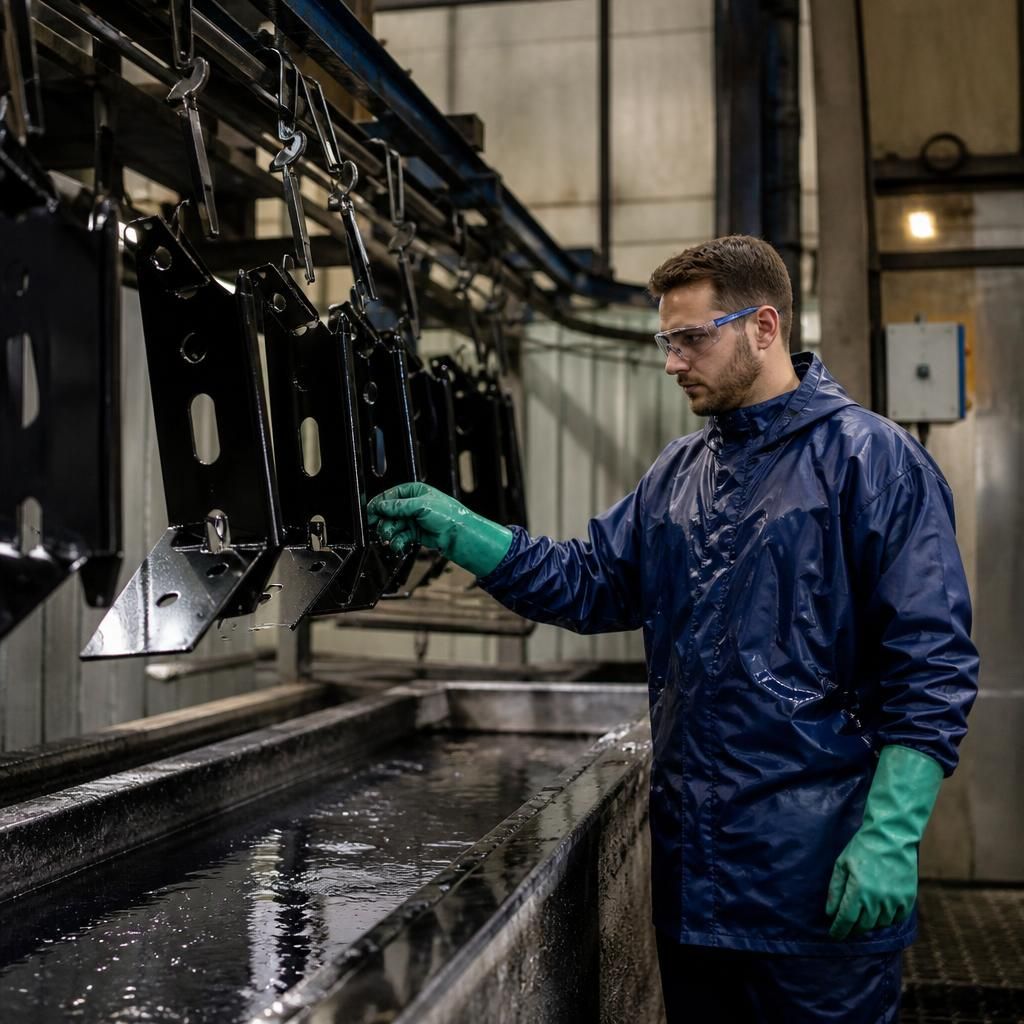
Pre-treatment is a key part of preparing metal for a durable shiny black powder coat finish. Degreasing removes oils and fabrication residues, while suitable cleaning and conversion processes help address oxidation and provide a more receptive surface for the powder film. If these residues remain, the coating may bond inconsistently or show defects that become highly visible through the reflective black finish.
The pre-treatment must suit the base metal and the component’s service conditions. Steel, galvanised surfaces and aluminium may require different preparation methods, and the part should be thoroughly dried before powder application. A controlled, compatible pre-treatment supports adhesion and helps the finished coating provide more consistent protection against moisture and corrosion.