

What are the cost implications and potential savings associated with using powder colour paints compared to traditional liquid paints?
Powder colour paints can reduce overall coating costs through efficient material use, recoverable overspray, durable finishes and reduced solvent-related handling, although the process requires suitable application and curing equipment. Compared with traditional liquid paints, the most economical option depends on factors such as component size, batch quantity, colour changes, pretreatment requirements, curing energy and the number of coats needed.
Powder colour paint can offer a lower total cost of ownership than traditional liquid paint, but the saving depends on the complete coating system rather than the price of the paint alone. A sound comparison should include preparation, application, curing, labour, equipment, inspection, rework, maintenance and the expected service life of the finished component.
Initial investment and operating costs
Powder coating normally requires dedicated application and curing equipment, including a spray system, extraction, an oven and suitable handling arrangements. This can make the initial investment higher than a basic liquid-paint setup. For a business coating its own components, that capital cost needs to be assessed against production volume, available floor space, energy consumption and the expected period of use.
Using an established coating contractor changes the calculation. Rather than purchasing and maintaining the equipment, the manufacturer or fabricator pays for the required coating service. This can avoid capital expenditure and convert part of the finishing cost into a predictable production cost. The relevant comparison is therefore not simply the price per kilogram of powder and liquid paint, but the cost per acceptable, finished component.
Labour requirements can differ between the two methods. Powder coating may require time for loading, masking, racking, oven handling and inspection. Liquid paint may involve several application or drying stages, depending on the specification. The number of handling operations, the need for intermediate checks and the amount of manual finishing should all be included when preparing a cost model.
Where powder coating can reduce costs
- Fewer finishing stages: Where the specification can be met with a single powder coating system, the process may reduce handling and production time compared with a multi-coat liquid system.
- Lower rework exposure: A consistent application process and controlled curing can help limit defects such as uneven coverage, runs and visible variation. Avoiding stripping, re-preparation and re-coating is often more significant than a small difference in material price.
- Longer maintenance intervals: If the selected powder system is suitable for the service environment, its resistance to wear, impact and corrosion can reduce the frequency of refinishing during the component’s working life. This is particularly relevant for equipment, fabricated assemblies and metalwork that would be costly to remove or access for maintenance.
- Reduced process disruption: A robust finish can reduce the need to take coated parts out of service for cosmetic repairs. The value of this benefit depends on the component’s role and the consequences of downtime, so it should be assessed with the end user rather than assumed.
- More predictable batch costing: Once the coating specification, preparation method and loading arrangement are established, repeat work can often be priced using consistent process information. This supports more accurate production planning for regular batches.
Costs that can reduce or remove the saving
Powder coating is not automatically the lowest-cost option. Pretreatment remains essential: oil, scale, rust and other contaminants must be removed, and the substrate may require a conversion treatment or primer for the intended environment. The preparation method and its inspection requirements can add materially to the finished price.
Curing also introduces a temperature and energy requirement. Components must tolerate the specified oven conditions, and their size, mass and geometry can affect how efficiently they are loaded and cured. Heat-sensitive materials, mixed-material assemblies or parts that cannot fit the available equipment may require a different coating approach. For these items, liquid paint may be more practical even if its finishing sequence involves additional labour.
Colour and specification changes can create indirect costs through cleaning, line preparation, masking and production planning. These costs should be allocated across the relevant batch rather than treated as a general overhead. Small or irregular batches may therefore have a higher unit cost than repeat production with stable specifications.
Part design also affects the comparison. Deep recesses, enclosed sections, threaded holes and areas that must remain uncoated may need masking or additional inspection. Large components may require special handling, while fragile or tightly toleranced parts can incur extra protection and measurement costs. A coating quote based only on surface area may not reflect these practical requirements.
Comparing powder and liquid paint fairly
Request both options against the same technical brief. The comparison should identify the substrate, pretreatment, coating system, required film thickness, colour, gloss or texture, corrosion environment, masking points, curing requirements, inspection standard and packaging arrangements. It should also state whether any primer, seal coat or second application is included.
Ask for the cost to be separated into preparation, coating, curing or drying, masking, inspection, packaging and transport. This makes it easier to identify whether a price difference comes from the material, the labour content or the complexity of the process. It also prevents a low initial price from concealing later costs for rework, additional coats or special handling.
For repeat work, calculate the expected cost over the full production run and, where relevant, over the component’s service life. Include setup and changeover costs, rejected or reworked parts, storage, maintenance access and the financial effect of removing components for recoating. A coating that costs more at the application stage may be more economical overall if it reduces future intervention; conversely, a lower-cost system may be suitable where parts have a short life or are easily replaced.
For Midlands manufacturers, fabricators, construction businesses and automotive suppliers, the most useful assessment is usually based on representative components or a trial batch. Providing drawings, part dimensions, material details, batch quantities and the required finish allows the process requirements to be identified before a direct powder-versus-liquid comparison is made. Powder-coating specialists can then advise whether the proposed finish is technically suitable and whether the expected production profile supports the potential saving.
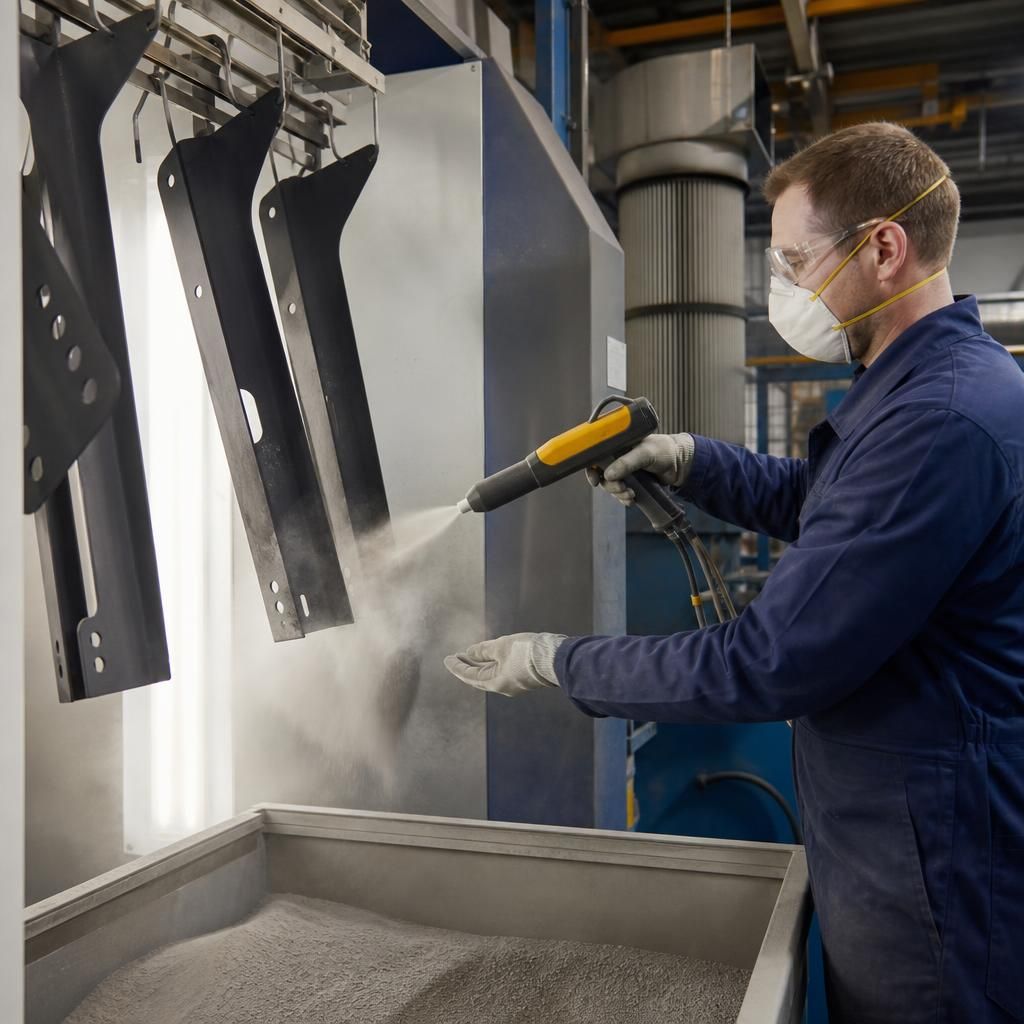
One cost advantage of powder colour paint is the potential to recover usable overspray. During electrostatic application, some powder does not reach the metal component and can be captured by the booth and filtration system. Where the coating specification allows it, suitable recovered powder may be reused, reducing material waste and the amount of new powder required for a batch.
Recovery is not appropriate for every colour or finish. Contamination, mixed colours, metallic effects and strict appearance requirements can limit reuse, while recovered material must be controlled to avoid affecting colour consistency. Liquid paint overspray generally cannot be returned to the process in the same way because of its formulation and solvent content, so disposal and material-loss costs may be higher.
When comparing quotations, ask whether the costing includes expected powder recovery, waste handling and any restrictions on reclaiming material. This helps distinguish a genuine material-efficiency benefit from an assumption that may not apply to the required colour or finish.