

How do powder colour paints compare to traditional liquid paints in terms of durability and finish quality?
Powder colour paints generally provide a tougher, more abrasion- and impact-resistant finish than traditional liquid paints, making them well suited to metal components exposed to regular handling or demanding conditions. They can also produce a more uniform finish with consistent colour and coverage, although liquid paint may be preferable where very thin coats, intricate touch-ups or certain specialist visual effects are required.
Powder colour paints generally offer superior long-term durability and finish quality for suitably prepared metal components, particularly where the coating must withstand weathering, handling, chemicals or repeated use. Traditional liquid paints remain useful when a very thin film, extensive on-site repair, complex masking or a particular visual effect is more important than maximum resistance.
The performance difference comes partly from how each coating forms its film. Powder is applied as a dry, electrostatically charged material and then heated so the particles melt, flow and cure into a continuous coating. This produces a bonded film without the solvents used in conventional liquid systems. Liquid paint is applied as a wet material, with the carrier evaporating or reacting during drying and curing. Its final performance depends on the resin system, solvent or water content, application method, drying conditions and the number of coats.
For industrial metalwork, powder coatings are often selected for their resistance to:
- corrosion, when the metal is correctly prepared and the coating system is appropriate for the environment;
- weathering caused by moisture, sunlight and temperature changes;
- scratching, scuffing and general handling during service;
- selected oils, detergents and chemicals, subject to the specific powder formulation; and
- loss of adhesion caused by poor surface preparation, where a suitable pre-treatment is used to support bonding.
Liquid paints can also provide high durability. Specialist liquid systems may be preferable for substrates or operating conditions that cannot tolerate the heat needed to cure powder. They can also be built up as primer-and-topcoat systems, allowing the coating specification to be matched closely to corrosion, chemical or temperature requirements. The correct comparison is therefore between complete coating systems rather than powder and liquid technology in isolation.
Finish quality depends on more than the paint type. The substrate must be clean, free from oil, rust, scale and other contaminants, and suitable for the chosen preparation process. Welds, sharp edges, recesses and areas of mixed metal can affect coverage and appearance. Powder application also requires an appropriate cure schedule: insufficient curing can reduce performance, while excessive heat can affect the finish or the substrate. With liquid paint, dust control, viscosity, spray technique, flash-off and drying conditions have a similar influence.
Powder coatings can produce an even visual film with controlled gloss and a wide range of surface textures. They are well suited to repeat production because the same preparation, application and curing parameters can be applied across a batch. The finish may be smooth, matt, satin, textured or structured, depending on the selected product. Liquid paint offers its own range of gloss levels and effects and can be advantageous when a finely blended finish, very thin coating or detailed local application is required.
There are practical limitations to both methods. Powder coating normally requires the component to fit inside the preparation and curing equipment and to tolerate the curing temperature. It may be less convenient for large assemblies that cannot be dismantled or for work requiring a small local repair. Liquid paint can be applied to larger fixed structures and is easier to blend or touch up on site, but achieving the same film thickness and repeatability over a large batch can require careful process control.
Film thickness is another important consideration. A heavier coating is not automatically a better coating: excessive build can obscure detail, affect fits and create problems around threads, holes or mating surfaces. Conversely, insufficient coverage may leave vulnerable areas exposed. The specification should identify the required coating system, preparation standard, target film characteristics, gloss or texture, colour reference and service environment before production begins.
For a fair assessment, compare samples or trial components under the conditions they will face in service. Consider exposure to sunlight, rain, salt, cleaning chemicals, abrasion, heat and mechanical handling, as well as the required appearance. A finish that looks excellent immediately after application may not be suitable if its resin system is not designed for prolonged exterior exposure. Likewise, a highly durable coating may be unnecessary for an indoor component with limited handling.
For manufacturers, fabricators, construction firms and automotive businesses, the most reliable choice is usually the coating process that matches the component, production volume and operating environment. Powder colour paint is commonly favoured where a robust, repeatable factory-applied finish is required. Liquid paint remains a technically valid option where substrate sensitivity, component size, repairability, thin-film requirements or specialist appearance outweigh the advantages of powder.
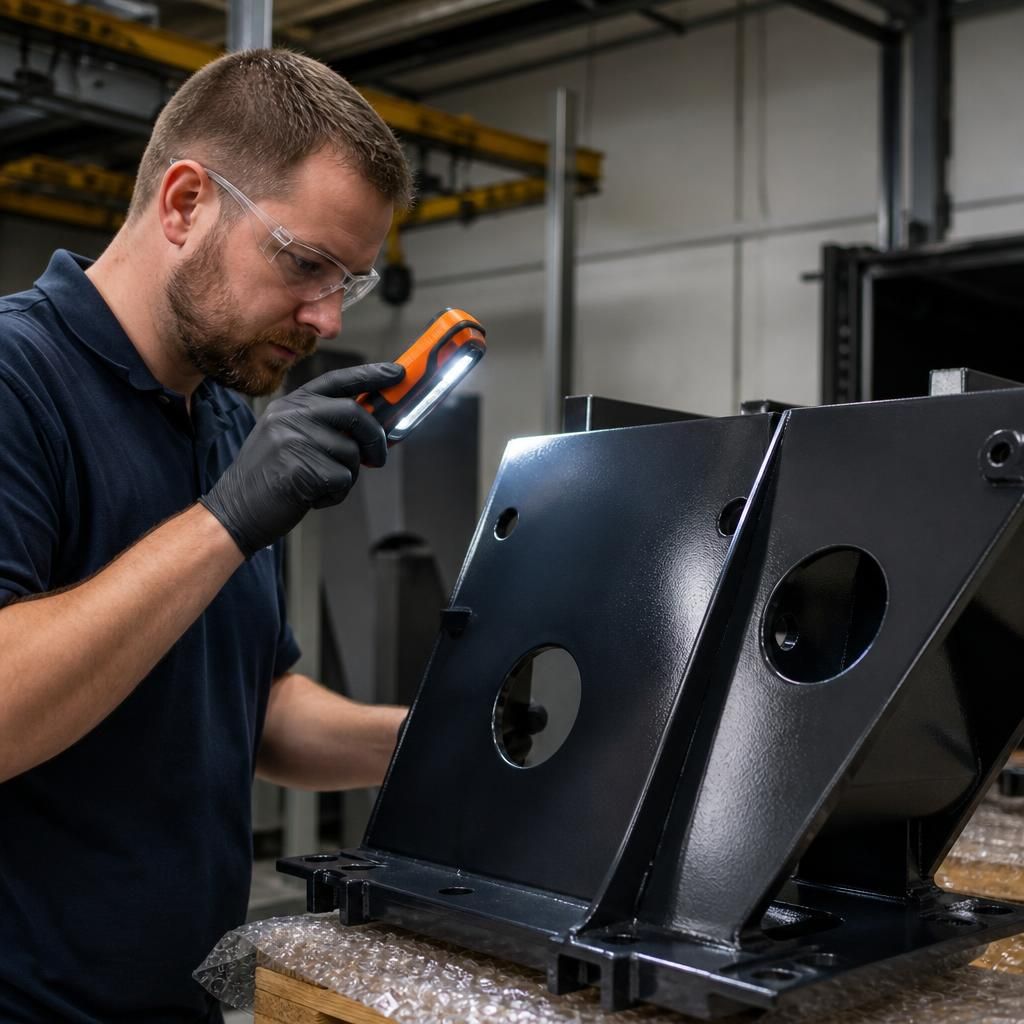
Finish quality should be assessed by more than colour and gloss. A properly evaluated powder-coated component should be checked for an even film, consistent texture, clean edges and the absence of visible defects such as pinholes, craters, blisters or trapped contamination. Colour should be compared with the agreed reference under consistent lighting, as the same shade can appear different under daylight and artificial light.
For repeat production, inspection criteria should be agreed before coating begins. This allows powder and liquid finishes to be compared against the same requirements for appearance, coverage and acceptable variation, rather than relying on an informal visual judgement. It is particularly important for visible panels, coordinated assemblies and components that will be installed together.
Discuss powder colour paint options for your metal components
Discuss your component’s service environment, appearance requirements and production needs with a powder coating specialist to determine whether powder colour paint is the right alternative to liquid paint. You can then request a coating recommendation for your metal parts.