

What makes black protective powder coatings more durable than traditional paint?
Black protective powder coatings are more durable because the powder is electrostatically applied and heat-cured into a tough, continuous film that bonds closely to prepared metal. Compared with traditional liquid paint, this finish generally provides stronger resistance to chipping, abrasion, corrosion, chemicals and weathering.
Black protective powder coatings are generally more durable than traditional paint because they form a chemically cross-linked finish with consistent film properties, rather than relying primarily on a liquid coating drying on the surface. This difference affects how the finish responds to impact, handling, moisture, cleaning chemicals and prolonged exposure to the surrounding environment.
Traditional liquid paint contains solvents or water that evaporate as the coating dries. Its final performance depends on the binder, the number of coats, drying conditions and the time allowed for each layer to harden. A powder coating uses a formulated resin system that develops its final structure during the curing stage. Once correctly cured, the coating has a stable polymer matrix that is less prone to softening, marking or losing cohesion under normal industrial use.
Another advantage is control over the applied film. Powder particles are attracted to the metal component before curing, helping the applicator build a consistent coating across the prepared surface. A well-controlled application reduces variations caused by brush marks, runs, sags and uneven solvent evaporation. Consistent coverage is particularly important on fabricated parts, brackets, enclosures, frames and other components that may be handled repeatedly or exposed to outdoor conditions.
The coating’s mechanical performance also contributes to its service life. A properly selected formulation can tolerate knocks, rubbing and general abrasion better than many conventional decorative paints. This does not make the surface immune to damage: a sharp impact can still expose the substrate, especially at an edge or weld. However, the tougher film can reduce the frequency of minor damage that would otherwise lead to flaking, bare patches or early recoating.
Corrosion protection depends on more than the black topcoat. Surface preparation removes contamination and helps the coating bond to the substrate, while suitable pretreatment provides an additional barrier between the metal and moisture. This layered approach is important because corrosion often begins at scratches, edges, welds or areas where grease and oxidation remain beneath the coating. If the metal is poorly prepared or the coating is damaged through to the substrate, even a high-quality powder finish cannot prevent corrosion indefinitely.
Powder coating can also provide more dependable resistance to routine industrial contaminants. Oils, detergents, mild chemicals and atmospheric pollutants may cause a conventional paint film to soften, stain or lose adhesion over time, depending on its formulation. A protective powder system is selected according to the expected exposure, so the finished component can be matched more appropriately to its working environment. Chemical resistance is not universal; aggressive solvents, acids, alkalis and prolonged immersion require a coating specification designed for those conditions.
Black is a practical finish for many industrial applications, but colour alone does not determine durability. The resin chemistry, pigment package, gloss level and intended exposure all influence resistance to ultraviolet light, weathering and colour change. A coating specified for interior machinery may not be suitable for continuous outdoor exposure. For external components, the formulation should be chosen for weather resistance as well as appearance.
The main factors that determine whether a black protective powder coating will outperform traditional paint are:
- Substrate condition: rust, oil, mill scale and other contaminants must be removed before coating.
- Pretreatment: the correct chemical or mechanical preparation supports adhesion and corrosion resistance.
- Coating selection: the resin system should match the component’s exposure to impact, chemicals, moisture and sunlight.
- Film consistency: the applied coating needs sufficient and even coverage, including around edges, recesses and joints.
- Curing: the component must reach the specified curing conditions so the coating develops its intended properties.
- Component design: sharp edges, water traps and inaccessible recesses can create weak points regardless of the coating method.
Powder coating is not automatically more durable in every situation. Poor preparation, incorrect application or insufficient curing can produce adhesion failure, brittleness or premature deterioration. Likewise, a professionally specified multi-coat liquid paint system may be appropriate for some substrates or specialist environments. The meaningful comparison is between complete coating systems, not simply between powder and liquid materials.
For manufacturers, fabricators, construction firms and automotive businesses, the practical benefit is reduced vulnerability during handling and use, provided the coating specification and preparation are suitable for the component. Black protective powder coating is therefore best understood as a complete corrosion and surface-protection system: its durability comes from the interaction between the metal preparation, pretreatment, powder formulation, application control and curing process.
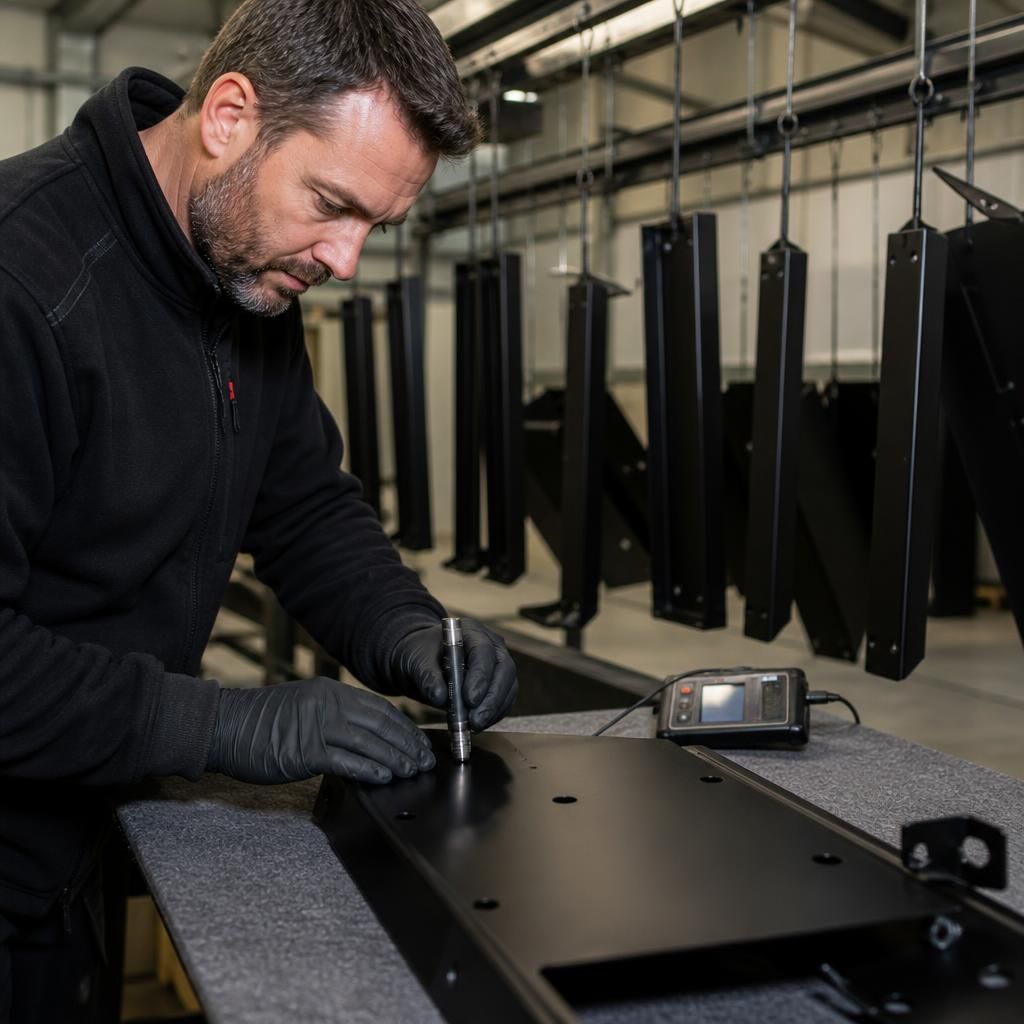
The durability of a black protective powder coating should be assessed by performance, not appearance alone. A smooth, even finish may look satisfactory while still having inadequate adhesion, incomplete curing or insufficient film coverage. Coating inspection and, where required, practical testing help confirm that the finished component is suitable for its intended handling and operating conditions.
Assessment may consider adhesion, impact resistance, abrasion resistance, film thickness and resistance to the substances or weather conditions the component will encounter. These checks help distinguish a properly specified and processed coating from a merely decorative black finish. For industrial parts, the coating requirements should therefore be agreed alongside the component’s substrate, use and expected exposure.