

What certifications or testing standards should black protective powder coatings meet to ensure industrial performance requirements?
Black protective powder coatings should be assessed against standards relevant to their end use, including corrosion resistance, adhesion, coating thickness, impact, flexibility, gloss and accelerated weathering. Common references include ISO 12944 for corrosion-protection requirements, ISO 9227 for salt-spray testing, ISO 2409 for adhesion and ISO 2808 for dry-film thickness; the required specification should be agreed according to the component, environment and expected service conditions.
There is no single certification that proves a black protective powder coating is suitable for every industrial application. The correct evidence is normally a combination of a recognised coating specification, product conformity information, documented application controls and test results that match the component’s material, exposure and service conditions. A coating supplier should be able to identify the relevant standard, the acceptance criteria and the records used to demonstrate compliance.
Certification and testing are different. Certification usually confirms that an organisation, product or process has been assessed against defined requirements. Testing produces measured evidence about a particular powder, coating system or coated batch. An ISO 9001 quality-management certificate, for example, may demonstrate controlled business processes, but it does not by itself prove that a coating will resist corrosion, chemicals or abrasion. Those performance claims require suitable technical data and test evidence.
For general industrial steelwork, BS EN 13438 can be a relevant reference. It covers organic powder coatings for galvanised or sherardised steel products used in construction and related applications. Where aluminium components are involved, BS EN 12206-1 may be appropriate, particularly for architectural or building-related work. These standards should not be selected solely because a component is made from a particular metal; the intended environment, preparation method, coating thickness and required appearance also need to be considered.
Some projects specify an approved quality scheme rather than relying only on individual test results. Qualicoat and GSB International are examples of schemes associated with defined quality requirements for coated aluminium and other architectural applications. Their relevance depends on the substrate and sector. A scheme intended for architectural finishes may not be the right benchmark for heavy fabricated parts, machinery, vehicle components or chemically exposed equipment.
For specialist protective work, the specification should normally identify the following:
- the substrate, including steel, galvanised steel, aluminium or another alloy;
- the required pre-treatment and surface cleanliness;
- the powder type and whether a primer, topcoat or multi-layer system is required;
- the permitted coating thickness range and how it is measured;
- the acceptable appearance, including colour, gloss, texture, coverage and permitted defects;
- the resistance required against chemicals, moisture, abrasion, heat, impact or outdoor exposure;
- the inspection method, sampling plan and criteria for accepting or rejecting a batch; and
- any cleaning, handling, packaging and repair requirements after coating.
ISO/IEC 17025 is relevant when independent laboratory evidence is needed. It concerns the competence of testing and calibration laboratories, helping the customer judge whether reported results have been produced using controlled methods and suitable equipment. This does not certify the powder coating itself, but a report from an appropriately accredited laboratory can provide stronger supporting evidence than an informal internal test with no defined method or calibration record.
Product documentation should be checked as carefully as the headline certification. A technical data sheet should state the recommended substrate, curing conditions, application range, storage requirements and limitations. A declaration of conformity or batch certificate may provide information about the supplied material, but it should not be treated as proof that every finished component meets the required performance level. The finished coating can be affected by preparation, contamination, incorrect curing, film build and handling damage.
For this reason, the most useful quality records are linked to the actual production batch. They may include powder identification, substrate preparation checks, oven temperature records, coating-thickness readings, visual inspection results and details of any approved repairs. Where the application is safety-critical or contractually controlled, retained samples, laboratory reports or witness inspections may also be required.
Additional standards may apply to the end use rather than to powder coating generally. Construction products may need a documented reaction-to-fire classification under BS EN 13501-1, but a fire rating must relate to the tested construction and coating system rather than being assumed from the colour or powder type. Components exposed to aggressive chemicals may need chemical-resistance testing using an agreed reagent, concentration, contact time and evaluation method. Abrasion, heat or electrical-performance requirements should likewise be specified with a recognised test method and a defined pass criterion.
Automotive, engineering and equipment manufacturers may also issue their own customer specifications. These can define preparation, pretreatment, appearance, cure verification, coating-system compatibility and approval testing in greater detail than a general standard. The applicable customer specification should be identified before production because compliance with a broad industry standard does not automatically satisfy a project-specific requirement.
A practical compliance review should therefore ask:
- Which standard or customer specification governs the component?
- Does it apply to the substrate and intended operating environment?
- Is the requirement for a single powder, a complete coating system or the finished component?
- Are the test methods, laboratory competence and acceptance limits clearly defined?
- Can the coating batch and production checks be traced to the supplied parts?
- Are repair, inspection and non-conformance procedures documented?
The strongest specification is not the one with the longest list of certificates. It is the one that connects a suitable standard to the actual risk of the application and sets measurable requirements for the powder, preparation, application and finished coating. For industrial black protective powder coatings, those details provide a more reliable basis for performance decisions than colour, product name or a general statement of compliance.
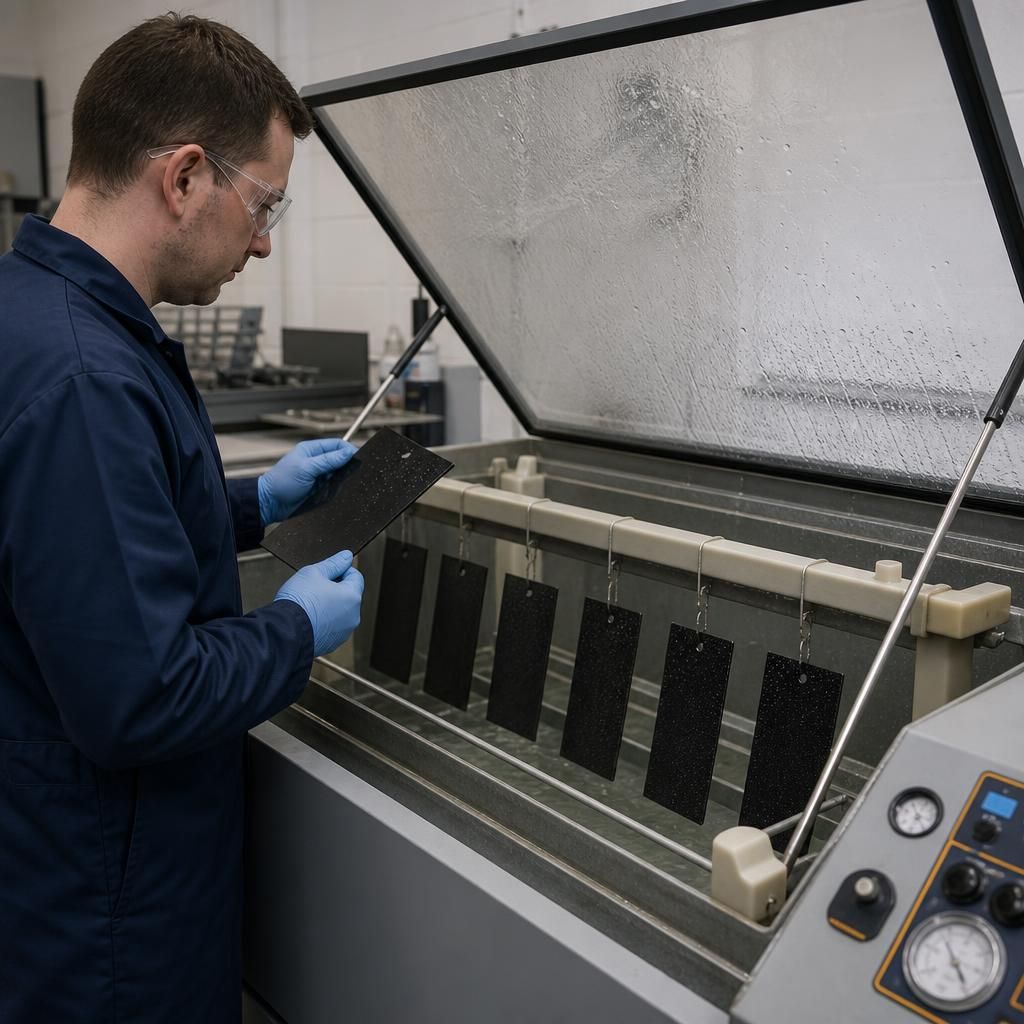
Accelerated testing is useful for comparing black protective powder-coating systems, but its results should not be read as a direct prediction of service life. Salt spray, humidity and accelerated weathering expose test panels to controlled conditions that may differ from the actual combination of moisture, pollutants, temperature changes, abrasion and chemicals affecting an industrial component.
A meaningful test report should therefore state the coating system tested, substrate, preparation, curing conditions, film thickness, exposure method and assessment criteria. Results are most useful when these details match the proposed production process and the component’s operating environment. A pass result from a different substrate or coating build may provide background information, but it should not automatically be treated as evidence that the finished black coating meets the project requirement.