

What are the key differences in performance between black protective powder coatings and Kingsport Gray powder coat for industrial applications?
The key difference is that black protective powder coating describes a performance-focused coating specification, whereas Kingsport Gray identifies a colour and may not indicate a particular level of corrosion, chemical or abrasion resistance. For an industrial comparison, assess the coating formulation, pretreatment, film thickness and required test performance rather than colour alone.
Black protective powder coating and Kingsport Gray powder coat cannot be compared reliably by colour alone. Black protective coating may be specified as part of a system designed for corrosion, chemical or abrasion resistance, while Kingsport Gray primarily identifies a colour. The meaningful performance comparison depends on the resin chemistry, pretreatment, primer or topcoat arrangement, film build and test requirements attached to each specification.
Corrosion resistance
For steel components, corrosion resistance is determined mainly by surface preparation and the coating system rather than whether the finish is black or grey. Degreasing, removal of mill scale and rust, suitable conversion treatment and control of coating thickness all affect how well the finish prevents moisture and contaminants reaching the substrate.
A black protective system may include a formulation selected for demanding exposure, such as outdoor structures, machinery, fabricated assemblies or components exposed to industrial contaminants. Kingsport Gray can provide comparable corrosion protection if it is applied using an equivalent powder chemistry and pretreatment system. Conversely, a black powder with a basic specification may provide less protection than a properly prepared and applied grey system. Ask for the complete coating specification rather than assuming that either colour has an inherent corrosion advantage.
Resistance to impact and abrasion
Impact and abrasion performance depend on the cured film’s hardness, flexibility, adhesion and thickness. A coating that is too brittle may chip when a component is handled or struck, while a coating with poor adhesion may lift from an inadequately prepared surface. These properties are controlled by the powder formulation and curing process, not by the pigment colour itself.
Where components are subject to repeated handling, rubbing, contact with tools or movement against other parts, the specification should identify the required abrasion and impact performance. A protective black coating may be selected for this type of service, but a Kingsport Gray finish can perform to the same level when the underlying powder system is equivalent.
Chemical and solvent resistance
Industrial parts may come into contact with oils, detergents, fuels, hydraulic fluids, cleaning agents or process chemicals. Resistance varies considerably between powder chemistries and levels of cure. Some coatings retain their adhesion and appearance after exposure, while others soften, stain, swell or lose gloss.
Colour does not establish chemical compatibility. The correct comparison requires identification of the chemicals, concentration, contact temperature, contact time and whether exposure is occasional or continuous. A protective black specification may be more suitable where chemical exposure is a defined risk, but Kingsport Gray should be assessed against the same conditions if it is being considered as an alternative.
Ultraviolet exposure and colour stability
Outdoor durability includes both protection of the metal and retention of appearance. Black finishes can show surface dust, light scratches and chalking more visibly than some grey shades. A grey finish may make minor marks less conspicuous, but this is an appearance and maintenance consideration rather than proof of greater protective performance.
Colour stability and gloss retention are influenced by the resin and pigment package, exposure to sunlight and weather, and the intended durability class. If the component will be installed outdoors, the specification should state the required resistance to ultraviolet exposure and weathering. The selected colour should then be checked against that formulation, rather than treating all black or grey powders as equivalent.
Heat absorption and operating temperature
Black surfaces generally absorb more solar radiation than lighter colours, so an externally exposed black component can reach a higher surface temperature under strong sunlight. That can affect thermal expansion, touch temperature and the temperature experienced by seals, lubricants or nearby materials. Kingsport Gray may reduce this effect depending on its shade and reflectance.
This distinction is relevant where parts are exposed to direct sun or where dimensional tolerances and operating temperatures are tightly controlled. It is less significant where the component is indoors, shaded or heated mainly by the surrounding process. The coating must still be checked for its specified service-temperature range, because colour-related solar heating does not replace a temperature rating.
Appearance and defect visibility
Black commonly provides a strong contrast and a uniform industrial appearance, but uneven pretreatment, surface dents, dust and scratches can be more noticeable. Grey can offer a softer visual contrast and may be preferred where parts are frequently handled or where a less severe appearance is required. Texture, gloss level and surface preparation also have a major effect on how defects are seen.
For components that will be assembled with other painted or coated parts, colour consistency, gloss and texture should be agreed in advance. A change from black protective coating to Kingsport Gray may therefore affect visual uniformity even when the technical protection remains equivalent.
How to specify the better option
- Define the substrate, end-use location and expected exposure to moisture, chemicals, sunlight, impact and abrasion.
- Specify the powder chemistry and whether a primer, topcoat or multi-layer system is required.
- Confirm the pretreatment appropriate to the metal, particularly where corrosion protection is a priority.
- Set requirements for adhesion, impact, abrasion, chemical resistance, gloss, colour stability and weathering where relevant.
- Confirm the required cured film thickness and curing conditions for the component’s material and geometry.
- Use representative test panels or sample components when appearance, edge coverage or colour matching is important.
In practical terms, black protective powder coating is the stronger choice only when its specification provides the required protection for the service environment. Kingsport Gray is not automatically less durable because it is grey, nor is black automatically more resistant. If both finishes use the same suitable powder system, preparation and application controls, their core corrosion, adhesion and mechanical performance can be substantially similar; the main differences may then be appearance, visibility of damage and solar heat absorption.
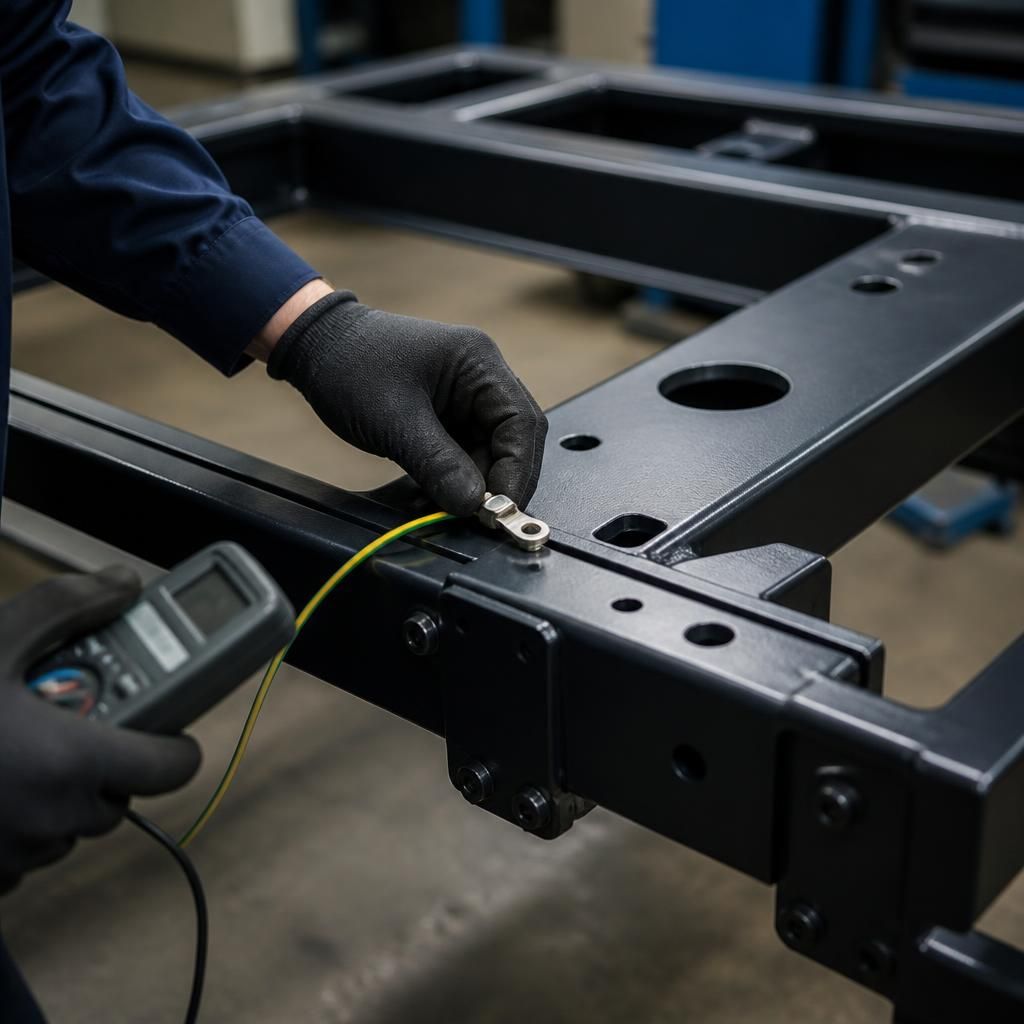
Electrical continuity is a separate consideration from colour. Most cured powder coatings act as an insulating layer, so a black protective finish and Kingsport Gray may affect earthing or bonding points in the same way when their coating systems are otherwise equivalent. If a component forms part of an electrical path, the specification should identify contact areas that must remain uncoated or be masked before application. Continuity should then be checked after coating, particularly on enclosures, frames and fabricated assemblies requiring reliable bonding. This requirement should be agreed alongside corrosion and mechanical performance, rather than inferred from the selected colour.
Compare Your Black and Kingsport Gray Coating Requirements
Share your component material, operating environment and required finish so the coating specification can be assessed against black protective powder coating and Kingsport Gray options. Powder-coatings.co.uk can advise on a suitable industrial finish and arrange collection or delivery across the Midlands and surrounding areas.