

How are black protective powder coatings applied to ensure maximum coverage and durability?
Black protective powder coatings are applied by thoroughly preparing and cleaning the metal, applying an even electrostatic powder layer, and curing it in a controlled oven so the coating bonds and hardens. Careful attention to surface preparation, edge coverage, coating thickness and curing conditions helps produce a consistent finish with durable protection.
Maximum coverage and durability come from controlling the entire coating process, not simply applying a black powder coat to the visible faces of a component. The coating specification, masking arrangement, racking method, application access, film build, curing profile and final inspection must all be matched to the metal part and its intended service environment.
Begin with the component specification. Before coating, the coater should establish the metal type, areas requiring protection, surfaces that must remain uncoated, required appearance and the conditions the finished part will encounter. This determines the suitable powder system and whether a single protective layer or a more robust primer-and-topcoat arrangement is appropriate. Black is primarily a colour choice; resistance to corrosion, chemicals, abrasion and weathering depends on the powder chemistry and the complete process.
Masking and racking are important for complete coverage. Threads, bearing seats, electrical contact points, drain holes and close-tolerance faces may need suitable plugs, caps or masking materials. These must be positioned securely without shielding adjacent areas from the powder. Components are mounted so that the coating equipment can reach external faces, recesses and less visible sections. Good electrical contact through the rack also helps maintain a stable application process, while the contact point should be placed where it will not affect the finished or functional surface.
Part geometry must be considered during application. Corners, deep recesses, box sections and narrow gaps can behave differently from open flat surfaces. Recesses may receive less powder, while edges can attract more material or become vulnerable during handling. The spray path, gun angle and movement are therefore adjusted to provide suitable access rather than relying on a single pass over the part. Where the design permits, drainage and venting features also help prevent trapped treatment chemicals or air from affecting the finished coating.
Coating thickness is verified rather than judged by colour alone. A black finish can look visually uniform while still having thin areas, excessive build, pinholes or inclusions. Non-destructive thickness measurements on representative surfaces help identify variation and confirm that the coating is within the agreed specification. Excessive thickness can be as undesirable as insufficient coverage: it may affect fit, obscure detail, increase the risk of runs or interfere with the proper development of the coating film.
Curing is confirmed against the component temperature. The required cure relates to the temperature reached by the metal and the specified time at that temperature, rather than simply the oven’s displayed air temperature. This distinction matters when parts vary in thickness or are loaded differently. Under-cured powder may have reduced adhesion and chemical resistance, while excessive heat or time can affect appearance and performance. Process records and temperature checks provide better control than relying on oven settings alone.
Inspection follows the coating process. A finished batch may be checked for:
- consistent colour, gloss and texture;
- uncoated areas, pinholes, craters, runs or contamination;
- coverage around edges, recesses and masked boundaries;
- film thickness at agreed inspection points;
- adhesion where testing is specified; and
- correct masking removal, thread condition and dimensional fit.
Where a part fails inspection, the appropriate correction depends on the defect. A small cosmetic issue may require local assessment, whereas poor adhesion, widespread thin coverage or incorrect curing may require the coating to be removed and the component processed again. Reworking without identifying the cause can reproduce the same fault across a batch.
Handling and packing also affect durability after curing. Parts should be allowed to reach a suitable handling condition before being stacked, packed or fitted together. Contact between finished surfaces, sharp supports and contaminated packaging can mark the black coating even when the coating itself has been correctly applied. For industrial batches, agreed inspection points and clear handling requirements help maintain consistent results from the first component to the last.
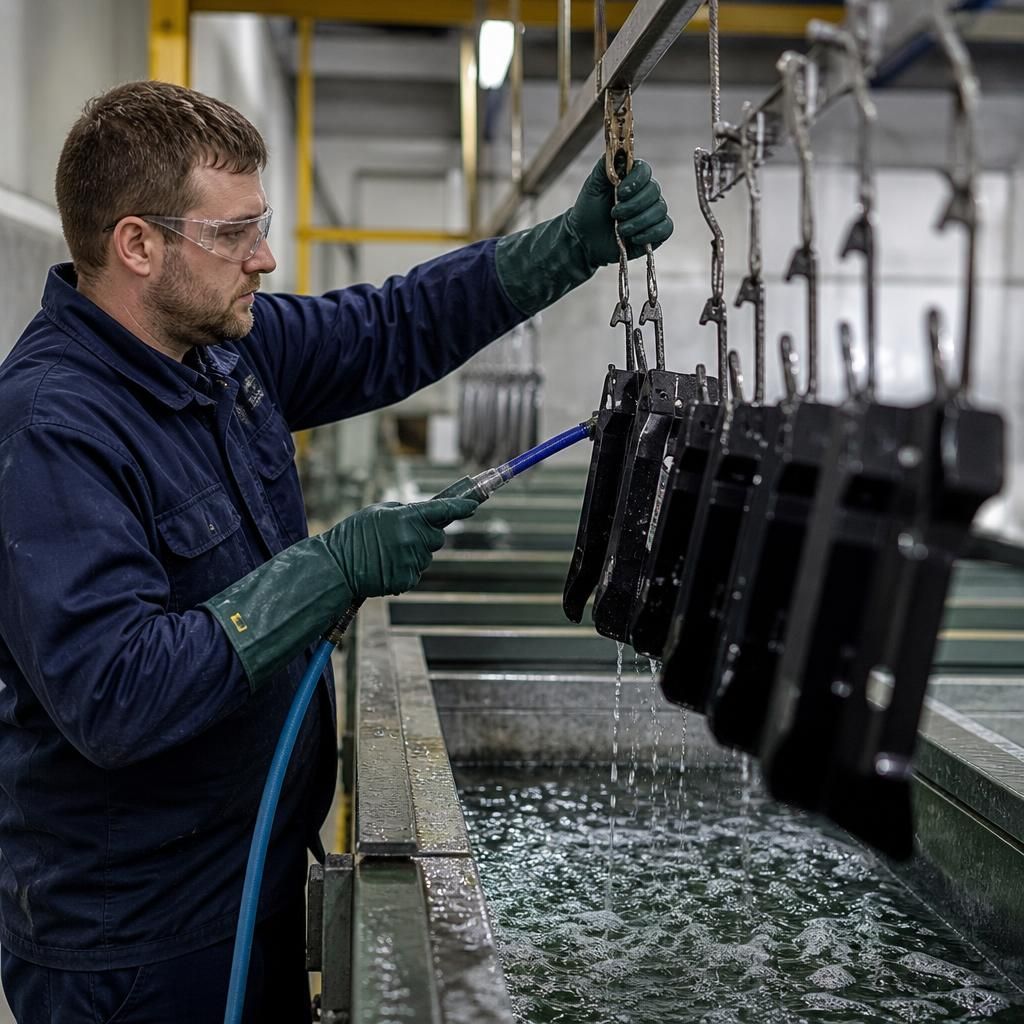
Pretreatment creates the surface conditions needed for a black protective powder coating to adhere and resist corrosion. The process is selected for the substrate, so steel, galvanised metal and aluminium may require different cleaning and conversion treatments. Rinsing must remove residues from earlier stages, and the component must be fully dry before powder application; moisture, salts or treatment chemicals left on the surface can contribute to adhesion defects or corrosion beneath the coating.
For this reason, pretreatment quality should be checked as part of the coating process rather than treated as a separate preliminary task. Components with contamination, surface oxidation or incompatible existing finishes may need additional preparation before they enter the spray stage. This is particularly important for parts exposed to moisture, road contaminants or industrial chemicals, where weaknesses at the metal-to-coating interface can reduce the effective life of the finished black surface.
Discuss your black protective powder coating requirements
Discuss your black protective powder coating requirements with the team, including the component geometry, substrate and intended service conditions. This helps establish an appropriate coating specification and inspection approach for your parts.