

How does black powder-coated sheet metal compare in performance to other surface treatments used in industrial settings?
Black powder-coated sheet metal generally provides a tougher, more uniform and abrasion-resistant finish than conventional wet paint, with good corrosion protection when the metal is correctly prepared and the coating is properly applied. Compared with treatments such as galvanising or anodising, it offers greater colour and texture choice, although the best option depends on the substrate, exposure conditions, required thickness and resistance to chemicals, impact or ultraviolet light.
Black powder-coated sheet metal is best understood as a balanced finish rather than a universally superior treatment. Its industrial performance depends on the failure risks involved: impact, abrasion, moisture, chemicals, ultraviolet exposure, heat, dimensional tolerances and the ease of future repair. A meaningful comparison therefore considers both the coating itself and the substrate, component design and service environment.
Compared with conventional wet paint
Powder coating forms a dry, fused film during curing, whereas wet paint relies on liquid coating layers drying or chemically curing after application. This difference affects how the finish is handled and assessed. Powder coating is generally consistent across a batch when the parts have similar geometry and the application conditions are controlled. Wet paint can be more practical for on-site work, small repairs, complex masking requirements or components that cannot tolerate a curing oven.
Wet paint may also be selected where several separate coats are needed, such as a primer, intermediate layer and specialist topcoat. That system can be advantageous where a particular chemical, heat or atmospheric exposure requires a coating formulation not available as a powder. Powder coating, by contrast, is often suited to repeatable production work where the whole component can be prepared, coated and cured as one controlled process.
Repairs are another important distinction. A damaged powder-coated area cannot normally be re-cured in exactly the same way as the original factory finish once the part has left the coating line. Local touch-up may be possible, but the repaired area can differ in gloss, texture or colour. Wet paint is usually easier to blend on site. This makes the intended maintenance method relevant when comparing the two finishes.
Compared with galvanising
Galvanising protects steel through a zinc layer that provides both a physical barrier and sacrificial protection when exposed steel is present. It is therefore particularly relevant for components facing persistent outdoor moisture or aggressive atmospheric conditions. The zinc surface, coating thickness and component design can affect the final appearance, and holes, enclosed sections and drainage paths need consideration during processing.
Black powder coating on steel provides the visible decorative and protective finish directly, but it does not operate as a sacrificial zinc system. It can be the more appropriate choice where a controlled black appearance, a defined texture or compatibility with adjacent coated parts is important. For demanding external exposure, a duplex system combining galvanising with powder coating may be considered, provided the preparation and compatibility of the layers are properly managed.
Galvanising can also influence dimensions and fit, particularly on close-tolerance assemblies. Powder coating adds its own film thickness, so mating faces, threads, apertures and sliding interfaces should be identified before production. Parts that require electrical contact or precise assembly may need masking or post-coating treatment regardless of which protective system is selected.
Compared with anodising
Anodising is an electrochemical treatment normally associated with aluminium. It converts the surface of the metal into an oxide layer rather than applying a separate organic film. This can make it useful where the aluminium substrate, low added thickness and retained surface detail are central requirements.
Black powder coating may be preferable when a more substantial organic film, a particular texture or a consistent opaque appearance is required across steel or aluminium components. Anodising remains relevant where the design depends on the characteristics of the aluminium surface, tight dimensional control or the appearance of an anodised finish. The substrate is therefore a decisive factor: these treatments are not interchangeable simply because both can produce a black surface.
Performance factors that often decide the choice
- Impact and flexing: The coating must suit the way the part is formed, handled and assembled. Excessive deformation after coating can damage any finish, so bending, pressing and forming operations are normally planned around the treatment sequence.
- Chemical exposure: Oils, cleaning agents, solvents, fuels and process chemicals vary considerably. The coating specification should be checked against the actual substances, concentration, contact time and operating temperature rather than relying on the colour or coating name alone.
- Heat: Continuous and intermittent temperatures can affect gloss, colour stability and film properties. Black surfaces can also absorb more solar radiation, which may increase the temperature of an exposed component compared with a lighter finish.
- Ultraviolet exposure: Outdoor black finishes should be selected for the required level of colour and gloss retention. Fading or chalking can become more noticeable on prominent dark surfaces, particularly where adjacent parts remain unchanged.
- Edges and apertures: Corners, cut edges, holes and folded sections can behave differently from broad flat faces. The design should allow suitable coverage and avoid crevices that retain moisture or cleaning residues.
- Appearance and inspection: Black can make dust, fingerprints, rub marks and light scratches readily visible. Gloss level, texture, colour reference, masking requirements and acceptable visual variation should be agreed before batch production.
- Repair and replacement: If the finished item will be repaired frequently, a system that permits straightforward local recoating may be more practical than one optimised solely for factory appearance.
For industrial sheet metal, the most suitable treatment is the one that matches the dominant service risks and the manufacturing route. Black powder coating is a strong option where a controlled opaque finish, batch consistency and a durable protective film are required, but galvanising, anodising, wet paint or a combined system may be better where sacrificial protection, substrate-specific performance, field repair or unusual chemical and temperature resistance takes priority.
A coating specification should therefore state the substrate, preparation standard, coating type, colour and gloss, film requirements, curing conditions, exposure category, chemical limitations and inspection criteria. For manufacturers and fabricators, reviewing these points before production is more reliable than selecting a treatment by colour alone.
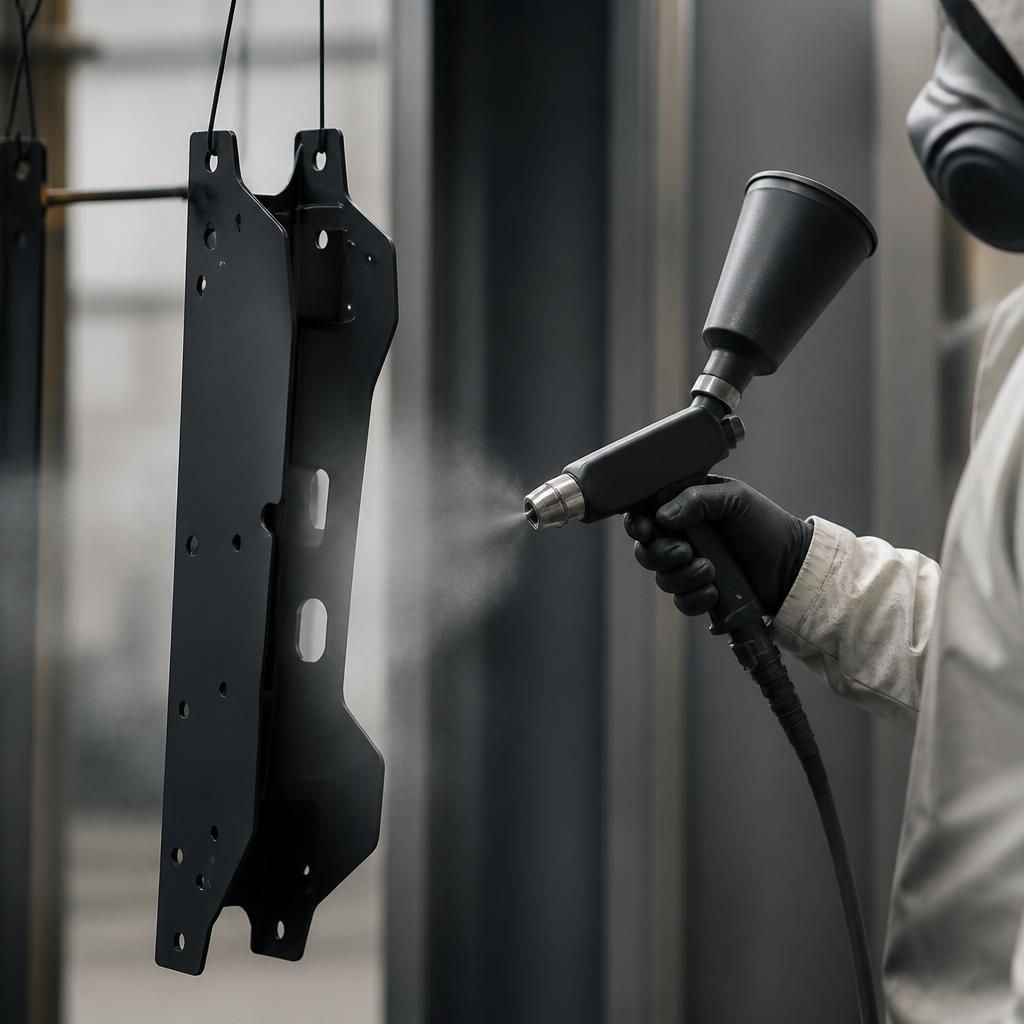
One performance difference that is often overlooked is how the treatment reaches recessed areas. Powder coating is applied electrostatically, so deep channels, internal corners and narrow recesses can create a Faraday-cage effect in which the electric field is weaker. These areas may receive less powder than exposed faces unless the component geometry and application settings are suitable.
This matters when comparing powder coating with wet paint or other treatments on folded and fabricated sheet metal. The coating specification should identify difficult-to-reach surfaces and confirm whether they require additional application methods, design changes or acceptance criteria. A finish that performs well on broad faces may not provide equivalent protection inside every recess, so coverage should be assessed across the complete component rather than judged from its visible exterior.