

What specific qualities should I look for in a black powder coated metal sheet to ensure it meets industrial standards?
Look for a black powder coated metal sheet with a suitable substrate, even coating thickness, strong adhesion, consistent colour and gloss, and resistance to corrosion, impact, abrasion and the conditions of its intended use. Evidence of controlled preparation, curing and testing against the relevant industrial specification is also important, particularly for components used in demanding environments.
An industrially suitable black powder coated metal sheet is one that conforms to the project specification in four areas: material identity, dimensional accuracy, coating classification and documented quality control. The correct choice is therefore not based on black colour alone. The sheet must be defined against the conditions in which it will be fabricated, installed and used, with measurable acceptance criteria agreed before production.
Start with the applicable specification. There is no single quality level that suits every metal sheet. Internal engineering requirements, customer drawings and any relevant British, European or international standard should establish the required sheet material, dimensions, coating designation, appearance limits and inspection method. For architectural, structural, automotive or general fabrication work, the acceptable criteria may differ significantly. A quotation or purchase order should refer to the exact specification rather than using a general description such as “black powder coated sheet”.
Check the sheet’s dimensional quality. Industrial sheet should match the stated length, width, gauge and flatness tolerances. This is particularly important where panels are nested, folded, punched or assembled with other components. Check whether the supplied tolerance applies before or after coating, as the coating adds a small amount of material to the surface. The specification should also address squareness, hole positions and the condition of cut edges where these affect assembly.
Review the coating designation, not just the colour name. A suitable specification should identify the powder coating type and its intended use, such as interior, exterior, decorative or specialist industrial service. It should also define the approved colour reference and permitted appearance range. If the sheet will be exposed to sunlight, chemicals, cleaning agents or frequent handling, the coating manufacturer’s technical data should confirm that the selected formulation is intended for those conditions.
Pay attention to edges, apertures and formed areas. Large flat faces are relatively straightforward to inspect, but quality problems often become more significant around corners, folded edges, drilled holes, slots and welded areas. Ask how these features are to be treated and inspected. The finished sheet should not have sharp burrs, loose powder, blocked apertures, excessive build-up in recesses or uncoated areas that could interfere with fitting. If the sheet will be folded after coating, confirm that the coating system and bend radius are compatible with that process; otherwise, fabrication can damage the finish even where the original coating was correctly applied.
Look for a defined visual acceptance standard. Industrial acceptance should distinguish between permissible minor variation and defects that require rejection. The agreed criteria may cover runs, craters, pinholes, inclusions, scratches, impact marks and visible contamination. Inspection conditions should also be defined, including viewing distance, lighting and whether the surface is assessed before or after fabrication. This prevents subjective disputes over what constitutes an acceptable black finish.
Require traceability and supporting records. A reputable industrial process should allow the finished batch to be linked to the incoming metal, the coating material and the relevant production records. Depending on the project, useful documentation may include:
- the metal grade and batch or heat reference;
- the powder coating product description, colour reference and batch identification;
- the agreed drawing and revision number;
- inspection results against the specified acceptance criteria;
- records identifying the production batch and any approved deviations; and
- care, handling and storage instructions for the finished sheets.
Traceability is especially valuable where coated sheets form part of a regulated, safety-critical or repeat-production assembly. It enables a non-conforming batch to be identified without unnecessarily placing unrelated material on hold.
Consider how the finished sheet will be handled. Packaging should prevent sheets rubbing against one another, collecting moisture or suffering edge damage during storage and transport. Protective interleaving, suitable stacking and clear identification can be important quality requirements, particularly for pre-finished panels. The specification should state whether temporary protective film is required and when it must be removed, since adhesive residues or prolonged exposure can affect the appearance.
Check compatibility with downstream operations. A black powder coated sheet may need cutting, drilling, folding, riveting, bonding or assembly after coating. Confirm which operations are permitted and how exposed cut edges or damaged areas are to be treated. If the finished part requires electrical earthing, masking or designated contact points may be necessary because the cured coating is electrically insulating. If welding is required after coating, the process should account for coating removal, fumes, rework and subsequent protection.
Use a written inspection plan for repeat work. The plan should identify what is inspected, the sampling approach, the measuring equipment and the action taken when a result falls outside the agreed limit. For critical components, a first-off sample or approved reference panel can provide a practical comparison before a full batch is released. This is more reliable than relying on an informal visual judgement at the end of production.
Before placing an order, provide the coater with the drawing, metal specification, intended use, post-coating operations, appearance requirements and any required documentation. A black powder coated metal sheet is most likely to meet industrial expectations when these details are converted into clear, inspectable requirements rather than left to interpretation.
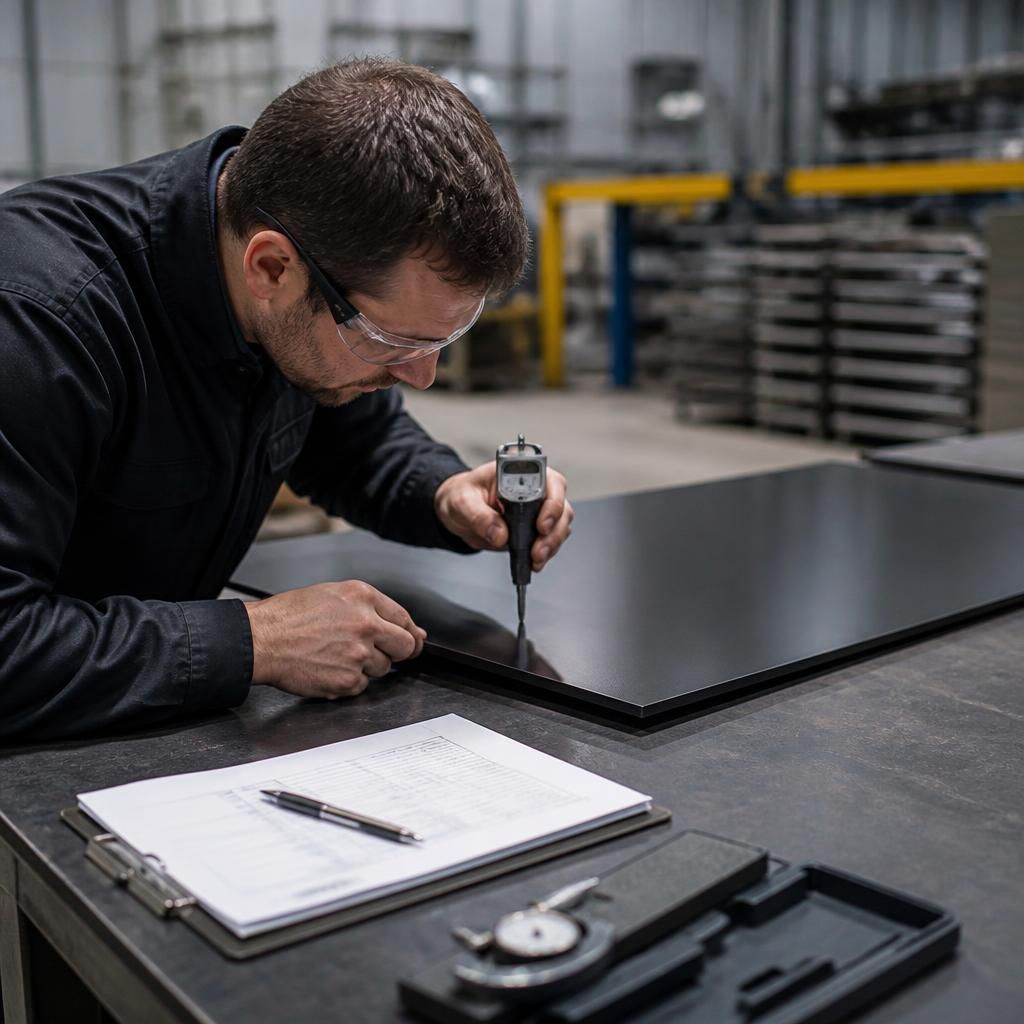
Test evidence is useful only when the test method matches the sheet’s intended service conditions. When reviewing a technical datasheet or quality report, check the stated substrate, pre-treatment, coating system, test standard and acceptance limit rather than relying on a general claim such as “corrosion resistant”.
Accelerated corrosion, adhesion, impact and flexibility tests can help compare coating systems, but they do not represent every installation environment. Evidence should therefore be considered alongside exposure to moisture, chemicals, sunlight, abrasion and temperature changes. The result should relate to the complete coated system, including the metal substrate and pre-treatment, not the black powder formulation in isolation.