

How does the thickness of the black powder coating impact its durability and performance?
The thickness of a black powder coating affects coverage, corrosion resistance, impact protection and finish quality. A coating that is too thin may leave the metal vulnerable, while excessive thickness can cause defects such as uneven coverage, cracking or poor adhesion, so the correct specification and curing process are essential.
Black powder coating thickness refers to the dry film thickness left on the metal after application and curing. It is one part of the coating specification and must be considered alongside the powder chemistry, metal substrate, surface preparation, curing conditions and service environment. Thickness should therefore be selected for the component’s exposure and function rather than increased automatically.
A suitable film provides a continuous barrier between the metal and its surroundings. This is particularly important where components may encounter moisture, condensation, road contaminants, industrial residues or cleaning chemicals. However, the protective value of the film depends on its continuity and adhesion as well as its measured thickness. A thicker coating cannot compensate for oil, rust, mill scale, salts or other contaminants left on the substrate before application.
Thickness can also vary across a fabricated sheet or component. Edges, corners, folds, recesses, holes and areas affected by the electrostatic field may receive a different deposit from broad, exposed faces. Welds and cut edges can introduce further variation if they are not prepared correctly. For this reason, a coating inspection should assess representative locations rather than relying on a single reading from a flat area.
- Flat faces: these are usually the simplest areas for achieving a consistent film.
- Edges and corners: these may have less effective coverage or may require particular preparation and application control.
- Recesses and internal areas: powder deposition can be affected by the component’s geometry and the electrostatic effect.
- Welded or machined areas: surface condition and contamination can influence the result independently of film thickness.
For mechanical performance, the correct thickness helps the coating accommodate normal handling, contact and service conditions without unnecessarily changing the flexibility of the finish. The best specification depends on whether the part is mainly exposed to weather, abrasion, impact, chemicals, heat or repeated movement. A rigid structural panel, a fabricated enclosure and a frequently handled machine component may require different coating systems even when all are black.
Thickness also influences appearance in ways that are not limited to colour. Variation across a batch can produce differences in gloss, texture, edge definition and the visual consistency of adjacent parts. On formed sheet, an unsuitable build may make surface irregularities more apparent. Black finishes can make visual variation especially noticeable because differences in gloss and texture are readily seen under directional lighting.
When greater protection is needed, the answer is not always a heavier single coat. A primer and topcoat system may be more appropriate where the specification requires additional barrier protection, improved adhesion or resistance to a particular environment. The compatibility of the layers, the combined dry film thickness and the curing requirements must all be confirmed before production. Applying another layer without checking the system can create adhesion or curing problems.
Dry film thickness is normally checked after curing with a suitable calibrated coating thickness gauge. Readings should be taken at agreed inspection points and compared with the project specification or the powder manufacturer’s recommended range. The inspection should also include visual checks for pinholes, contamination, poor edge treatment, texture variation and other discontinuities, because a numerical thickness result alone does not establish coating quality.
For a reliable specification, provide the coater with the following information:
- the metal type and substrate condition;
- component dimensions, folds, holes, welds and other geometry;
- indoor, outdoor, marine, industrial or chemical exposure;
- expected contact, abrasion, temperature and cleaning conditions;
- required appearance, including gloss and texture; and
- any inspection, test or documentation requirements.
In practice, the most durable black powder-coated metal sheet is not necessarily the one with the greatest coating build. Consistent application within the agreed specification, properly prepared metal, an appropriate powder system and a verified curing process are more useful indicators of performance than thickness considered in isolation.
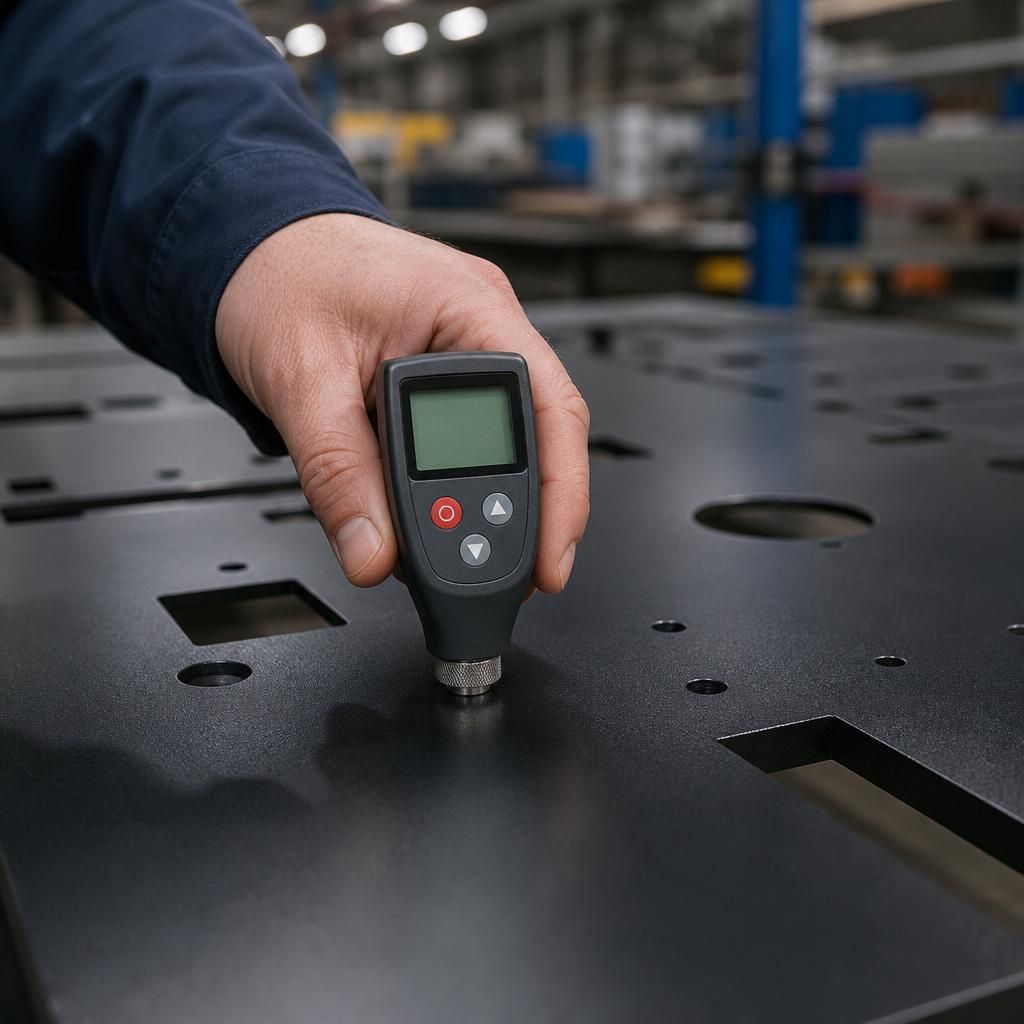
Powder coating thickness is best controlled against a specified target range rather than a single nominal reading. The target indicates the intended film build, while minimum and maximum limits define the acceptable variation for the component and its service conditions.
This distinction matters because an average measurement can conceal local areas that fall outside the specification. A batch may show an acceptable overall result while individual edges, recesses or broad faces have insufficient or excessive build. Reviewing the spread of readings helps determine whether the coating has been applied consistently and whether the stated durability and appearance requirements are being met.