

What crucial factors should be considered when choosing a black powder coated metal product for industrial use?
When choosing a black powder coated metal product for industrial use, assess the base metal, operating environment, required corrosion and impact resistance, coating specification, surface preparation, finish, dimensional tolerances and expected service life. Also confirm that the coating process and quality controls are suitable for the component’s size, shape, production volume and end-use requirements.
Choosing a black powder coated metal product for industrial use means matching the coating system and component design to the part’s operating conditions, assembly requirements, quality controls and whole-life cost. A black appearance alone does not indicate whether a product is suitable for a particular application.
Consider the coating chemistry and exposure together. Different powder formulations are intended for different conditions. A coating suitable for an indoor machine guard may not be the right choice for an externally installed frame, chemically exposed component or part subject to repeated abrasion. Ask for the proposed powder type, its intended use and any limitations relating to ultraviolet exposure, chemicals, heat or contact with other materials. Where the product may reach elevated temperatures, assess both the coating’s temperature tolerance and the effect of a dark surface on heat absorption.
Check the component design before coating. Corners, narrow recesses, deep cavities, overlapping sections and enclosed profiles can affect how powder is deposited and cured. Components should be designed or reviewed to support drainage, cleaning and adequate access during processing. Trapped moisture, air or pretreatment chemicals can cause defects later. Suitable vent and drain holes may be necessary for hollow fabrications, while sharp edges may require attention because they are more difficult to coat consistently than properly formed or radiused edges.
Identify every area that must remain free of coating. Threads, bearing seats, sliding faces, earth points, close-fitting bores, hinges and welded interfaces may need masking or plugging. The required uncoated zones should be shown on a drawing rather than left to interpretation. Also confirm whether the finished coating thickness has been allowed for in mating parts, fasteners and adjustable components. This is particularly important where coated parts are assembled with tight clearances or must maintain electrical continuity.
Define the appearance in measurable terms. “Black” can describe several acceptable visual results, including different gloss levels, textures and shades. Specify the required colour reference, gloss or texture, visible face and acceptable variation between batches. If components will be installed next to existing painted or coated parts, compare an approved sample under consistent lighting. A small sample or first-off part can establish the expected appearance more reliably than a general colour description.
Review the production and inspection plan. For repeat orders, agree how the coater will identify parts, control batches and record key process information. The inspection plan may include checks for coverage, adhesion, visual defects, coating continuity and dimensional conformity, with the acceptance criteria stated before production. Ask how defects such as pinholes, runs, inclusions, thin areas or handling marks will be assessed, and establish whether rework is permitted for the particular component.
Consider the implications of the manufacturing route. Welding, grinding, forming, machining and the use of temporary oils or marking materials can influence the final result. Fabrications should be presented in a condition that allows them to be processed consistently, with weld spatter and sharp contamination removed where appropriate. If coating follows machining, decide which operations take place before and after coating, since subsequent cutting or drilling can expose bare metal and require suitable protection.
Assess handling, packaging and installation. Powder coating is a durable finish, but finished parts can still be scratched by metal-to-metal contact, straps, stacking or careless lifting. The specification should cover contact points, separators, protective wrapping and whether components need individual packaging. Installation procedures should also prevent damage from dragging parts, overtightening fasteners or using unsuitable tools. Any damage found before installation should be recorded and dealt with using an agreed repair method rather than concealed.
Include documentation in the purchasing decision. A useful enquiry should contain drawings, quantities, material details, masking requirements, appearance references, operating conditions and any applicable industry or customer requirements. The quotation should make clear what is included, such as preparation, masking, coating, inspection, packaging and transport. This makes quotations comparable and reduces the risk of an apparently suitable finish being supplied without the processing needed for the complete component.
Compare whole-life suitability rather than initial price alone. The relevant comparison includes preparation, masking, coating, inspection, packaging, transport, assembly and any likely rework. A finish that is inexpensive at the coating stage may be unsuitable if it creates assembly problems, inconsistent appearance or frequent touch-up requirements. For repeat production, the ability to reproduce the agreed result across successive batches is often as important as the first completed delivery.
For industrial components, the strongest specification therefore combines a defined appearance with coating chemistry, component drawings, masking details, assembly tolerances, handling instructions, inspection criteria and documentation requirements. A powder coating specialist can then assess the part as a complete manufactured item rather than treating black colour as the main selection criterion.
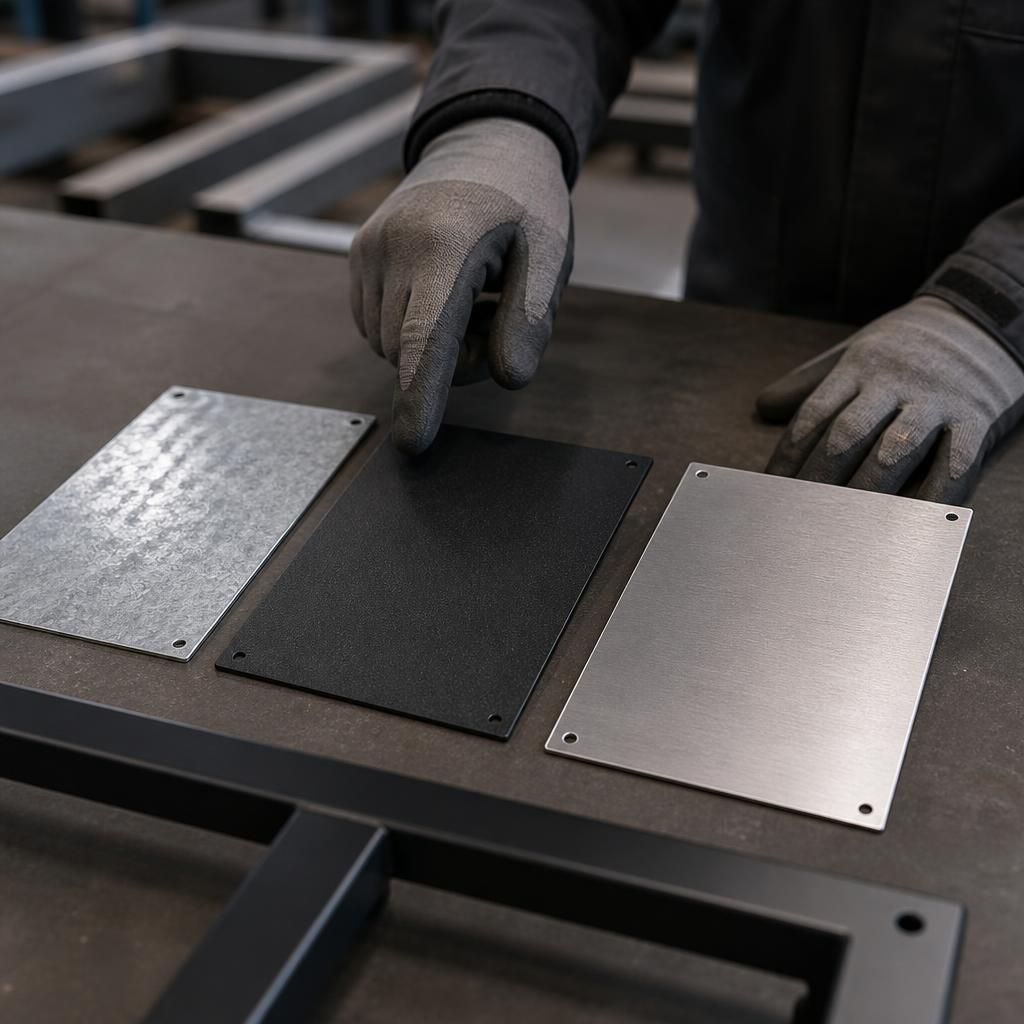
The metal substrate must be compatible with the selected powder coating system. Steel, aluminium and galvanised components can require different cleaning, pretreatment and curing controls, and a finish that performs well on one substrate may not provide the same adhesion or corrosion protection on another. Confirm the substrate specification, pretreatment route and any risk of outgassing or galvanic interaction before production. For critical applications, an approved sample or test panel can help verify adhesion, coverage and the finished appearance on the actual metal.