

What are the specific benefits of choosing black powder coatings for enhancing the performance of metal components in harsh industrial environments?
Black powder coatings provide metal components with a tough, uniform barrier against corrosion, abrasion, chemicals and weathering, helping them withstand demanding industrial conditions. They also offer strong colour retention and a consistent finish, supporting reliable performance while reducing the need for frequent refinishing.
Black powder coatings enhance industrial metal components by providing a controllable, bonded finish that supports service performance, thermal management, inspection and product standardisation in demanding environments. The black colour is only one part of the specification: the resin, pigment package, pretreatment, coating thickness and curing conditions determine how well the finished component performs in its intended setting.
Improved resistance to temperature-related stress
Black surfaces absorb more solar radiation than lighter finishes, which can increase the temperature of an exposed component. This is important for outdoor equipment, enclosures, frames and fabricated assemblies that experience direct sunlight or repeated heating and cooling. A suitable powder formulation can accommodate the expected service temperature and help maintain adhesion through thermal cycling, but the coating should be selected alongside the metal grade, component design and operating temperature. Black powder coating is therefore not automatically the right choice for high-temperature equipment; the complete coating system must be assessed for the application.
Reliable adhesion to prepared metal
Powder coating is applied to electrically conductive metal and then cured to form a continuous film. When the substrate is correctly cleaned and pretreated, the coating can bond effectively across the accessible surfaces of a component. This helps prevent premature lifting, flaking and local breakdown caused by contamination, mill scale or poor surface preparation. For harsh industrial use, preparation is as important as the black powder itself. Oil, rust, moisture and residues must be removed, and the preparation method should suit the substrate, whether it is steel, aluminium or another compatible metal.
Protection of complex manufactured parts
Powder coating can be applied to many fabricated shapes, including brackets, frames, panels, cabinets and formed components. Electrostatic application allows charged powder particles to adhere to grounded metal before curing, supporting efficient coverage of the surfaces that can be reached by the spray equipment. Component design still matters: sharp internal corners, deep recesses, narrow gaps and enclosed sections can be difficult to coat consistently. Designers should identify drainage, masking, hanging and access requirements before production so that the finished coating does not obstruct assembly or leave critical areas untreated.
Support for mechanical service conditions
A correctly specified powder system can provide a hard, well-adhered surface for components exposed to handling, contact and routine industrial use. Where greater flexibility, impact tolerance or low-friction performance is required, a specialist coating such as black nylon powder may be considered, provided it is compatible with the substrate and operating conditions. This is particularly relevant to parts that experience repeated contact or movement. The suitable system depends on the load, temperature, mating material and exposure; a standard decorative powder should not be assumed to perform like an engineered protective coating.
Clear visual identification and inspection
Black provides a consistent reference colour across batches of components and can make changes in the surface easier to identify during inspection. Scratches, exposed substrate, runs, pinholes, impact marks and areas of incomplete coverage can be assessed against the dark finish before a part enters service. This supports quality control, especially where components are produced in batches or assembled into larger industrial equipment. Inspection should take place after curing and before dispatch, with attention to edges, fixing points, masked areas and other locations where coating defects are more likely.
Controlled coating thickness and dimensional planning
Powder coating adds a measurable film to the metal rather than relying on an uncontrolled wet layer. This can help manufacturers plan clearances, threaded holes, mating faces and assembly tolerances more accurately. Masking may be required on earth points, bearing seats, threaded features and close-tolerance interfaces. The coating specification should therefore state which surfaces are to be coated and which must remain bare. Accounting for the film during design reduces the risk of interference during assembly and avoids removing the coating from functional contact areas.
Consistent appearance across industrial batches
Black finishes are commonly selected where components need a uniform appearance across machinery, fabricated assemblies or product ranges. Consistency depends on using compatible powder batches, maintaining appropriate application conditions and controlling the curing process. Different gloss levels, textures and resin systems can produce visibly different blacks, even when the colour description is the same. A reference sample or agreed finish specification is useful where separate components must match after coating.
For harsh environments, the coating should be chosen from the actual exposure conditions rather than colour alone. Relevant factors include outdoor or indoor use, operating temperature, moisture, salt contamination, cleaning chemicals, impact, friction, ultraviolet exposure and the possibility of galvanic contact with other metals. The specification should also cover substrate preparation, masking, required finish, curing requirements and inspection criteria. Where the service conditions are uncertain, representative test pieces can help confirm adhesion, appearance and compatibility before a full production batch is coated.
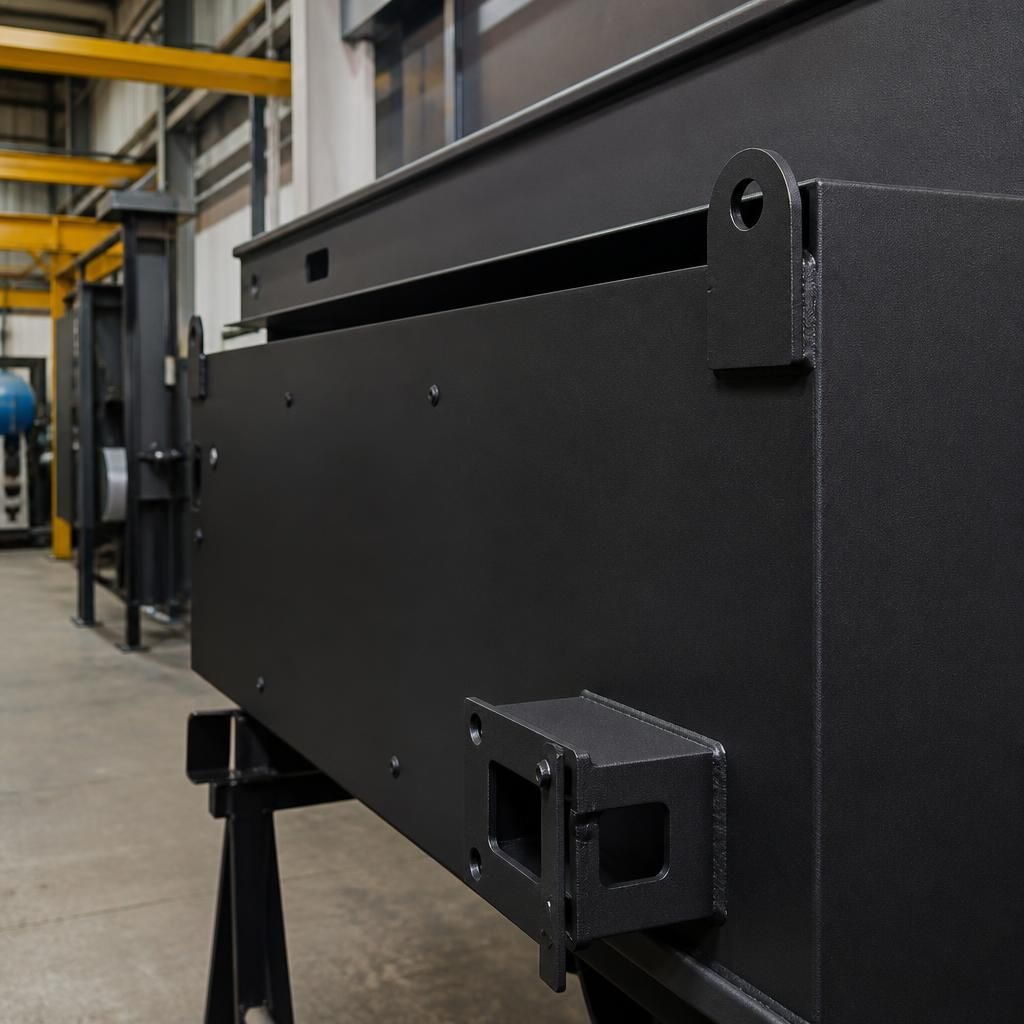
A further benefit of a properly cured black powder coating is the continuity of its film across broad metal surfaces, which limits the number of exposed transition points where moisture and contaminants can reach the substrate. This is particularly valuable around fabricated panels, welded assemblies and enclosure surfaces, where small gaps in an inconsistent finish can become starting points for local deterioration. The result depends on suitable pretreatment, coating coverage and curing; powder coating cannot compensate for uncoated faces, trapped contamination or unsuitable component design.
Discuss black powder coating for harsh industrial environments
If you are specifying black powder coating for metal components in a harsh industrial environment, discuss the substrate, exposure conditions, operating temperature and required finish with a coating specialist. This helps establish a suitable coating system and identify any preparation, masking or dimensional requirements before production.