

What are the different finish options available for black powder coated metal products?
Black powder coated metal products can be specified with smooth, satin, gloss or textured finishes, depending on the required appearance and practical use. The chosen finish affects light reflection, visual uniformity and how prominently minor surface marks may appear.
Black powder-coated metal can be specified with different sheen levels and surface profiles, including low-sheen matt, semi-matt and high-sheen appearances, as well as fine-texture, wrinkle and hammertone effects. The most suitable option depends on the required visual character, the visibility of handling marks, the geometry of the component and the conditions in which it will be used.
Sheen level controls how much light the coating reflects. A low-sheen black tends to give a restrained, understated appearance, while a higher-sheen surface produces stronger reflections and a more pronounced depth of colour. Intermediate levels are often selected where the product needs to look refined without appearing highly reflective. Sheen should be agreed before production because the same black shade can look noticeably different when applied with a different surface reflectivity.
Surface texture changes both the appearance and tactile character of the coating. Fine textures can add subtle surface definition without dominating the component. Wrinkle finishes create a more pronounced, patterned effect, while hammertone finishes produce a visibly irregular appearance. These options may be considered for equipment, frames, brackets, enclosures and fabricated parts where a strongly functional or industrial look is appropriate.
Texture also affects how the coating interacts visually with the underlying metal. A profiled finish can reduce the prominence of minor visual variation in the substrate, but it does not remove the need for suitable preparation. Welds, sharp edges, porosity, grinding marks and contamination can remain visible or become more apparent after coating. The metal should therefore be prepared to a consistent standard before the finish is selected.
Finish selection should reflect the component’s use.
- For architectural or customer-facing components, the decision usually centres on colour depth, reflectivity, uniformity and how the finish fits with adjacent materials.
- For machinery, plant and fabricated equipment, a lower-reflection or textured surface may be preferred where a highly decorative appearance is not required.
- For items that are frequently handled, the practical implications of marks, scuffs and cleaning should be considered alongside appearance.
- For components exposed to outdoor or demanding industrial conditions, the finish must be considered together with the coating system, substrate preparation and required protective performance.
Black is not a single visual specification. It can vary in apparent depth, reflectivity and texture depending on the powder formulation, application conditions, curing and the shape of the part. Large flat areas can make small differences in sheen more noticeable than complex components, while corners, recesses and assembled sections may show the finish from several angles. Where appearance is important, a representative sample or approved reference panel is useful before a full batch is processed.
The design of the component also influences the final result. Deep recesses, narrow channels, enclosed sections and tightly positioned parts can be more difficult to coat evenly. Masking may be required for threads, bearing seats, electrical contact points and close-tolerance interfaces. These requirements should be identified before coating so that the visible finish and the functional areas are both protected.
For repeat production, the finish specification should record more than the word “black”. It should identify the required colour reference, sheen level, texture, approved sample if applicable, masking requirements and any areas where coating must be excluded. This gives the coater and the manufacturer a consistent basis for inspection and helps prevent different parts of the same assembly from having visibly mismatched finishes.
When comparing options, assess a representative coated sample under the lighting in which the finished product will normally be viewed. Also consider the substrate, part dimensions, intended cleaning method and exposure conditions. Powder-coating specialists can then advise whether the requested appearance is compatible with the component and whether a standard, textured, nylon or other protective coating system is appropriate for the application.
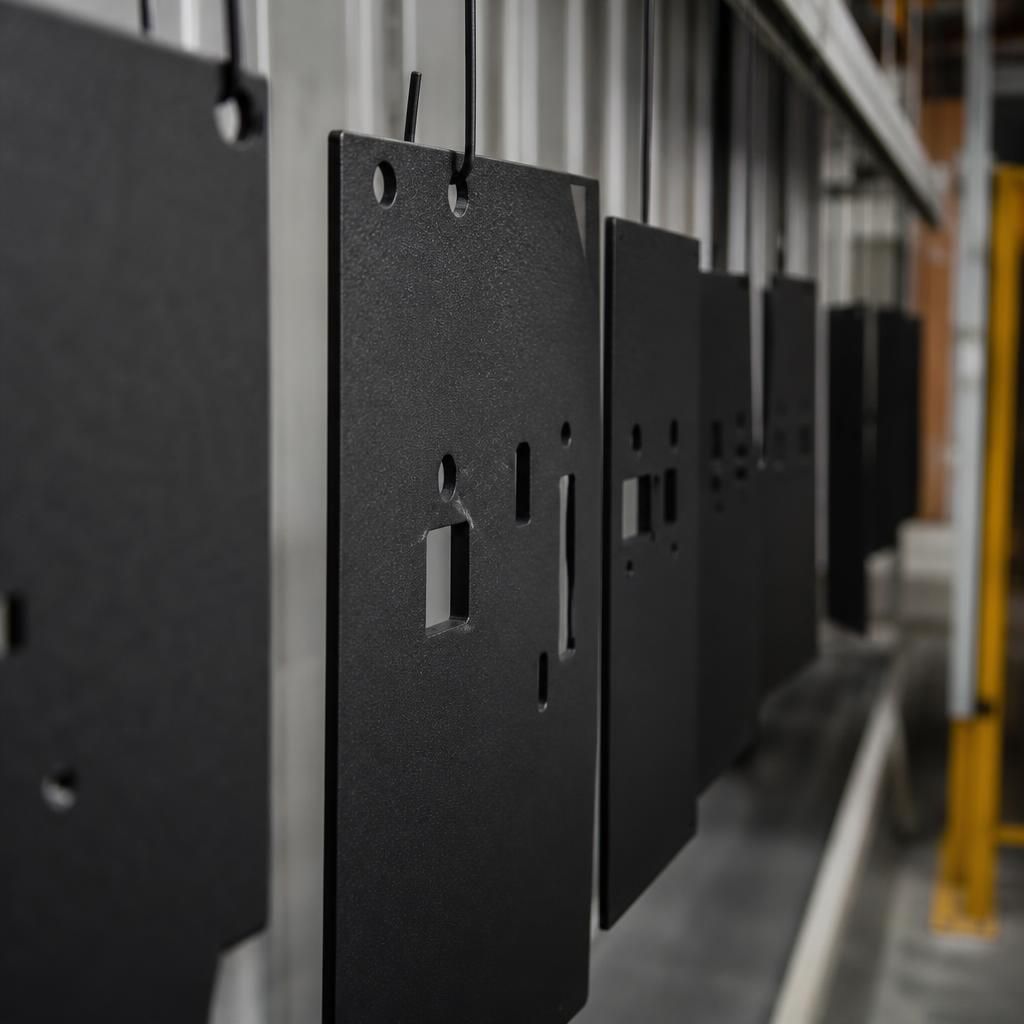
A finish option describes the coating’s visible surface, not its complete protective specification. Two black products may have a similar appearance while using different powder formulations, pretreatment requirements or curing parameters. The correct choice should therefore consider the substrate, exposure conditions and required protective performance as well as the desired sheen or texture.
For industrial components, the finish should be recorded alongside the technical coating requirements rather than specified simply as “black powder coat”. This helps distinguish the required appearance from the properties needed for the application and gives the coating specialist a clear basis for selecting a suitable system.