

How does the black powder coating process enhance durability and longevity?
Black powder coating enhances durability by applying a dry powder electrostatically to prepared metal before curing it into a continuous, firmly bonded protective film. This finish helps resist abrasion, corrosion, impacts, moisture and everyday chemical exposure, reducing surface deterioration and extending the service life of metal components.
Black powder coating enhances durability and longevity by creating a chemically cross-linked finish that adheres closely to correctly prepared metal. Its service life depends not only on the powder itself, but also on substrate preparation, coating specification, application control, curing and the conditions in which the finished component will be used.
The coating process improves long-term performance in several ways:
- Strong adhesion: Cleaning and pretreatment remove oil, rust, mill scale and other contaminants that could weaken the bond. A properly prepared surface gives the coating a stable foundation and reduces the risk of lifting, flaking or under-film corrosion.
- Consistent coverage: Powder is applied as charged particles, allowing it to adhere to the grounded metal before curing. Controlled application can produce an even film over broad surfaces, helping avoid thin areas where the substrate would be more exposed to wear or environmental attack.
- Cross-linked structure: During curing, the powder resin reacts to form a tightly linked polymer film. This structure gives the finish greater resistance to indentation, scuffing and general handling than an inadequately cured coating, while retaining the adhesion established during preparation.
- Protection of edges and profiles: Corners, apertures, welds and folded sections often require particular attention because coating coverage can vary around changes in shape. Suitable racking, application technique and curing practice help achieve more reliable protection across the complete component rather than only on its largest flat faces.
Black is a colour choice rather than a separate durability mechanism. The performance of a black finish is determined by the resin system, pigment package and product specification selected for the intended environment. For external components, the specification should take account of sunlight, moisture, temperature changes and the required retention of colour and gloss. A coating selected for an interior fabricated part may not be the right choice for a component exposed to sustained weathering.
Correct curing is particularly important. The oven schedule must suit the powder formulation and the metal’s actual temperature, not simply the air temperature around the component. Insufficient curing can leave the film with reduced hardness, adhesion or chemical resistance. Excessive heat or an unsuitable cycle can also affect the finish. Component size, mass, geometry and loading arrangement may therefore influence how consistently the coating reaches the required cure.
Powder coating can also support longer service intervals by reducing the number of weaknesses associated with an inconsistent liquid finish. The dry application method does not rely on a solvent evaporating from the film, and a correctly applied coating can provide a smooth, continuous surface with fewer opportunities for runs, sags or solvent-related defects. This does not make every powder coating suitable for every duty; specification and process control remain decisive.
For industrial metalwork, longevity should be assessed against the complete operating environment. Important considerations include:
- the base metal and its condition before coating;
- the level and type of pretreatment required;
- exposure to outdoor weather, humidity, salt or industrial pollutants;
- contact with oils, detergents, solvents or process chemicals;
- the frequency of impact, abrasion, loading and handling;
- the required appearance, including black shade, texture, gloss and resistance to fading; and
- the design of joints, drainage points, recesses and areas that may retain water.
Design and handling after coating are also significant. Sharp edges, poorly protected lifting points and metal-to-metal contact can damage even a well-cured film. Components should be packed, transported and installed in a way that limits scraping and impact. Any damage should be assessed and repaired using a method compatible with the original coating and the exposure conditions.
In practice, black powder coating extends the useful life of a metal component when the coating system is matched to the substrate and environment, applied at a controlled thickness and fully cured. A clear specification and suitable preparation provide more reliable durability than choosing black solely for its appearance.
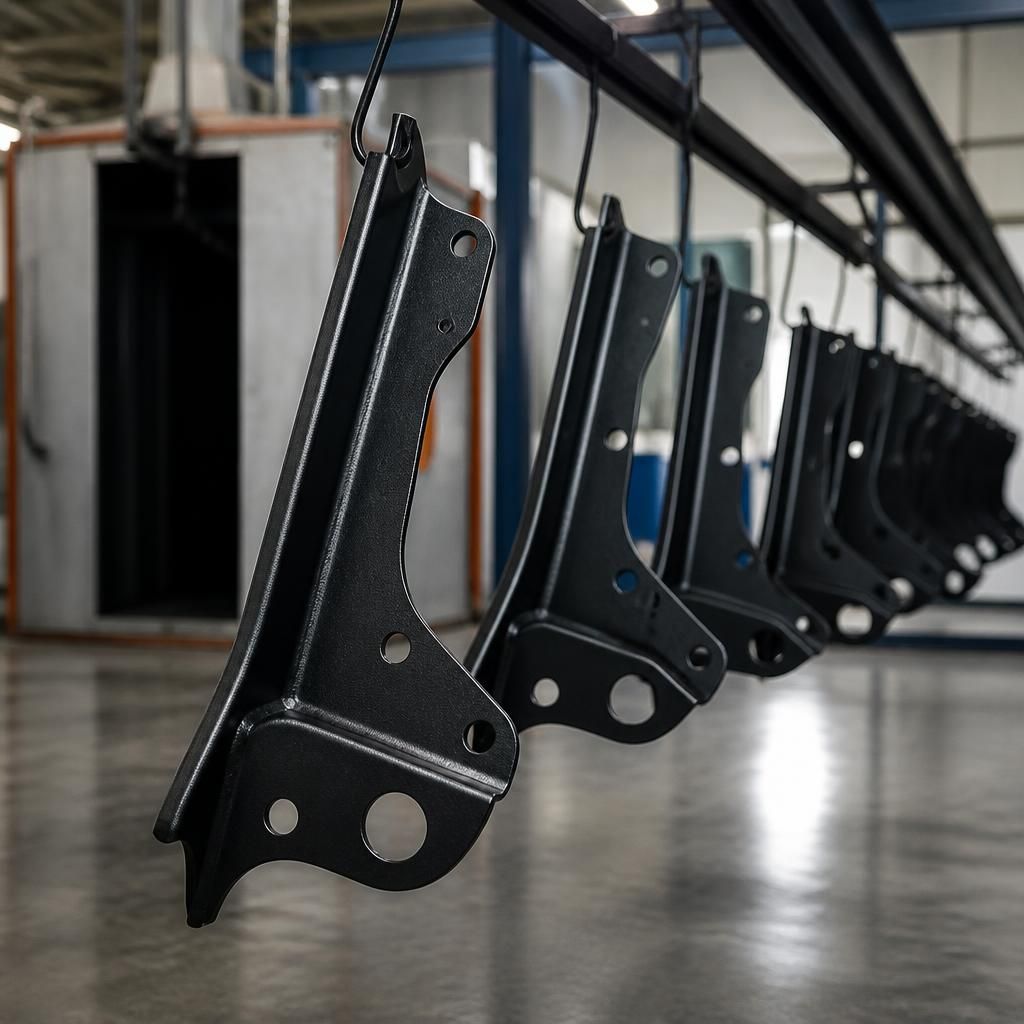
Long-term durability depends on balancing coating hardness with flexibility. A very hard film may resist scratching, but if the metal component flexes, vibrates or expands and contracts with temperature changes, insufficient flexibility can encourage cracking or loss of adhesion. A suitable powder formulation allows the cured film to withstand the component’s expected movement while maintaining a protective surface.
This balance is particularly important for fabricated parts exposed to repeated handling, vibration or mechanical loading. The coating specification should therefore reflect how the component moves in service, not just the appearance and initial hardness required after curing.
Discuss your black powder coating requirements
Discuss your component’s substrate, operating environment and required finish with the powder-coating team to identify a suitable black powder coating specification. Provide details of the part and expected exposure so the preparation, application and curing requirements can be assessed.