

What are the long-term benefits and potential drawbacks of using advanced powder coatings versus traditional paint methods for anti-corrosion protection on steel surfaces?
Advanced powder coatings can provide steel with a tougher, more uniform and durable anti-corrosion finish than many traditional paint systems, with strong resistance to impact, abrasion and environmental exposure. Their drawbacks include higher process requirements, limited on-site application flexibility and the need for careful surface preparation and curing, while traditional paint can be easier to repair or apply to large fixed structures.
Advanced powder coatings can offer a longer service life and more consistent protection for steel than a basic paint system, particularly where components are manufactured off site and exposed to regular handling, moisture or abrasion. However, powder is not automatically the better anti-corrosion solution. Long-term performance depends on the steel grade, preparation, pretreatment, coating specification, film thickness, curing and the conditions in which the finished component will be used.
What makes powder coating effective against corrosion? Powder coating is applied as a dry, electrically charged powder that bonds to the prepared steel before being heated and cured. The resulting film can form a continuous barrier that limits the movement of water, oxygen, salts and industrial contaminants towards the steel. A consistent application process also makes it easier to control coverage across repeat batches than a manually applied liquid coating.
For demanding anti-corrosion work, the powder layer may form part of a multi-stage system rather than acting alone. Suitable preparation can remove mill scale, oil, rust and other contaminants, while chemical pretreatment can improve adhesion and reduce the risk of corrosion developing beneath the coating. A primer and topcoat may be specified where the steel will face severe moisture, chemicals, salts or mechanical wear. The coating specification should therefore be assessed as a complete system, not selected solely by its colour or nominal finish.
Long-term advantages over traditional paint
- More stable film formation: Once correctly cured, powder produces a solid coating with no liquid solvent evaporating from the film. This can help provide consistent coverage and reduce some of the defects associated with runs, sags or uneven brush and spray application.
- Reduced permeability in suitable systems: A properly formed coating can restrict the passage of moisture and corrosive agents. This is particularly useful on fabricated components with repeatable dimensions and controlled application conditions.
- Better resistance to routine handling: Powder systems are often well suited to components that are moved through manufacturing, installation and service because the cured film can resist everyday scuffing and contact. Preventing damage to the barrier helps reduce the points at which corrosion can begin.
- Consistent batch production: Where steel parts are processed in repeat quantities, application parameters can be controlled and recorded more readily than with some site-applied paint methods. Consistency is important because isolated thin areas, missed edges and contamination can shorten the life of an otherwise well-specified system.
- Lower solvent use during application: Powder coating does not rely on the same liquid solvent content as conventional solvent-borne paint. This can support a cleaner controlled production process and may simplify environmental management, although the complete energy and material impact still needs to be considered.
- Potentially lower maintenance frequency: If the coating remains well bonded and the underlying steel is protected from moisture, fewer routine touch-ups may be needed than with a less durable paint finish. This is a lifecycle benefit rather than a guarantee, and inspection is still necessary.
Where traditional paint can remain the more practical choice
Liquid paint retains important advantages for steel that cannot be removed or transported to a suitable curing facility. It can be applied on site, built up in several coats and used for large fixed structures, complex assemblies and local repairs. Paint systems can also be selected for specific functions, such as zinc-rich primers, high-build barrier coats or chemically resistant topcoats. These options may be useful where the specification requires a particular primer technology or where the substrate cannot tolerate the heat associated with powder curing.
Paint is generally easier to blend into an existing finish during maintenance. A damaged section can often be cleaned, primed and recoated locally without processing the whole component. Powder-coated steel can also be repaired, but the repair material and preparation must be compatible with the original system, and a local repair may be more visible or provide a different level of protection.
Traditional paint can also be preferable where components contain heat-sensitive materials, sealed cavities or assemblies that cannot be safely heated. Its application is less dependent on fitting the complete article into an oven, although achieving a reliable finish in uncontrolled site conditions can introduce its own risks.
Potential drawbacks of advanced powder coatings
- Dependence on preparation: Powder cannot conceal oil, salts, loose rust or poorly prepared welds. Contamination left beneath the coating can cause adhesion failure, blistering or corrosion that spreads under the film.
- Difficulty with hidden and enclosed areas: Recesses, internal corners, narrow gaps and Faraday cage areas can receive less powder than exposed surfaces. Design details should be reviewed before coating, especially where drainage is poor or moisture can be trapped.
- Heat-related restrictions: The component must tolerate the curing cycle. Heat-sensitive inserts, seals, bearings, certain fabrications and assembled products may require a different process or partial disassembly.
- Limited correction after curing: A defect discovered after curing may require stripping and recoating rather than simple wet-on-wet correction. This makes inspection before and after curing important.
- Damage can expose bare steel: No barrier coating is immune to severe impact, cutting or prolonged abrasion. Once the steel is exposed, corrosion can begin at the defect and may spread beneath the surrounding coating if the repair is delayed.
- Specification constraints: Powder selection must account for temperature, ultraviolet exposure, chemicals, immersion, atmospheric salts and expected mechanical contact. A general-purpose decorative powder is not equivalent to an engineered anti-corrosion system.
Lifecycle cost and environmental considerations
The relevant comparison is the total cost over the component’s working life, not simply the initial coating price. Assessment should include preparation, transport, masking, curing, inspection, installation damage, access for maintenance, recoating and eventual removal. Powder may be economically favourable for repeatable steel components that can be processed efficiently, while paint may be more practical for oversized structures or work requiring staged site application.
Powder overspray can often be collected and, where the process permits, reused, but this does not remove the need to manage waste and energy consumption. Curing requires heat, and transport to a coating facility can affect the overall environmental assessment. Liquid paint may have greater solvent-management requirements, but the environmental performance of any system depends on its formulation, application method, maintenance needs and service life.
How to choose between the two systems
- Define the exposure: indoor, outdoor, coastal, industrial, chemically contaminated, submerged or subject to condensation.
- Assess the steel and fabrication, including welds, sharp edges, crevices, drainage points and any existing corrosion.
- Decide whether the component can be cleaned, coated and cured under controlled factory conditions.
- Specify the full system, including preparation, pretreatment, primer, powder or paint layers, target coverage and repair procedure.
- Consider the consequences of failure and the access available for future inspection and maintenance.
For repeat-manufactured steel parts, a properly specified powder system can provide an efficient long-term barrier with consistent production control. For fixed, oversized, heat-sensitive or frequently repaired structures, a suitably selected paint system may offer greater flexibility. In both cases, corrosion protection is determined more by the complete specification and execution than by the word “powder” or “paint” alone.
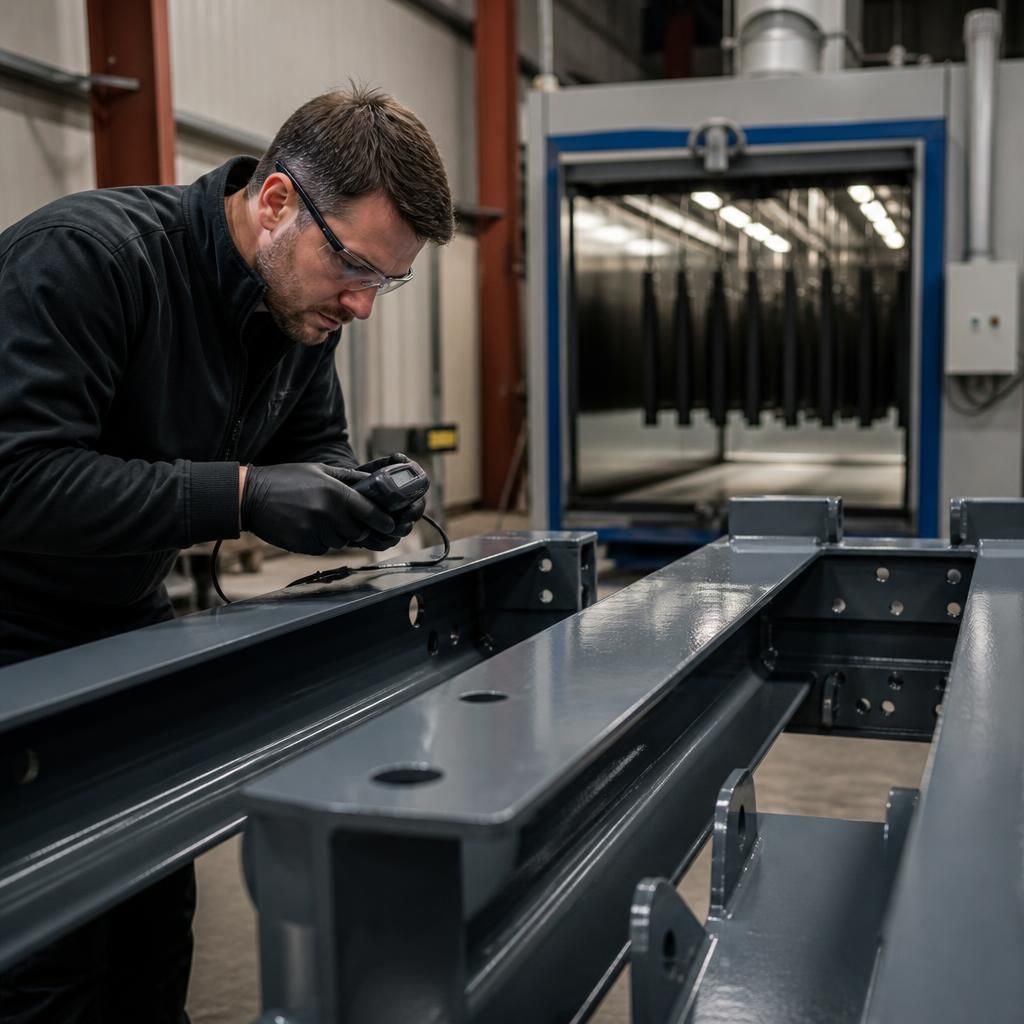
The long-term advantage of an advanced powder coating depends on verification as well as material selection. A coating can appear uniform while still having insufficient coverage, poor adhesion or incomplete curing, so inspection should be built into the process rather than left until corrosion becomes visible.
- Visual checks can identify missed areas, pinholes, contamination, damage and defects around welds, edges and apertures.
- Film-thickness measurements help confirm that the applied coating matches the specified range without relying on appearance alone.
- Adhesion and cure checks can indicate whether the coating has bonded correctly and developed the required properties.
- Records of preparation, pretreatment, application and curing provide useful evidence when repeat batches or future maintenance work are required.
This approach also improves comparison with traditional paint. Paint systems require equivalent checks for surface preparation, layer build, drying and intercoat adhesion; neither technology should be judged on its nominal product type alone. For steel components where corrosion failure would be difficult or costly to correct, documented quality control can be as important as the choice between powder and paint.