

How does the powder coating process enhance the longevity and appearance of steel railings compared to traditional painting methods?
Powder coating enhances steel railings by bonding a dry powder finish to the prepared metal and curing it into a hard, even protective layer. Compared with traditional paint, this finish generally offers greater resistance to chipping, abrasion, corrosion and weathering, while providing a more consistent colour and appearance.
Powder coating improves the service life and appearance of steel railings by creating a chemically cured finish that is closely bonded to correctly prepared metal. The process is more controlled than conventional brush, roller or spray painting, so the completed railing can achieve a more uniform coating with fewer visible application marks and a stronger resistance to everyday handling and exposure.
The process begins with the removal of contaminants such as oil, grease, rust, mill scale and previous coatings. Steel may be cleaned mechanically, chemically or through abrasive blasting, depending on its condition and the specification required. This stage is important because powder coating cannot compensate for weak adhesion, corrosion left beneath the finish or contamination on the surface. Any weld spatter, sharp edges and surface imperfections may also need attention before coating if a smooth decorative result is required.
After preparation, the dry powder is applied to the grounded steel railing. An electrostatic charge helps the powder particles adhere to the metal before curing. Unlike liquid paint, which is applied as a wet film containing a carrier, powder is deposited as a dry coating and then heated in a curing oven. The heat allows the particles to flow together and form a continuous finished film.
This curing stage affects both performance and appearance. If the coating is correctly specified and the steel reaches the required curing conditions, the resulting film has a stable surface that is less prone to the softening, marking and uneven drying associated with some conventional paint systems. The finish is also less likely to show runs, brush strokes or variations caused by inconsistent wet application.
For railings, the practical advantages include:
- More consistent coverage: Powder can produce an even film across rails, posts and infill sections, including areas that are difficult to coat uniformly by hand.
- Improved edge and detail definition: Correct preparation and application can preserve the visual definition of profiles, apertures and formed sections without the heavy build-up that can occur with repeated wet coats.
- Reduced risk of premature surface deterioration: A properly cured coating provides a durable barrier between the steel and moisture, pollutants and handling, helping to limit the conditions that lead to surface degradation.
- Stable decorative quality: Powder systems are available in different colours, gloss levels, textures and effects, allowing the appearance to be matched to the surrounding building or metalwork specification.
- Better resistance to routine contact: Railings are frequently touched, leaned against, moved during installation or exposed to contact from equipment. A correctly cured finish is designed to withstand this type of use more effectively than a comparatively fragile decorative paint layer.
Traditional painting can still be suitable for some railing projects, particularly where on-site application, minor repairs or a specialised liquid coating system is required. However, its final performance depends heavily on application conditions, drying between coats, film thickness and protection during handling. Dust, moisture, overspray and uneven application can affect the visual result. Powder coating transfers more of the process into a controlled coating environment, which helps reduce these variables for components that can be transported and oven-cured.
The difference is most apparent on railings with repeated sections or complex geometry. A factory-applied powder finish can provide a consistent appearance from post to post, whereas manually painted assemblies may show differences in sheen, coverage or texture between individual parts. Coating the components before assembly can also help achieve a cleaner finish around joints, provided the design and fabrication process allow for it.
Longevity is not determined by the coating alone. Steel grade, preparation standard, edge condition, weld quality, coating type, film build and the surrounding environment all influence the result. Railings near roads, industrial premises, coastal areas or sources of chemical contamination may require a specification suited to increased exposure. Poor drainage, trapped moisture and damage caused during installation can also create localised failure even when the original finish was applied correctly.
For that reason, the coating specification should be agreed alongside the railing design and intended use. The required appearance, exposure conditions, handling risks and any additional corrosion protection should be considered before production. Once installed, routine cleaning with suitable non-abrasive methods helps prevent deposits from building up and makes damage easier to identify. Scratches or impact damage should be assessed and repaired using a compatible method rather than simply covered with an unrelated paint.
In summary, powder coating enhances steel railings through controlled preparation, electrostatic application and oven curing. Its principal advantage over traditional painting is not simply the colour choice: it is the combination of a consistent factory-applied finish, strong adhesion when the substrate is prepared correctly and a surface designed to retain its protective and decorative properties under regular outdoor and industrial use.
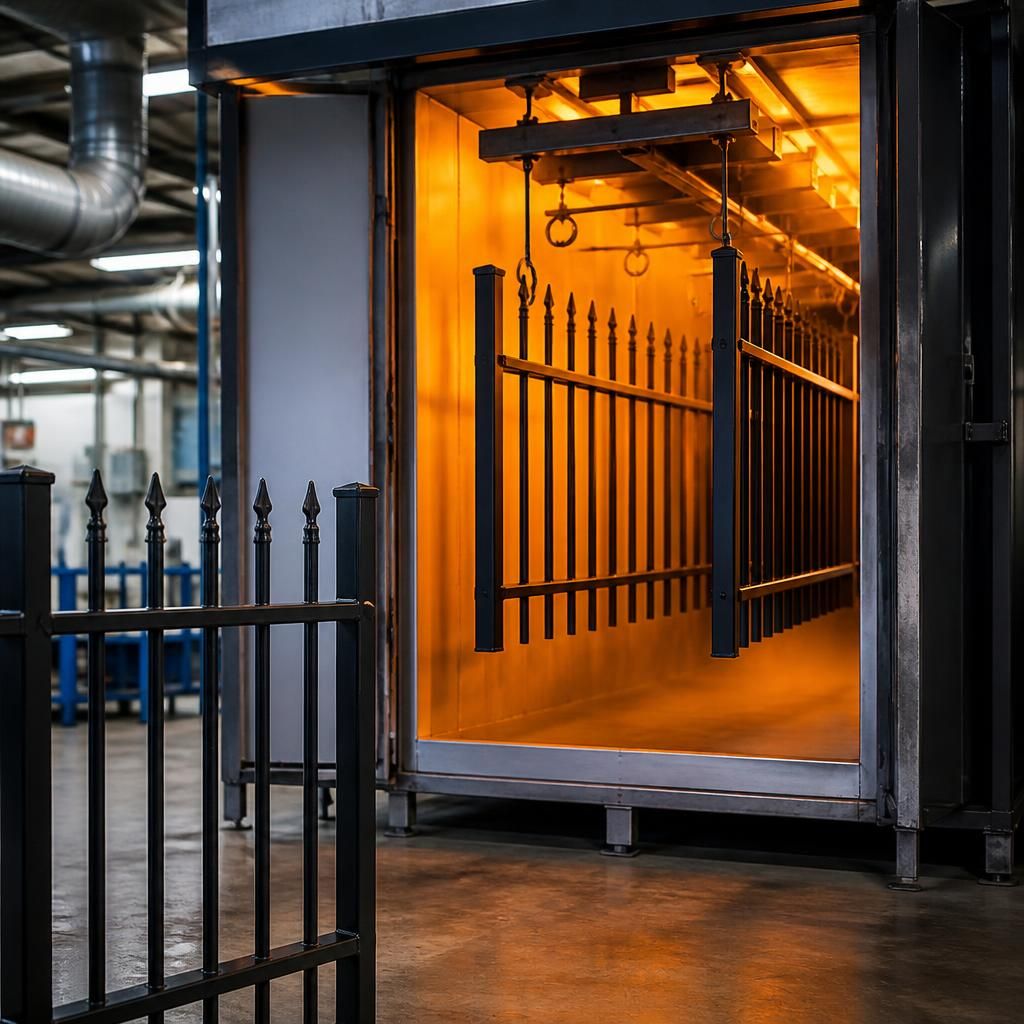
The curing stage is critical because powder coating develops its final properties only when the steel reaches the required temperature for the specified period. The resin and curing agent react to form a cross-linked film, rather than simply allowing a liquid carrier to evaporate. This gives the finish its intended hardness, flexibility and resistance to marking.
For steel railings with different tube sizes, brackets or heavy welded sections, the metal may heat at different rates. Professional coating processes therefore account for the temperature of the component itself, not just the air inside the oven. Consistent curing helps prevent premature loss of gloss, brittleness, soft areas or uneven appearance, supporting both the protective performance and visual quality of the finished railing.