

What considerations should be taken into account when selecting the right powder coating for galvanised metal projects?
Selecting powder coating for galvanised metal involves assessing the required durability, environmental exposure, colour and finish, part geometry, and compatibility with the galvanised surface. The specification should also account for surface preparation, adhesion requirements, coating thickness, and the component’s intended use to achieve a reliable, uniform finish.
The right powder coating for a galvanised metal project is selected by matching the powder chemistry and curing process to the condition of the zinc coating, the component’s functional requirements, and the production specification. Galvanised steel is not a uniform substrate: its surface may vary according to the galvanising method, zinc layer condition, age, storage history and any post-galvanising treatment. These factors should be confirmed before a coating system is specified.
Start with the condition of the galvanised surface. Ask whether the component is newly galvanised, weathered, passivated, contaminated during storage or affected by wet storage staining. Passivation treatments, oils and temporary corrosion inhibitors can interfere with the powder system unless they are compatible with the agreed pre-treatment route. White corrosion products on zinc, sometimes called wet storage stain, also need to be assessed rather than simply covered. The coater should know the galvaniser’s process and any chemicals applied after galvanising so that the preparation system can be selected accordingly.
Choose the powder chemistry for the service requirement. Polyester powders are commonly considered where the finished part will be exposed to sunlight because they are formulated for exterior colour and gloss retention. Epoxy powders can provide useful resistance to chemicals and corrosion in suitable applications, but they are generally not the first choice where long-term direct ultraviolet exposure is expected because their surface may chalk. Epoxy-polyester hybrid powders are often used for interior components, while polyurethane systems may be considered where a particular surface quality or performance balance is required. The correct choice depends on the full duty of the part, not simply whether it is made from galvanised steel.
Check the curing schedule against the complete component. Powder must reach its specified metal temperature for the required time, so the oven cycle should be considered alongside the steel thickness, component mass and loading arrangement. A substantial or irregularly shaped part may heat at a different rate from a small bracket. If the powder is under-cured, properties such as adhesion and chemical resistance can be affected; excessive heat or an unsuitable cycle can also affect appearance and productivity. Where the galvanised surface is prone to releasing trapped gases, a powder and process designed to reduce outgassing may be appropriate. Trial work is useful when the component has a complex construction or an unusual galvanised finish.
Allow for gas release and surface porosity. Zinc coatings and the underlying steel can contain irregularities, pores or absorbed contaminants. During oven curing, expanding air or vapour may create pinholes, blisters or small craters in the powder film. This risk is influenced by the galvanising condition, the component’s shape, the preparation process and the heating profile. Venting hollow sections where appropriate, avoiding enclosed unsealed cavities and agreeing a realistic visual acceptance standard can reduce disputes over defects. A sample part or representative test panel can show whether the proposed system produces an acceptable appearance before a full batch is processed.
Define the specification in measurable terms. A useful specification should identify the powder type, approved colour reference, gloss or texture requirement, target film build, curing conditions, masking requirements and inspection criteria. It should also state which surfaces must remain uncoated, such as earth points, bearing faces, mating faces, threads or close-fitting holes. Stating these details in advance is particularly important where coated parts must assemble with other components, because powder adds measurable thickness and can alter clearances.
Consider how the component will be handled and assembled. Racking marks, contact points and lifting locations should be planned before coating. Drainage and vent holes may be needed on hollow fabrications to allow cleaning, rinsing and air movement during processing. Threads may require masking or later clearance, while sharp edges, welds and folded returns should be reviewed for their effect on coverage and appearance. These design details can determine whether a coating is practical without compromising fit or function.
Assess chemical contact and contamination risks. Parts used near oils, fuels, cleaning agents, coolants, fertilisers or other chemicals may need a coating formulated for that particular exposure. Consider not only continuous contact but also splash, immersion, cleaning temperature and the time contaminants remain on the surface. A powder that is suitable for general indoor use may not be suitable for repeated chemical washing. If the final application involves a substance with a specific composition, request compatibility information or arrange representative testing rather than relying on a general product description.
Plan for quality control and repeatability. Galvanised components can differ in surface profile and zinc appearance from one batch to another. The specification should therefore include agreed checks for visual finish, cure, adhesion and film thickness, using methods appropriate to the part and coating system. Where appearance is critical, retain an approved reference sample and assess parts under consistent lighting. For repeat orders, record the powder system, preparation route, curing parameters and masking arrangement so that later batches can be compared with the original approval.
Include repair and maintenance requirements in the decision. Powder coating is applied in a factory process, so damage caused by transport, fabrication or assembly may need local treatment. The repair method should be agreed before production, particularly where exposed zinc or bare steel could be revealed. Touch-up materials may not match the original powder exactly in colour, texture or durability. Components should also be designed so that damaged areas can be inspected and maintained rather than hidden inside inaccessible joints.
For a reliable specification, provide the coater with drawings, galvanising details, substrate information, service conditions, assembly tolerances and the required acceptance standard. A representative sample or trial batch can then confirm that the selected powder, preparation route and cure produce the required result on the actual galvanised component.
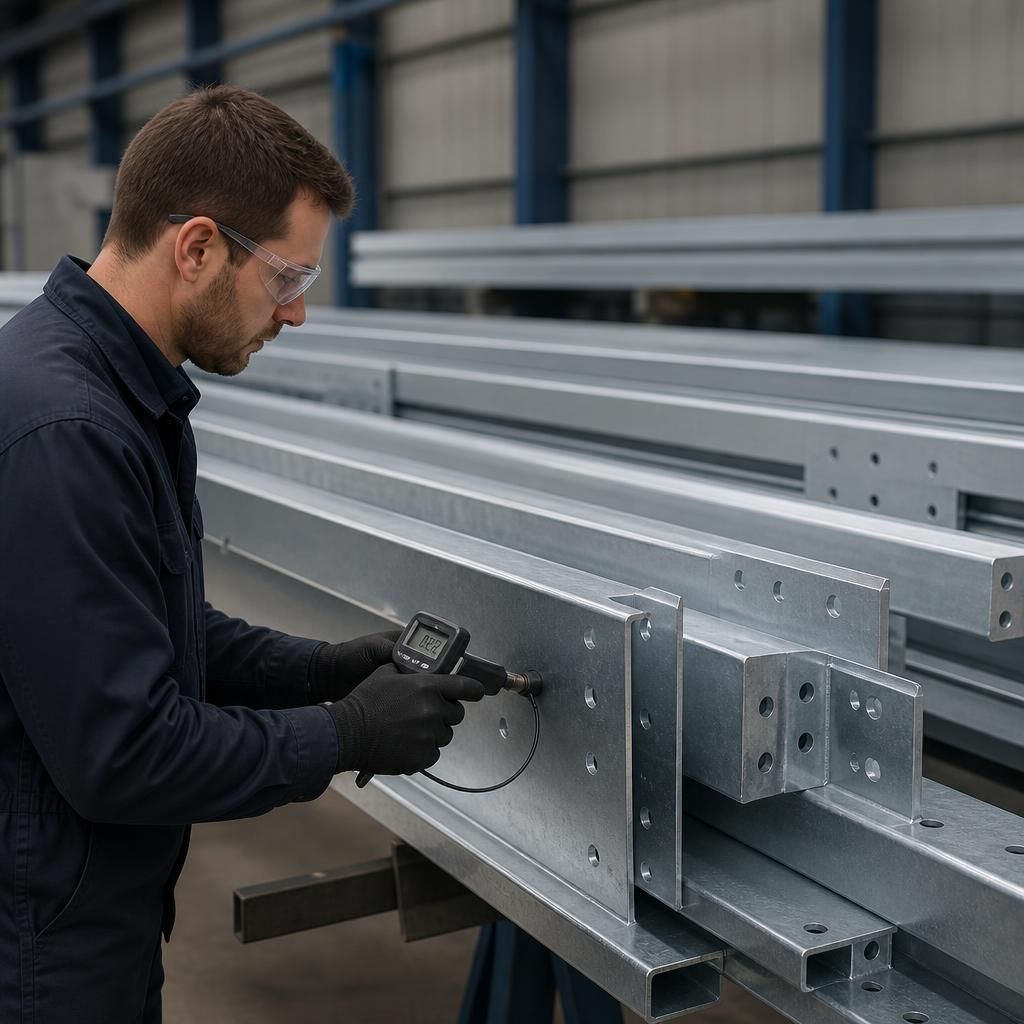
Powder coating for galvanised metal should be specified as a duplex system rather than as an isolated finish. The zinc layer provides sacrificial corrosion protection, while the powder coating forms a barrier and supplies the required colour, texture and appearance. Selection should therefore consider how the preparation process will affect the zinc surface and how any exposed areas will be treated if the coating is damaged during handling or assembly.
Assess the complete coating system against the component’s actual duty, including outdoor exposure, chemical contact, cleaning methods and dimensional requirements. This approach helps prevent a powder that appears suitable in isolation from being selected where the galvanised layer, interface or finished component has different performance needs.