

How does anti-corrosion powder coating compare with traditional paint coatings for protecting steel in industrial settings?
Anti-corrosion powder coating generally provides steel with a tougher, more uniform and abrasion-resistant finish than traditional liquid paint, while producing fewer application solvents. Traditional paint can be more suitable for on-site application, complex repairs or situations requiring frequent colour changes, so the better option depends on the steel’s preparation, exposure conditions, component size and required maintenance approach.
For industrial steel, anti-corrosion powder coating usually offers a more consistent factory-applied barrier than a conventional liquid paint system, but its performance depends on surface preparation, coating formulation, film thickness and curing. Traditional paint remains useful where work must be carried out on site, where the steel cannot enter a curing oven, or where future local repairs and colour changes are likely.
Both systems protect steel by separating the metal from water, oxygen, salts and other contaminants that drive corrosion. Neither coating should be treated as a substitute for proper preparation. Rust, mill scale, oil, welding residues and embedded contaminants can undermine adhesion and allow corrosion to develop beneath the finish.
For powder coating, preparation commonly includes degreasing, mechanical cleaning or abrasive treatment, followed by a suitable chemical pretreatment. The powder is then electrostatically applied and heated so that it melts, flows and cures into a continuous film. This process can produce reliable coverage across repeated batches, provided the component is suitable for the application equipment and oven.
Traditional liquid paint is normally applied in one or more coats, often with separate primer, intermediate and topcoat stages. This allows the coating system to be selected for particular exposure conditions. For example, a primer may promote adhesion and corrosion resistance, while subsequent coats provide additional barrier protection and resistance to weathering or chemicals. The final result depends heavily on mixing, application technique, drying conditions, recoat intervals and control of the surrounding environment.
The main comparison points for steel used in industrial settings are:
- Barrier continuity: Powder can form a seamless cured film with no brush or spray overlap marks when applied correctly. Liquid paint can also provide effective coverage, but runs, pinholes, dry spray, missed edges and inconsistent application are possible if application controls are poor.
- Edge and weld protection: Sharp edges, corners, welds, folded sections and recessed areas are difficult for any coating system. These locations need particular attention during preparation and inspection. Rounding sharp edges where practical and ensuring adequate coverage are often more important than simply choosing powder or paint.
- Adhesion: Powder relies on a clean, suitably pretreated substrate and correct curing. Liquid systems can accommodate different primers and preparation methods, but poor adhesion can still result from contamination, excessive surface roughness, moisture or incompatible coats.
- Mechanical resistance: A properly cured powder film generally resists handling damage, scuffing and routine industrial wear well. Liquid systems can be specified for similar duties, although performance varies considerably between formulations and coating schedules.
- Exposure and chemistry: The correct resin and coating build must reflect whether the steel will face outdoor weather, condensation, salt, oils, cleaning chemicals, abrasion or elevated temperatures. A powder selected for indoor service should not automatically be used for a harsh external or chemical environment.
- Repairability: Liquid paint is often simpler to apply to isolated damage while the steel remains installed. Powder-coated parts can also be repaired, but a local repair may not reproduce the original finish exactly and should be assessed for compatibility, adhesion and edge sealing.
Powder coating is particularly well suited to steel components that can be transported through a controlled preparation and curing process. Its repeatability is valuable for manufactured parts, fabricated assemblies and batch work, because the same preparation and application sequence can be monitored across multiple items. The coating must, however, be fully cured. Under-cured powder may have inadequate adhesion or chemical resistance, while excessive heat can affect the substrate or the finish.
Traditional paint has greater flexibility for large fixed structures, awkward assemblies and steel that cannot be removed for factory processing. It can be applied in stages and recoated during maintenance, which is important where dismantling or transport would be impractical. Its limitations include longer process control across multiple coats, sensitivity to application conditions and the need to manage drying and recoat times.
Cost should be assessed over the complete coating life rather than by comparing the price of a single tin of paint with the price of powder. Relevant factors include preparation, masking, labour, curing, transport, access equipment, coating repairs, inspection and future maintenance. Powder may be efficient for repeatable batch production, whereas liquid paint may be more practical for one-off, oversized or installed structures. The least expensive initial option is not necessarily the lowest-cost option if early repairs or recoating are required.
Environmental considerations also differ. Powder application does not use the same solvent-based liquid carrier associated with many conventional paint systems, and overspray powder may be collected and managed within the process. Liquid paint can be formulated with lower solvent content, but its environmental profile depends on the specific product, application method, waste controls and cleaning procedures. These factors should be reviewed alongside technical performance rather than used as the sole basis for selection.
Inspection should cover the steel condition before coating, preparation quality, coverage at welds and edges, coating thickness, cure and visible defects. For a paint system, inspectors may also need to check each coat, drying conditions and recoat intervals. After installation, both powder and paint require periodic checks for impact damage, blistering, cracking, corrosion at edges and fasteners, and areas where water or debris can collect.
In practical terms, anti-corrosion powder coating is often the stronger choice for prepared steel components requiring a durable, repeatable factory finish, while traditional paint is often more adaptable for site work, unusual component dimensions and ongoing repair. The correct decision should be based on the steel’s exposure category, design, preparation requirements, production method and maintenance plan, not on the coating type alone.
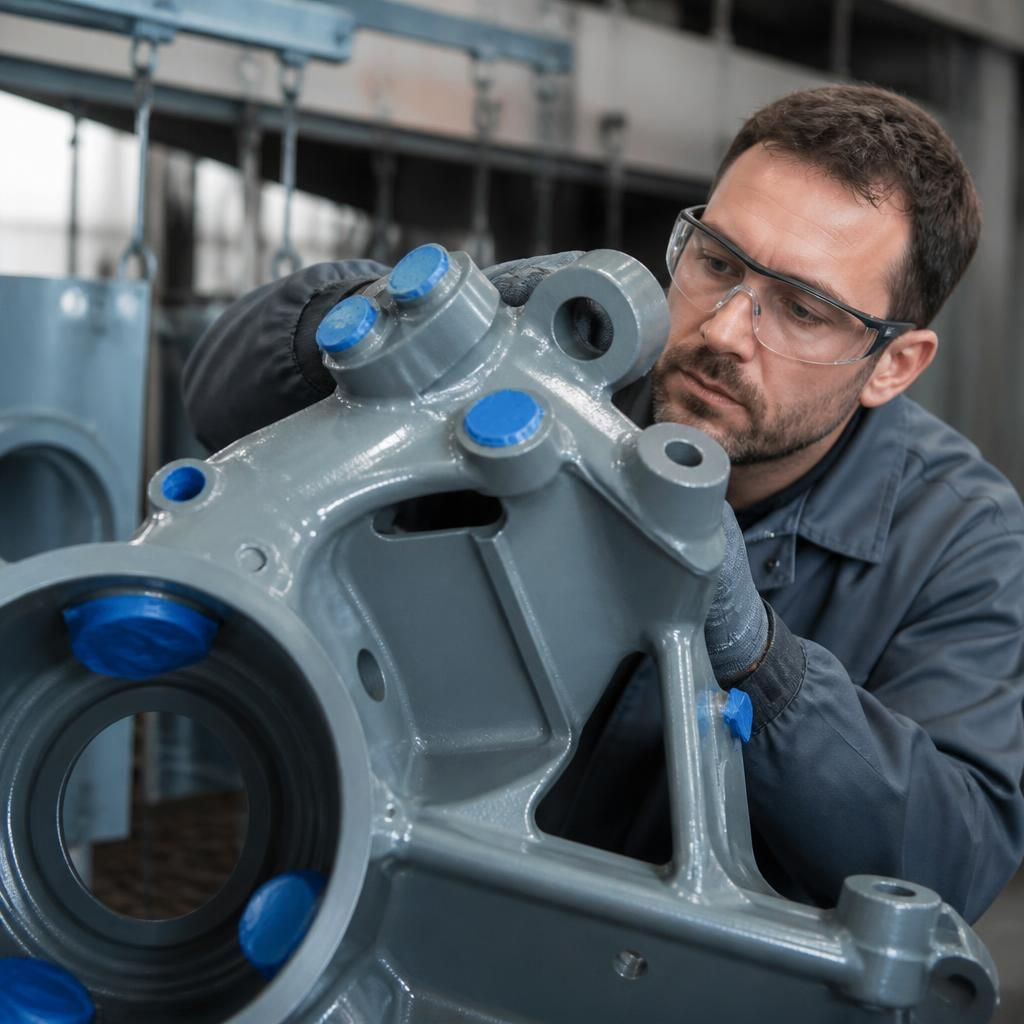
Component fit and masking can influence the choice. On steel parts with threaded holes, bearing seats, sliding faces or close-fitting joints, the coating must not interfere with assembly. Powder coating adds a cured film that needs to be excluded from specified contact areas using suitable masking, while liquid paint can be applied selectively in stages. Neither approach removes the need to define protected and uncoated zones before work begins.
Design drawings should identify threads, bores, mating faces, drain paths and inspection points that require masking or post-coating cleaning. This is particularly important for fabricated assemblies, where trapped coating or blocked drainage can affect fit and create areas in which moisture collects. Comparing powder with traditional paint therefore involves not only corrosion resistance, but also how each process fits the component’s tolerances and assembly requirements.