

What are the benefits of using advanced powder coats over traditional liquid coatings for anti-corrosion purposes on steel?
Advanced powder coatings can provide steel with a tougher, more uniform and durable anti-corrosion barrier than traditional liquid coatings, helping resist impact, abrasion and moisture. They also avoid solvent-based application and can reduce material waste, making them an efficient option where consistent, long-lasting protection is required.
Advanced powder coatings can offer more reliable anti-corrosion protection for steel than traditional liquid coatings because they form a chemically cured, tightly bonded coating system with no solvent evaporation stage. Their main advantages are improved film integrity, better control of the coating system and the ability to combine barrier protection with specialist primers or topcoats suited to the exposure conditions.
A more robust coating structure
Liquid coatings dry as solvents or water leave the applied film, whereas thermosetting powder coatings melt and cross-link during curing. This creates a continuous polymer matrix rather than a film that depends on solvent evaporation. When correctly specified and cured, the resulting coating is less vulnerable to pinholes, solvent entrapment and uneven drying. These defects can create routes for water and oxygen to reach the steel and start corrosion.
Advanced powder systems can also be built in layers. A corrosion-resistant primer may be applied beneath a powder topcoat, with each layer serving a different purpose. The primer can improve adhesion and provide additional protection at damaged areas, while the topcoat provides the main barrier against the surrounding environment. For particularly demanding steel applications, a zinc-rich powder primer may be considered where sacrificial protection is required, subject to the product specification and application process.
Reduced permeability and stronger adhesion
A well-designed powder film can restrict the movement of water, oxygen and corrosive contaminants through the coating. This is important because corrosion under a coating often develops after moisture reaches the steel through a scratch, pore, cut edge or poorly prepared area. Powder coating does not make steel immune to corrosion, but a properly prepared substrate and correctly cured system can delay the conditions needed for corrosion to develop.
Adhesion is equally important. Advanced powder coatings can be selected for compatibility with pre-treated steel, galvanised steel or other approved substrates. Strong adhesion reduces the risk of peeling, flaking and underfilm corrosion. Traditional liquid coatings can also achieve excellent adhesion, but their performance is more dependent on application conditions such as solvent evaporation, wet-film control and the time allowed between coats.
More consistent application on repeat components
For manufactured steel parts and repeat batches, powder application can provide a controlled process with defined preparation, application and curing stages. Electrostatic application helps attract powder to the earthed component, and the coating is then cured at a specified temperature for a specified time. This makes the process easier to standardise than many site-applied liquid systems, where temperature, humidity, spray technique and recoat intervals can vary significantly.
Consistency matters for corrosion protection because a coating that is too thin may provide insufficient barrier protection, while excessive thickness can create defects such as cracking or poor curing. Powder coating should therefore be applied to the thickness and cure schedule stated by the coating manufacturer, with checks made on the finished component where the specification requires them.
Fewer solvent-related limitations
Traditional solvent-borne liquid coatings release volatile organic compounds as they dry. These emissions require suitable ventilation, handling controls and environmental management. Powder coatings are supplied as dry particles, so they avoid the solvent content associated with conventional solvent-borne systems. Overspray can also be collected in suitable processes, although recovered material must be managed in accordance with the coating system and equipment requirements.
This does not mean powder coating is impact-free. It still requires energy for curing, careful control of airborne powder and appropriate measures to protect operators and the surrounding workplace. Its environmental and process advantages should be assessed alongside the curing temperature, transport requirements and the complete coating specification.
Where liquid coatings may still be appropriate
Powder coating is not automatically the best choice for every steel component. The part must generally tolerate the curing temperature, and its size, shape and construction must be compatible with the application equipment. Liquid coatings may be more practical for very large fixed structures, on-site work, heat-sensitive assemblies or repairs where heating the complete component is not possible. They can also be useful where a very thin film, extensive colour matching or local touch-up is required.
The comparison should therefore consider the full operating environment rather than coating type alone. Factors include exposure to water, salt, chemicals, ultraviolet radiation, temperature changes, impact, movement and abrasion. Component design also matters: sharp edges, recesses, welds, threaded areas and joints need suitable preparation and may require additional specification controls.
Preparation determines the result
Neither powder nor liquid coating can compensate for inadequate steel preparation. Rust, mill scale, oil, weld residue and other contaminants must be removed using a preparation method appropriate to the substrate and required corrosion category. Any chemical pre-treatment must be compatible with the chosen powder system, and the steel must be clean and suitably dry before coating.
For this reason, an advanced powder coating specification should define the substrate preparation, primer or topcoat arrangement, target film thickness, curing conditions, inspection requirements and repair procedure. When these controls are matched to the service environment, powder coating can provide a technically effective alternative to traditional liquid coatings for protecting steel against corrosion.
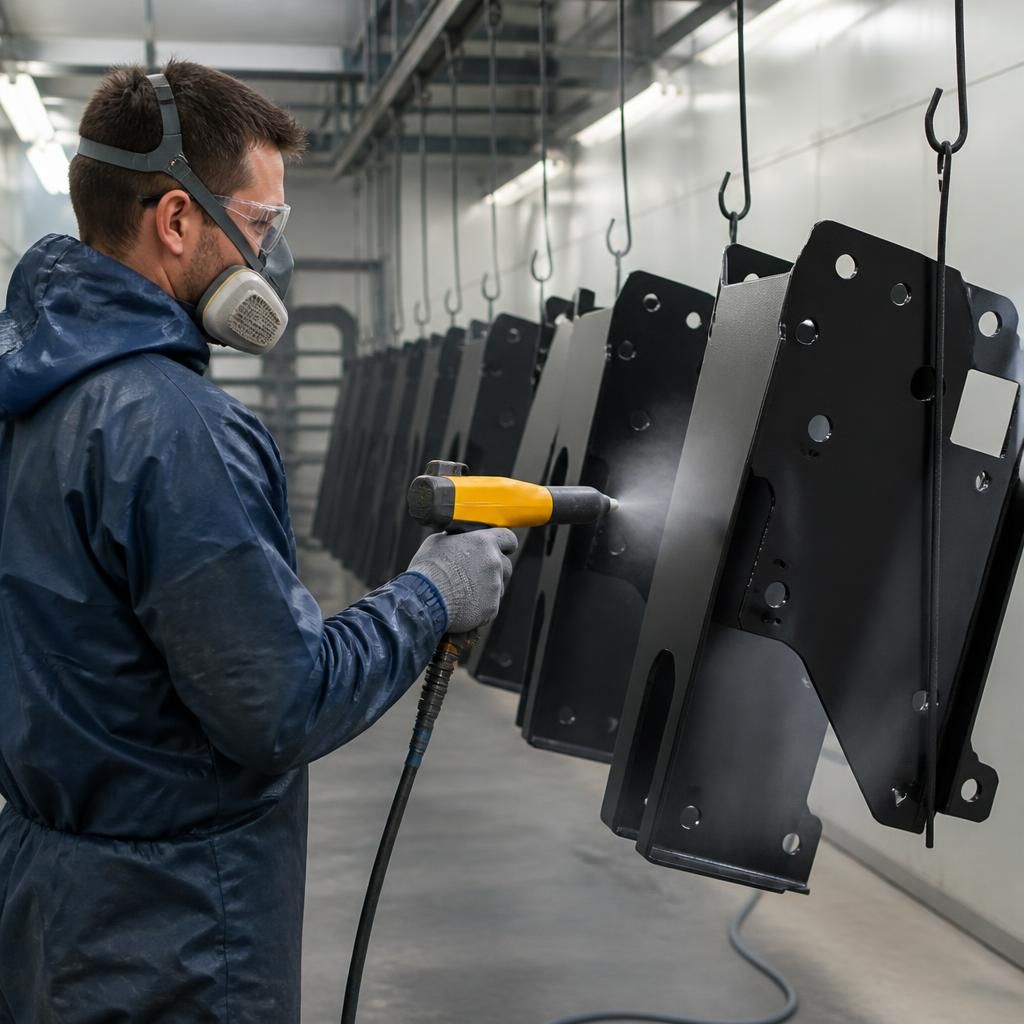
A key benefit of advanced powder coatings is the ability to match the coating chemistry to the steel’s exposure conditions. For example, epoxy-based powders can provide strong resistance to moisture and many chemicals, while polyester powders are generally better suited to exterior environments where ultraviolet exposure and weathering are significant. Hybrid systems can combine properties from both chemistries where the service conditions require a balance of corrosion and environmental resistance.
This allows the anti-corrosion specification to be based on the actual risks faced by the component rather than on a general-purpose coating choice. The expected contact with water, chemicals, sunlight and temperature variation should be assessed before selecting the powder system. Traditional liquid coatings also offer different chemistries, but an advanced powder specification can provide a carefully defined, factory-applied system in which the selected formulation and finish are matched to the component’s intended use.
Discuss advanced powder coating for steel
Discuss your steel components, exposure conditions and required finish with our powder-coating specialists to identify a suitable advanced anti-corrosion system. Contact us to explore the specification and collection or delivery requirements for your project.