

How does powder coating differ from other anti-corrosion coatings for steel?
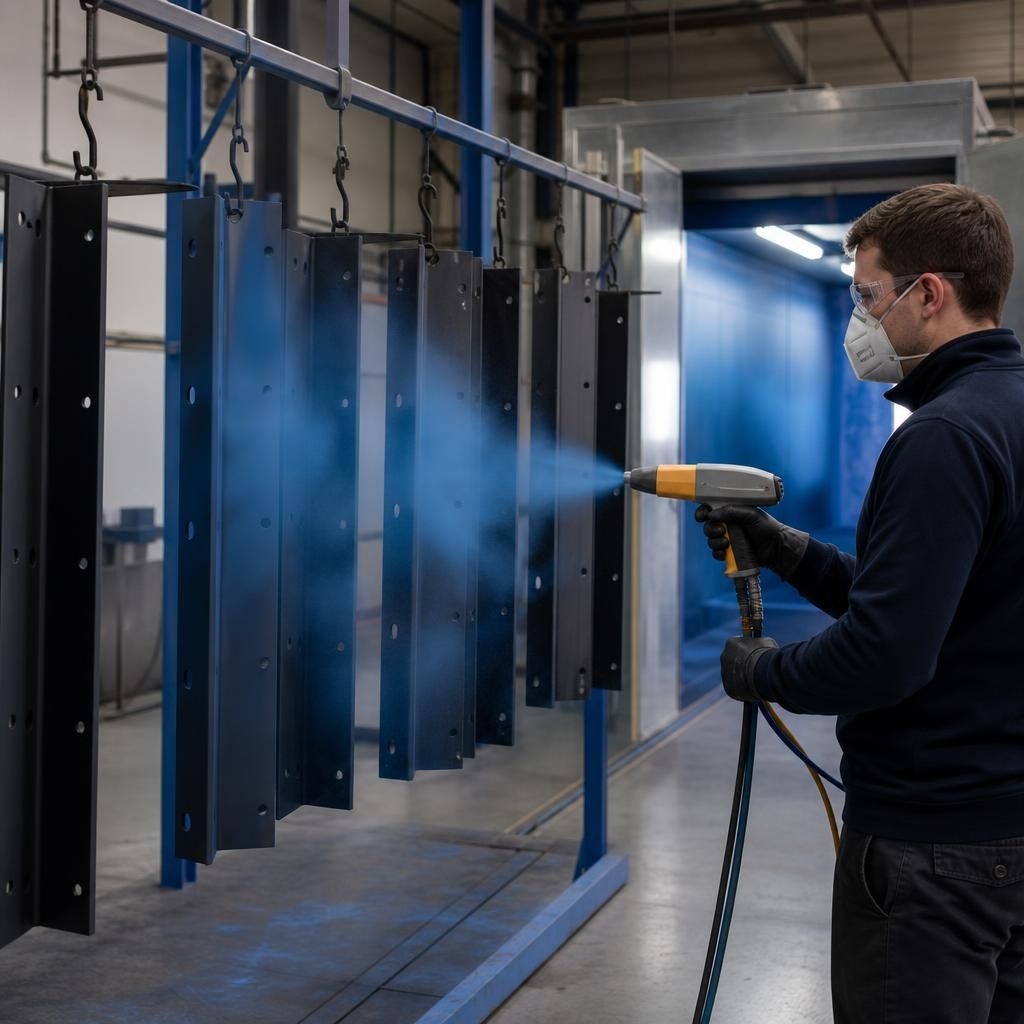
Powder coating applies dry, electrically charged powder to prepared steel before heat-curing it into a continuous protective film. Unlike liquid paint and systems such as galvanising, it offers a controlled, hard-wearing finish without relying on solvent-based application, although the most suitable option depends on the steel’s environment, geometry and required level of corrosion protection.
Powder coating differs from other anti-corrosion coatings for steel mainly in the way it forms its protective layer, the types of damage it resists and the conditions in which it can be applied. It is a factory-controlled finish that can provide a hard, uniform barrier, whereas liquid paint, galvanising and electroplating protect steel through different combinations of barrier protection, sacrificial action and chemical resistance.
Compared with liquid paint
Liquid coatings are applied as wet films and typically rely on evaporation or chemical curing to form a solid layer. They can be applied on site, brushed into local areas and used on assemblies that cannot be placed in an industrial curing oven. This makes them useful for large fixed structures, repair work and components that are sensitive to heat.
Powder coating is generally applied in a controlled production environment, where surface preparation, application and curing can be managed consistently. The cured film is usually more resistant to chipping, abrasion and general handling damage than a standard decorative liquid paint. Powder also provides a broad choice of colours, gloss levels and textures without the same wet overspray and solvent-handling considerations associated with many liquid systems.
That does not mean powder coating is automatically the better option for every steel application. Liquid systems may be more suitable where the component is too large for available equipment, cannot tolerate curing temperatures or needs coating after installation. They can also be easier to touch up on site. The correct comparison should therefore consider the full coating system rather than the product name alone: preparation, primer, film thickness, curing and the exposure environment all affect corrosion performance.
Compared with hot-dip galvanising
Hot-dip galvanising protects steel by covering it with a layer of zinc. Zinc provides barrier protection and can also act sacrificially if the steel is exposed at a small damaged area. This makes galvanising particularly useful where steel will face outdoor exposure, moisture or mechanical handling and where long-term protection is a priority.
Powder coating works principally as a sealed barrier. It can deliver a smoother and more varied decorative finish, with greater control over colour, texture and appearance. It is often preferred for visible architectural, fabricated or automotive components where finish quality matters as well as corrosion resistance.
Galvanised surfaces can require specialist preparation before powder coating because the zinc surface may contain residues, oxides or gases that affect adhesion. A combined galvanised-and-powder-coated system, sometimes called a duplex system, can be considered where both zinc protection and a coloured protective finish are required. Its performance depends on suitable preparation and compatibility between the two layers.
Compared with electroplating
Electroplating deposits a thin metallic layer, such as zinc, onto steel using an electrical process. It is commonly selected for smaller components, fixings and parts requiring controlled dimensions or a particular metallic appearance. Its coating thickness and coverage can be well suited to detailed items, although sharp edges, recesses and complex shapes require careful specification.
Powder coating normally produces a more substantial organic film and offers a wider decorative range. It can be advantageous for larger fabricated parts and components where colour, texture and resistance to everyday wear are important. Electroplating may remain preferable where dimensional tolerances, electrical properties or a metallic surface are more important than a coloured finish.
Surface preparation is a major differentiator
No anti-corrosion coating can compensate fully for poorly prepared steel. Powder coating commonly requires the removal of oil, mill scale, rust and other contaminants, followed by a preparation method appropriate to the steel and the intended service conditions. The coating must also reach the specified film thickness and be cured correctly; insufficient or excessive curing can affect adhesion and performance.
Edges, welds, joints, recesses and drainage holes deserve particular attention because they can be difficult to coat consistently and may retain moisture. For more demanding environments, a suitable primer or multi-layer powder system may be specified rather than relying on a single decorative coat. The design of the component can be as important as the coating material, especially where water or contaminants could collect.
Repair, damage and service conditions
Powder coating forms a tough finish, but it is not immune to impact, cutting, welding or prolonged exposure to aggressive chemicals. If the film is breached, moisture can reach the steel and corrosion may develop beneath or around the damaged area. Repairs should use a compatible system and include cleaning and preparation of the exposed steel; an ordinary touch-up product may not reproduce the original performance or appearance.
Liquid coatings are often more practical for in-service repairs because they do not require oven curing. Galvanising can offer an advantage where the zinc layer provides sacrificial protection, although severe damage and cut edges may still need treatment. In every case, the expected atmosphere, moisture, salts, chemicals, temperature, abrasion and cleaning regime should be assessed before selecting the system.
How to choose between the options
- Choose powder coating where a durable, consistent and decorative finish is required for steel components that can be suitably prepared and heat-cured.
- Consider liquid coating where on-site application, low-temperature curing, complex repairs or very large fixed structures are central requirements.
- Consider galvanising where sacrificial zinc protection is valuable in exposed or wet conditions, particularly when the appearance and colour range of an organic finish are less important.
- Consider electroplating for smaller precision components where a thin metallic coating, controlled dimensions or a specific functional surface is required.
- Consider a combined system where the steel needs both the underlying protection of zinc and the appearance or additional barrier provided by a powder-coated finish.
For Midlands manufacturers, fabricators and other commercial users, the practical decision is usually based on the component’s size and geometry, required appearance, production method, exposure category, expected handling and maintenance arrangements. A coating specification should identify the preparation standard, coating layers, target finish and inspection requirements so that powder coating can be compared fairly with alternative anti-corrosion systems.
Powder coating is best compared with other anti-corrosion systems by considering the type of protection each coating provides, rather than by treating all coated steel as equivalent. A powder-coated surface is an organic film whose performance depends on remaining continuous and well bonded to the steel. Zinc-based coatings offer a different form of protection because zinc can continue to protect exposed steel at a local breach. This distinction matters when specifying components likely to suffer cutting, impact or abrasion in service: the coating’s protection mechanism should match the expected damage as well as the surrounding environment.