

What are the steps involved in sandblasting for powder coating preparation?
Sandblasting for powder coating preparation involves removing contaminants and existing coatings, selecting a suitable abrasive, blasting the metal to create an even surface profile, and removing residual dust before coating. The prepared surface should then be inspected to confirm it is clean, dry and suitable for powder coating.
Sandblasting for powder coating preparation is a controlled sequence of planning, component assessment, protection, abrasive blasting and post-blast handling. The important steps are to establish the required coating specification, identify areas that must not be blasted, prepare the equipment, treat every part of the surface consistently and move the component into coating without allowing the prepared metal to deteriorate or become contaminated.
- Confirm the preparation requirement. The required surface condition depends on the base metal, the condition of any existing finish, the intended use of the component and the powder coating system to be applied. Before work begins, the preparation method should be agreed with the coating specification. This avoids using an unnecessarily aggressive process on a delicate component or an insufficient process where the existing finish is difficult to remove.
- Assess the component before blasting. Inspect the part for weld spatter, sharp burrs, casting defects, damaged threads, distortion and areas that could be affected by abrasive impact. Blasting is not a substitute for fabrication rectification: it will not correct poor weld geometry, repair dents or restore inaccurate dimensions. Any mechanical work that could introduce swarf or alter an edge should be completed as part of the preparation plan.
- Mask and protect critical areas. Threads, bearing seats, machined faces, electrical contact points, sealing surfaces and close-tolerance openings may need suitable plugs, caps or masking materials. Hanging points should also be planned so that the component can be handled without marking important faces. Masking must be secure enough to withstand the blasting process while still allowing the adjoining surface to be treated properly.
- Set up the blasting equipment. The operator checks the blast enclosure, recovery system, nozzle condition, air supply and abrasive delivery before processing the component. Pressure, abrasive flow, nozzle movement and working distance are selected for the substrate and the required surface condition. Equipment settings that are too forceful can erode edges, distort thin sheet or embed abrasive; settings that are too gentle may leave areas of the former finish behind.
- Blast the component methodically. The operator works in a planned pattern, maintaining consistent nozzle movement and overlapping passes. Flat faces, edges, corners, welds, recesses and internal sections all require attention because their geometry changes how the abrasive reaches the metal. Particular care is needed around thin sections and sharp edges, where prolonged exposure can alter the shape or produce an uneven surface.
- Check difficult features separately. Recesses, holes, folded joints and areas behind brackets can remain untreated even when the main faces appear complete. Components with complex geometry may need repositioning or a different access angle. The objective is consistent preparation across the areas that will receive powder, while preserving the dimensions and function of protected features.
- Control handling after blasting. Once preparation is complete, the component should be handled with suitable gloves and kept away from moisture, workshop dirt and unnecessary contact. Contact with bare hands can transfer residues, while poor storage or exposed transport can allow surface deterioration before powder is applied. Parts should therefore be supported and transferred in a way that avoids rubbing prepared faces against other materials.
- Carry out the final release check. Before the component proceeds to coating, the preparation should be checked for missed areas, embedded abrasive, damaged masking, excessive edge erosion and unwanted changes to critical dimensions. Where specified, the surface profile can be verified using an appropriate comparator or profile measurement method. The result should be suitable for the powder system rather than judged only by appearance.
Different substrates require different controls. Steel, aluminium, cast components, previously coated parts and galvanised materials do not respond identically to abrasive impact. Thin sections may need reduced blasting intensity, while intricate fabrications require careful access planning. If a component has a mixed construction or includes machined and unmachined areas, the preparation plan should identify these differences before work starts.
Sandblasting may also form one stage within a wider pretreatment process. Depending on the substrate and service conditions, the prepared component may require additional chemical treatment, a primer or another specified coating layer before the powder is applied. The correct sequence is determined by the coating system and the condition of the metal, not by blasting alone.
For manufacturers and fabricators, providing details of the material, dimensions, existing finish, protected areas and intended service environment helps the preparation process to be specified correctly. Those details also help identify handling risks before the component enters the blasting and powder coating stages.
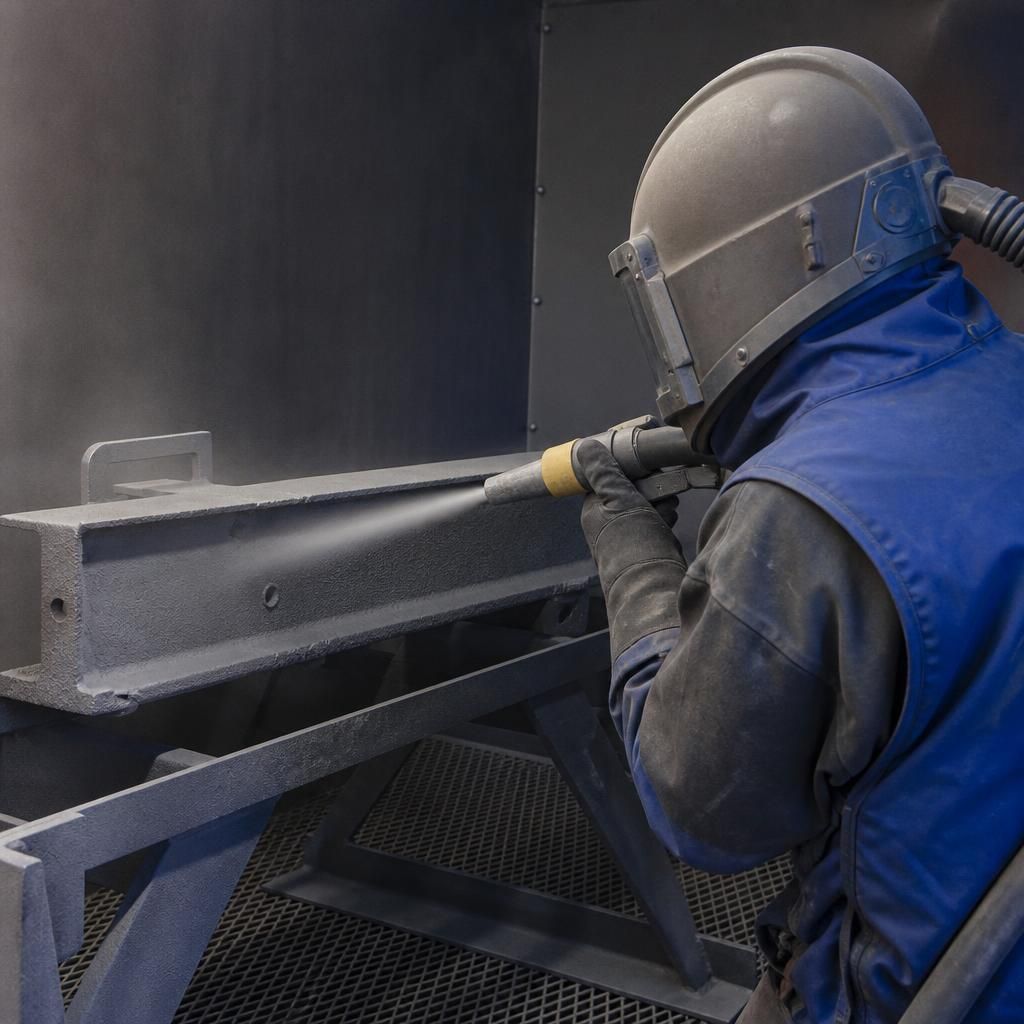
The aim of abrasive blasting is not to make the metal as rough as possible. It is to produce a controlled surface profile that gives the powder coating enough mechanical key without creating excessive peaks, sharp edges or uneven areas. A profile that is too slight may provide inadequate anchoring, while an overly aggressive profile can make it more difficult to achieve consistent coverage across the surface.
For this reason, the finished blast should be assessed against the requirements of the specified powder coating system rather than judged by appearance alone. The abrasive type, blasting intensity and operator technique all influence the result, so profile checks are particularly useful where components have demanding service conditions or large coated areas.
Discuss your sandblasting for powder coating preparation requirements
Discuss your component material, dimensions, existing finish and intended service conditions with the powder-coating.co.uk team to establish a suitable sandblasting preparation route. This helps ensure the prepared surface is compatible with the specified powder coating system.