

What are the key factors to consider when selecting a sandblasting medium for effective surface preparation in powder coating?
Select a sandblasting medium by considering the metal substrate, existing coating or contamination, required surface profile, component geometry and the finish specified for the powder coating system. The abrasive should remove contaminants and create a consistent key without embedding particles, distorting the component or producing a profile deeper than the coating can cover.
The right sandblasting medium is selected by balancing abrasive action, surface cleanliness, process control, operator safety and waste handling. A suitable medium must prepare the metal consistently without introducing residues or defects that could interfere with subsequent powder coating.
Abrasive shape and cutting action are important starting points. Angular media cut into the surface and are generally effective where a more active cleaning action is required. Spherical or rounded media tend to peen or burnish the surface rather than cut it aggressively, making them more suitable where a less sharply etched appearance is preferred. The choice should reflect the required preparation result, not simply the apparent speed of cleaning.
Particle size distribution also affects control. Coarser particles can remove material quickly but may produce a less uniform result, while finer particles offer greater control in detailed or lightly contaminated areas but may require more passes. A consistent, graded abrasive helps produce repeatable preparation across a batch. Mixed or heavily degraded media can give uneven results because the particles no longer behave in a predictable way.
Hardness and friability should be considered together. A harder abrasive can provide a strong cutting action and may be suitable for robust preparation work, whereas a softer or more friable medium breaks down more readily and can generate additional dust. Excessive abrasive hardness or aggressive operating conditions may damage edges, thin sections or machined details. The medium must therefore be strong enough for the work while remaining controllable under the available blasting conditions.
Typical media characteristics can be compared as follows:
- Aluminium oxide: an angular, hard abrasive offering a strong cutting action and commonly selected where thorough mechanical preparation is required.
- Garnet: a mineral abrasive that can provide effective cutting with comparatively low levels of embedded ferrous material, subject to correct handling and cleanliness control.
- Glass bead: a rounded medium that produces a more uniform, lightly peened appearance rather than the sharper cut associated with angular abrasives.
- Steel grit or shot: reusable ferrous media that can be efficient in suitable blasting equipment, but require careful control where ferrous residue, corrosion risk or equipment compatibility is a concern.
- Plastic or other softer media: useful for more delicate preparation tasks where aggressive cutting could damage the component, although their suitability must be confirmed for the required powder coating system.
These descriptions are general rather than interchangeable recommendations. The same medium can behave differently according to air pressure, nozzle distance, angle, feed rate, recovery equipment and the condition of the abrasive. Process settings should be established alongside the medium rather than treating the abrasive as an isolated choice.
Cleanliness and risk of residue are particularly important before powder coating. Abrasive particles should not contain oil, moisture, soluble salts or other substances that could remain on the metal. Recycled media need monitoring because they can accumulate removed material and fines during use. Where a ferrous abrasive is used, the preparation process should include suitable controls to prevent unwanted particles or corrosion products remaining on the surface before coating.
Dust generation and recovery affect both the consistency of the work and the practicality of the process. Friable media and very fine particles can increase airborne dust and place greater demands on extraction and filtration. A recoverable medium may reduce waste in an appropriately designed system, but it still needs regular screening, cleaning and replacement to maintain predictable performance. A low-dust option can be preferable where containment, visibility or housekeeping is a significant consideration.
Component protection should be assessed before blasting begins. Sensitive threads, precision faces, apertures, bearing seats and areas that must retain dimensional accuracy may need masking or a less aggressive medium. The abrasive should not become trapped in cavities or leave sharp transitions that are difficult to clean. Trial work on a representative component can reveal these issues before a full batch is processed.
Compatibility with the powder coating specification is another consideration. The coating manufacturer’s technical requirements may identify acceptable preparation methods, cleanliness levels or limitations on residual abrasive. If a primer, protective coating or specialist nylon system is planned, the preparation method should be checked against that system rather than selected solely on the basis of the visual appearance after blasting.
In practice, selection is best confirmed through a controlled test. Use the proposed medium and settings on a representative part, then inspect the surface for uniformity, trapped abrasive, dust, sharp damage and any visible residue. Check that the prepared metal can be cleaned and transferred to the coating stage without avoidable delay or recontamination. Record the medium type, particle grade and operating settings so that the preparation can be repeated consistently across future batches.
For industrial powder coating, the most suitable abrasive is therefore the one that delivers controlled preparation while meeting cleanliness, dimensional, safety, environmental and process requirements. Cost per bag alone is a poor basis for selection: abrasive life, recovery, waste disposal, equipment wear and the risk of rejected or inconsistently prepared components can all affect the overall suitability of the medium.
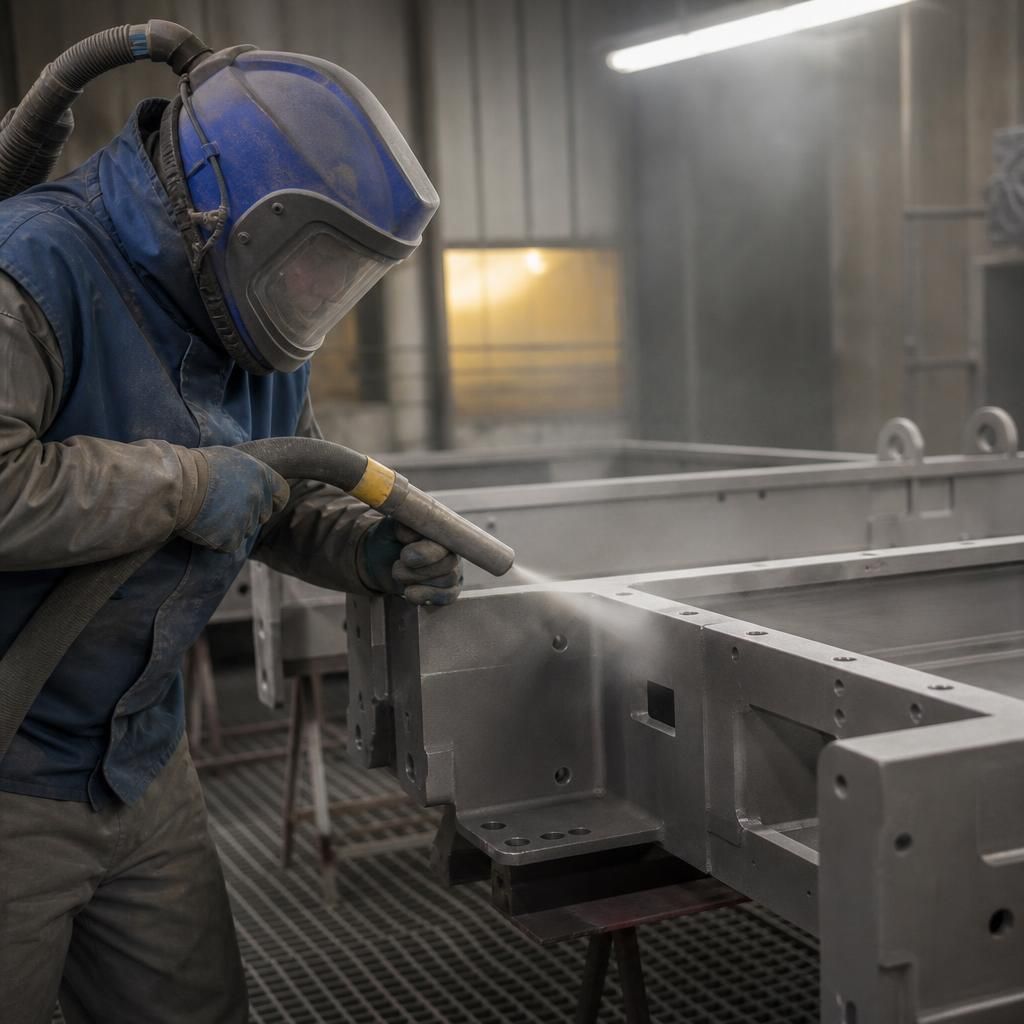
The metal substrate should be the first filter when selecting a sandblasting medium. Mild steel can usually tolerate a more forceful abrasive action, while aluminium and thin-gauge sections need a controlled medium and settings to avoid distortion or excessive metal removal. Stainless steel should be prepared with clean, non-ferrous media where possible, as contamination from ordinary steel abrasives can create later corrosion concerns. Galvanised or zinc-coated components require particular care because an overly aggressive blast can remove the protective layer rather than provide a suitable key.
Where a component combines different metals, or includes machined and coated areas, the medium should be selected for the most sensitive surface. Masking and a trial on a representative part can then confirm that the abrasive cleans effectively without compromising the substrate or any coating that is intended to remain.
Discuss Your Sandblasting Medium Requirements
Discuss your component requirements with our powder coating team, including the substrate, existing coating, component geometry and intended finish. We can help assess the most suitable sandblasting medium and preparation approach for your powder coating specification.