

What safety precautions are necessary during the sandblasting process?
Necessary precautions during sandblasting include using suitable respiratory, eye, hearing and skin protection, containing the work area, and providing effective ventilation or dust extraction. Operators should also inspect hoses, nozzles and connections before use, control access to the blasting zone, follow the abrasive manufacturer’s guidance, and use trained personnel who understand the equipment and associated risks.
Safe sandblasting requires a documented risk assessment, appropriate control of hazardous substances, safe management of compressed air and abrasive materials, and procedures that prevent people or equipment being exposed to uncontrolled energy and dust. For powder-coating preparation, the precautions should cover the entire operation, from abrasive delivery and component loading to waste removal and cleaning.
Assess the specific hazards before work begins
The risk assessment should consider the metal being treated, its existing coating, the abrasive selected, whether blasting is dry or wet, the size and shape of the component, and the equipment being used. Existing paint, plating or industrial residues may release hazardous substances when disturbed. The coating should therefore be identified where possible, and the relevant COSHH controls established before blasting starts. A generic procedure may not be suitable for components with unknown or potentially hazardous finishes.
Only abrasives suitable for the equipment and application should be used. Sand containing respirable crystalline silica presents a serious inhalation hazard and should not be treated as a routine blasting medium. Alternative abrasives may reduce particular risks, but each still requires assessment because dust, sharp particles, heavy-metal contamination and waste-handling hazards can vary.
Control the process at source
Engineering controls should be used before relying on individual behaviour. Enclosed blast cabinets, blast rooms, remote-control systems and properly designed extraction can keep the abrasive stream and contaminated air within a controlled system. Doors, seals, viewing panels and interlocks should remain effective, and an enclosure should not be operated if its containment or extraction system is defective.
Where blasting cannot be fully enclosed, the work area should be physically segregated from other activities. Nearby processes, walkways, vehicle routes and air intakes should be considered during the assessment. Warning notices and a defined exclusion zone help prevent unprotected people entering while blasting or clean-down is taking place.
Manage compressed-air and pressure hazards
Compressed air can cause severe injection injuries, propel abrasive at high velocity and move heavy hoses unexpectedly. The blast pot, hoses, couplings and nozzle assembly should be compatible with the operating pressure and maintained in accordance with the equipment instructions. Couplings should be secured against accidental separation, and whip checks or equivalent restraints should be used where appropriate.
The operator should have a reliable dead-man control that stops abrasive flow when released. The system should be depressurised before opening a vessel, disconnecting a hose, clearing a blockage or carrying out maintenance. Compressed air must never be directed at a person, clothing or skin, and it should not be used to blow dust from work areas or components where this would disperse contamination.
Prevent unintended start-up
Before loading, unloading, adjusting or repairing equipment, isolate the air and abrasive supply and release stored pressure. A clear isolation procedure should identify the relevant valves, controls and energy sources. Where more than one person is involved, everyone should understand who controls the restart. Controls should be positioned so that the operator can stop the process without reaching into the blasting zone.
Consider fire, explosion and electrical risks
Fine combustible dust can create a fire or explosion hazard in some circumstances, particularly where residues, coatings or other combustible materials are present. The assessment should consider dust accumulation, ignition sources, static electricity and the suitability of electrical equipment in the work area. Smoking, hot work and other ignition sources should be excluded where the assessment identifies a risk.
Electrical installations, lighting and extraction equipment should be suitable for the environment and protected from abrasive damage. Earthing and bonding arrangements may be necessary to control static build-up. Any unusual smell, heat, sparking, loss of extraction or visible equipment damage should result in the process being stopped and investigated.
Use safe handling and housekeeping procedures
Metal components and abrasive containers can be heavy, awkward or unstable. Loading equipment should be assessed for lifting, securing and manual-handling risks, with suitable lifting aids used where necessary. Components should be positioned so that they cannot tip, roll or fall when blasted.
Abrasive residues and removed coatings should be collected using a method that does not create a secondary dust cloud. Dry sweeping and uncontrolled compressed-air cleaning can spread contamination. Waste should be stored in suitable, labelled containers and disposed of according to its composition; spent abrasive may contain residues from the original coating or substrate and should not automatically be treated as ordinary waste.
Good housekeeping also includes removing accumulated dust from ledges, lighting, extraction surfaces and machinery using a suitable cleaning system. Cleaning should be planned as part of the job rather than left until contamination has spread beyond the controlled area.
Provide health and emergency arrangements
Workers should know the procedure for reporting damaged equipment, exposure incidents, skin or respiratory symptoms and unsafe conditions. Emergency arrangements should cover loss of containment, hose failure, pressure release, fire, injury and suspected exposure to hazardous dust. First-aid facilities, communication methods and access for emergency responders should be suitable for the location.
Where the risk assessment identifies a potential for significant exposure, the business may need occupational health advice, exposure monitoring or health surveillance under applicable UK workplace requirements. Records of assessments, equipment checks, maintenance, training and incidents should be retained and reviewed when the abrasive, coating, component or process changes.
These controls work together: selecting a lower-risk abrasive, containing the blast, maintaining pressure equipment, preventing unauthorised entry, controlling contaminated waste and reviewing exposure risks are all necessary parts of a safe sandblasting process. A professional coating operation should be able to explain how these measures are applied to the particular metal components and preparation method involved.
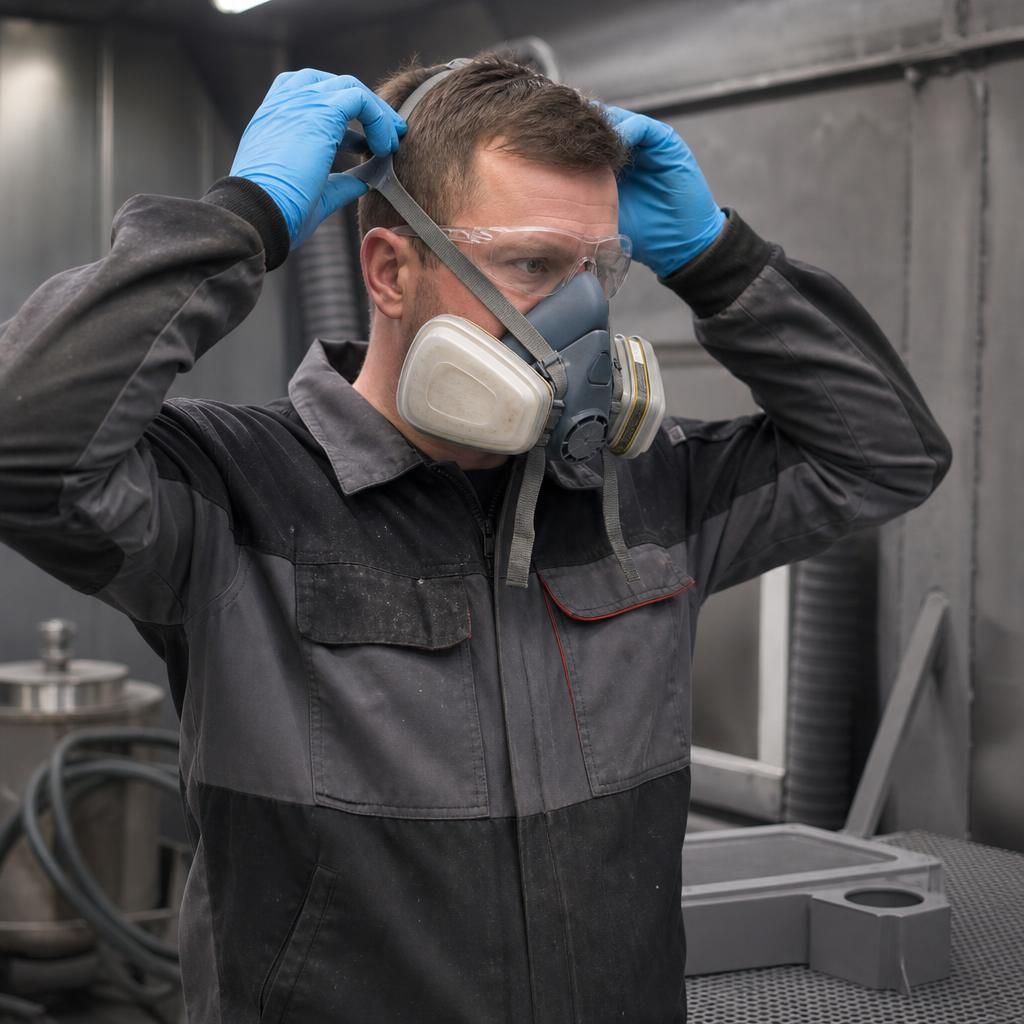
Respiratory protection must be selected for the actual dust and coating residues produced during blasting; a basic dust mask is not automatically adequate. Where tight-fitting respiratory protective equipment is required, it should be correctly fitted, maintained and face-fit tested for the individual wearer. Facial hair, spectacles or damaged seals can prevent a proper fit, while filters must be changed in line with the equipment guidance and exposure assessment. RPE should supplement containment and extraction, not replace them.