

What is the best abrasive media for sandblasting before powder coating?
The best abrasive media before powder coating depends on the metal, existing coating and required surface profile. Aluminium oxide is a versatile choice for many steel components, while garnet, glass bead or plastic media may be more suitable where a gentler clean or lower profile is required.
There is no single abrasive that is best for every powder-coating job. The correct choice is the media that removes contamination and failed coating while creating a suitable anchor profile without distorting, embedding residue in or excessively roughening the metal. For many carbon-steel components, a sharp, angular abrasive such as aluminium oxide, garnet or suitably graded crushed glass is appropriate; less aggressive media are generally preferable for aluminium, thin sections and previously prepared surfaces.
Aluminium oxide is often selected where firm removal of rust, mill scale, oxidation or an existing coating is required. Its angular particles cut into the surface and create a pronounced profile for the powder coating to key into. It is particularly useful on robust steel components, but an unsuitable grade or excessive blasting pressure can produce a profile that is too deep for the specified coating system.
Garnet provides a sharp cutting action for cleaning and profiling while offering a useful option where controlled surface preparation is needed. It can suit steelwork and some non-ferrous components, provided the operator adjusts the pressure, nozzle distance and abrasive grade to the substrate. Its suitability still depends on the condition of the part rather than the media name alone.
Crushed glass is an angular abrasive used to remove corrosion, old finishes and general surface contamination. It can produce an effective key for powder coating when correctly selected, although the operating parameters must be controlled to avoid an unnecessarily coarse finish. The prepared surface should be checked for remaining dust and loose particles before coating.
Glass bead is a different type of abrasive. Its rounded particles tend to clean and lightly peen the surface rather than cut it deeply. This makes it useful where a relatively gentle, uniform finish is required, but it may not be the first choice for heavy rust, thick mill scale or stubborn powder coating. Because powder coating needs a properly prepared key, a visually clean surface is not by itself proof that glass bead has provided enough profile.
Plastic media can be suitable for delicate components, thin metal or the removal of an existing finish where preserving the underlying substrate is important. It is less aggressive than many mineral abrasives and can reduce the risk of distortion or excessive metal removal. The resulting profile may be insufficient for some demanding coating specifications, so the surface should be assessed before the powder is applied.
Ordinary silica sand should not be treated as the default abrasive. Blasting products containing respirable crystalline silica present a serious inhalation hazard, and their use is restricted or controlled in many working environments. Professional preparation should use an appropriate alternative, suitable extraction and the required personal protective equipment rather than relying on general-purpose sand.
The metal being prepared is the first selection factor. Carbon steel can usually tolerate a more aggressive abrasive than aluminium or thin-gauge sheet. Aluminium is relatively soft and can be marked, eroded or distorted if the pressure and particle size are excessive. Stainless steel requires particular care to prevent contamination from ferrous particles or equipment. If the part will operate in a corrosive environment, avoiding embedded contaminants is as important as achieving the visible profile.
The existing surface condition also matters. Light oxidation, heavy corrosion, weld scale, grease and an old powder coating do not all require the same treatment. Oil and grease should be removed before abrasive blasting because blasting can spread contamination across the part or drive it into surface irregularities. Weld spatter, sharp edges and defects may need mechanical attention before blasting, while masking may be needed for threads, machined faces, bores and other areas that must retain precise dimensions.
Particle size and blasting settings work together. A coarse abrasive can remove material quickly but may leave a profile that is too prominent. A fine abrasive gives more controlled preparation but may take longer to remove a sound, thick coating. Pressure, nozzle size, stand-off distance and the angle of impact all affect the result. The objective is a consistently clean, keyed surface, not the roughest surface achievable.
Surface-profile requirements should be considered alongside the powder manufacturer’s coating specification and the metal’s condition. Where the required profile is uncertain, a small test area can be blasted and inspected using an appropriate profile comparator or measurement method. This helps confirm that the media and settings are removing contamination without damaging edges, reducing dimensions or creating excessive roughness.
After blasting, the component should be free from visible abrasive, dust, oil, moisture, loose corrosion and other contaminants. Clean, dry compressed air, vacuuming or another suitable method may be used, provided it does not recontaminate the surface. Any remaining abrasive trapped in recesses or joints can interfere with the coating process. Steel may also begin to develop flash rust if left exposed in damp conditions, so blasted parts should proceed through the agreed preparation and coating process without unnecessary delay.
In practical terms, aluminium oxide or another angular mineral abrasive is commonly suitable for robust steel requiring substantial preparation; garnet or crushed glass can provide controlled alternatives; and glass bead or plastic media may be better where a gentler treatment is needed. The final decision should be based on the substrate, contamination, existing coating, specified surface profile and the condition required after blasting. For complex, large or mixed-material batches, a powder-coating specialist can select and test the media before processing the full order.
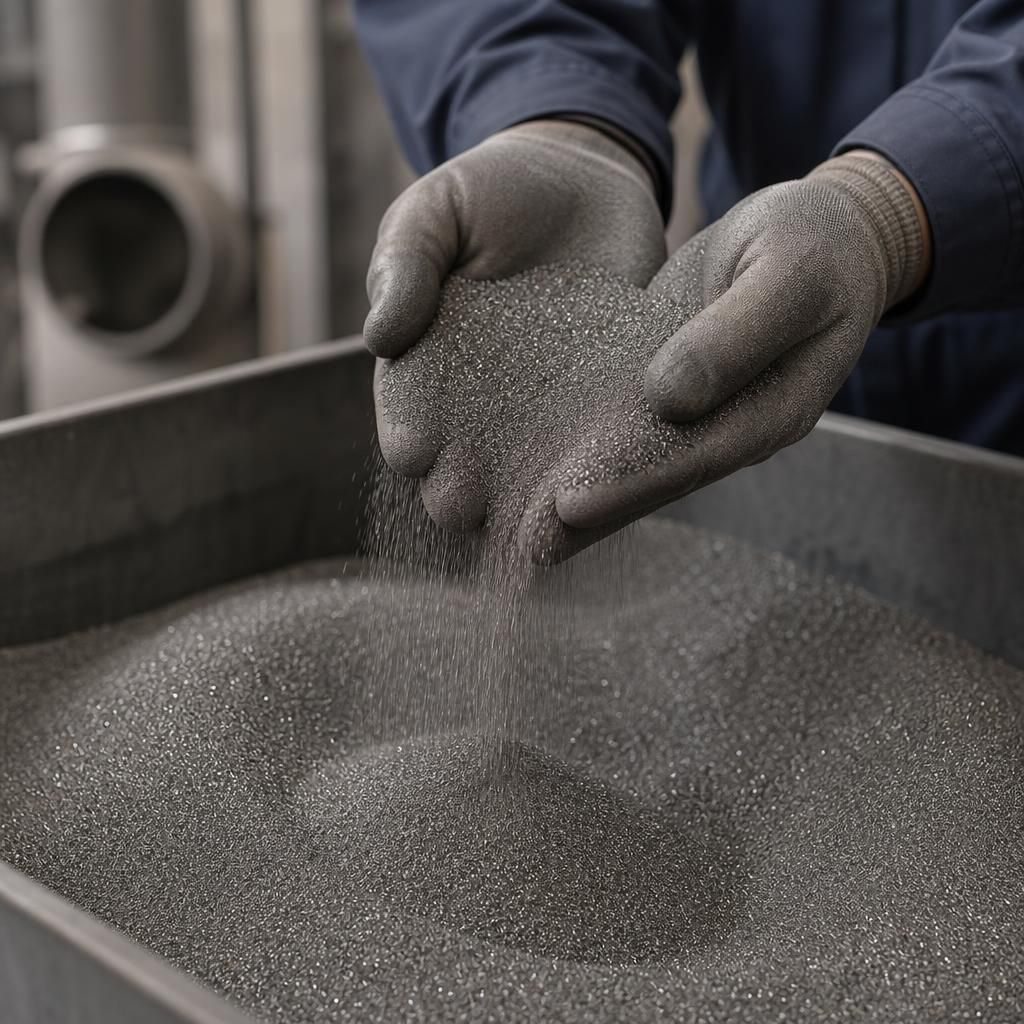
The condition of the abrasive is as important as its type. Media that has broken down into excessive fines may create dust without producing a consistent surface profile, while damp or contaminated media can transfer moisture, oil or salts to the component. These issues can affect preparation even when the nominal abrasive is suitable for the metal.
For repeat powder-coating work, abrasive should be stored dry and checked for contamination and excessive breakdown. Recycled media may need screening or replacement, depending on its condition and the preparation specification. Separate abrasive streams are particularly important when preparing stainless steel or other surfaces where particles from a different metal could cause contamination.
Discuss the best abrasive media for your powder-coating project
Share your component material, existing finish and required coating specification with our team to discuss the most suitable abrasive media for your powder-coating project. We can assess the preparation requirements before processing the full order.