

What are the most important safety considerations when performing sandblasting for powder coating preparation?
Safe sandblasting for powder coating preparation requires a documented risk assessment, trained operators, suitable respiratory and personal protective equipment, effective dust and abrasive containment, and well-maintained blasting equipment. Operators should control exposure to airborne particles and noise, inspect hoses and connections before use, secure the work area, and follow the abrasive manufacturer’s handling guidance.
Safe sandblasting for powder coating preparation depends on controlling the energy, materials and environment involved, not simply on wearing protective equipment. The main considerations are preventing contact with pressurised abrasive, avoiding harmful inhalation and contamination, controlling ignition and electrical risks, protecting other workers, and managing the workpiece and waste safely.
Choose the abrasive with health as well as surface performance in mind. Some materials can generate respirable dust, including dust containing respirable crystalline silica. The abrasive’s safety data sheet should be checked before use, and a lower-risk alternative should be selected where it can achieve the required surface profile. Used abrasive and removed coating may also contain hazardous substances, so the waste should not automatically be treated as harmless simply because the original component was made from metal.
Control the blast zone. The blasting area should be physically separated from people who are not involved in the operation. Access controls, warning signs and suitable barriers help prevent someone entering while the nozzle is live or while contaminated dust remains present. The operator should have a clear line of sight or reliable communication with anyone controlling the equipment, particularly where the blast cabinet, enclosure or work area restricts visibility.
Prevent unintended nozzle discharge. The dead-man control should function correctly and should never be bypassed. The nozzle must be directed only towards the workpiece or an approved blast surface, never towards a person, open doorway, fragile equipment or an unprotected floor. Before changing a nozzle, clearing a blockage or disconnecting a hose, the system should be isolated and depressurised. Compressed air should not be used to blow dust from clothing, skin or surfaces, as this can drive particles into the breathing zone and spread contamination.
Consider the workpiece itself. Components should be stable before blasting so that vibration, recoil or the force of the abrasive cannot make them fall, rotate or strike the operator. Hollow sections, enclosed cavities and fabricated parts may retain abrasive or contain trapped pressure, so they need to be assessed before handling or moving them. Sharp edges created or exposed during preparation should be dealt with using safe handling methods, and lifting equipment should be appropriate for the component’s weight and shape.
Manage ventilation and contamination correctly. Extraction systems should discharge or filter air in a way that does not transfer hazardous dust into occupied areas. Filters, collection units and ducting require checks for loading, damage and loss of performance; a blocked or poorly fitted filter can make an apparently enclosed process unsafe. Cleaning should use an approved industrial vacuum or another controlled method rather than dry sweeping or compressed air. Workers should avoid taking contaminated clothing, footwear or equipment into clean areas.
Account for fire, explosion and electrical hazards. Fine dust, combustible residues, coatings and some metal particles can create additional fire or explosion risks, particularly where dust can accumulate or where ignition sources are present. The process should therefore be assessed for static discharge, hot surfaces, unsuitable electrical equipment and nearby cutting, welding or smoking. Bonding and earthing arrangements should be suitable for the equipment, and any combustible-dust controls required for the materials and plant should be in place. Emergency routes and suitable fire-response arrangements must remain accessible.
Protect hearing and maintain communication. Blasting can produce high noise levels and can make alarms, instructions and warning signals difficult to hear. Noise controls should include suitable enclosure design, separation from other work and hearing protection selected for the actual exposure. Where verbal communication is unreliable, an agreed signalling or communication system should be established before work begins.
Plan for abnormal events. Operators should know what to do if a hose bursts, a coupling separates, extraction fails, visibility is lost, a person enters the exclusion zone or the operator experiences breathing difficulty. The safe response is normally to stop the blast, isolate the supply and raise the alarm rather than trying to correct the problem while the system remains pressurised. First-aid arrangements should reflect likely injuries such as eye contamination, cuts, impact injuries and dust exposure.
These controls should sit within the applicable UK requirements for hazardous substances, work equipment, pressure-related equipment and, where relevant, explosive atmospheres. Records of inspections, maintenance, incidents and waste handling help demonstrate that the process remains controlled. Before powder coating, the prepared component should also be checked for trapped abrasive, residue or damage so that cleaning and handling do not introduce a further safety risk.
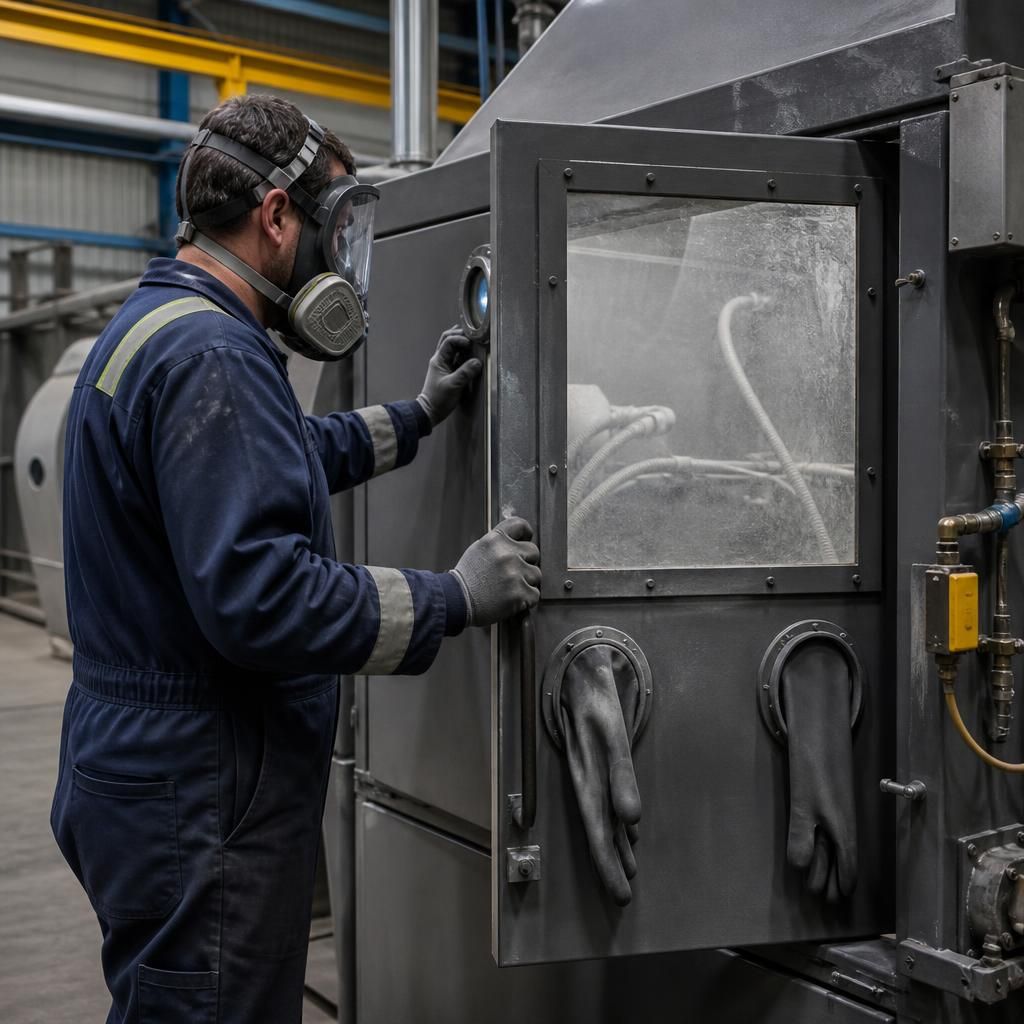
Engineering safeguards should prevent exposure before relying on personal protective equipment. Where blasting is carried out in a cabinet or enclosure, access doors should be guarded so the blast cannot operate while a door is open. Viewing panels, gloves, seals and extraction connections should be suitable for the pressure, abrasive and contaminants involved, with damage or deterioration treated as a reason to stop and investigate.
These safeguards should be verified as part of the operating procedure rather than assumed to be effective. Operators should know which controls must be active before blasting begins and what indication shows that the system is safe to enter. Bypassing an interlock, removing a guard or continuing with a damaged enclosure can expose people to abrasive discharge and contaminated dust, even when other protective equipment is being worn.