

What are the benefits of using stainless steel shot blasting media compared to other types of blasting media?
Stainless steel shot blasting media offers durable, reusable abrasive particles that produce consistent surface preparation with low risk of ferrous contamination. Compared with disposable or less durable media, it can support repeatable processing, cleaner work areas and reduced media replacement when correctly matched to the component and blasting equipment.
Stainless steel shot blasting media is a rounded metallic abrasive used to clean, prepare and condition metal surfaces before coating. Its main advantages over many other media are its compatibility with non-ferrous and stainless components, controlled impact, low risk of transferring ordinary iron contamination and reduced tendency to fracture into airborne dust. These characteristics make it useful where surface cleanliness, substrate protection and process control are important.
Better suited to stainless steel and non-ferrous components
Conventional carbon-steel shot can leave ferrous residues on stainless steel, aluminium and other non-ferrous substrates. Those residues may later contribute to staining or corrosion, particularly where the component is exposed to moisture or corrosive conditions. Stainless steel shot reduces this risk because its composition is more compatible with stainless and non-ferrous workpieces.
This does not mean that contamination is impossible. Media condition, blasting equipment, previous use and workshop handling still need to be controlled. However, stainless steel shot is generally a more appropriate choice than ordinary steel shot when the substrate or finished part must remain free from readily corroding iron particles.
A controlled surface effect
The rounded form of shot produces an impact or peening action rather than the pronounced cutting action associated with angular grit. Compared with abrasive grit, this can help remove surface residues while limiting unnecessarily deep or sharp surface irregularities. The result is particularly useful where the component needs preparation without excessive erosion of edges, profiles or machined features.
Compared with very soft media, stainless steel shot can provide a more substantial impact on robust metal parts. The correct balance depends on the substrate, existing surface condition, required profile and blasting settings. Shot that is too large or used at excessive pressure can distort thin sections or affect delicate details, so media selection must be treated as part of the process rather than as a universal specification.
Lower risk of media breakdown than friable abrasives
Mineral and glass-based abrasives can break down during use, creating fine dust and changing the working characteristics of the media. Stainless steel shot is less prone to this type of fragmentation. This can help maintain more stable blasting conditions and reduce the quantity of fine abrasive generated during processing.
Dust extraction and suitable personal protective equipment remain essential. Metallic shot can still create airborne particles from removed coatings and substrate contamination, and blasting systems must be operated with appropriate guarding, ventilation and filtration. The advantage is a reduced reliance on a media that rapidly turns into fine powder, not the removal of dust-control requirements.
More suitable for demanding industrial components
Stainless steel shot is well suited to parts that require thorough preparation but must retain their dimensional integrity. Typical examples include stainless fabrications, castings, machined components and selected aluminium parts. Its impact can remove scale, oxidation, old coatings and manufacturing residues, provided the media grade and operating parameters are appropriate for the component.
It can also be preferable where the prepared surface will be inspected closely or where contamination from a previous carbon-steel process would be unacceptable. Separating media by application is important: using dedicated stainless steel shot for suitable work prevents cross-contamination from other abrasive operations.
How it compares with common alternatives
- Compared with carbon-steel shot: stainless steel shot offers a lower risk of ordinary ferrous transfer and is therefore more appropriate for stainless and non-ferrous substrates.
- Compared with steel grit: its rounded particles create less aggressive impact and are less likely to cut a sharp, deep profile into the surface. Grit may be preferable where heavy cutting action is specifically required.
- Compared with glass bead: stainless steel shot can provide a stronger impact for robust components and is less dependent on a fragile bead structure. Glass bead may be selected when a lighter finishing or peening effect is needed.
- Compared with mineral or silica-based abrasives: stainless steel shot avoids the use of a friable mineral particle and can reduce the formation of fine media dust, although all blasting operations still require effective extraction and protection.
- Compared with plastic media: stainless steel shot is generally better suited to robust metal components requiring greater impact, while plastic media may be chosen for softer substrates or sensitive surfaces.
The best option is determined by the substrate, component geometry, existing contamination, required surface profile, coating specification and equipment capability. Stainless steel shot is not automatically the right choice for every job: its impact energy can be excessive for thin or easily marked parts, and its performance depends on correct shot size, pressure, delivery rate and separation of used media.
For powder coating preparation, its most important practical benefit is the combination of substrate compatibility and controllable impact. When specified correctly, it helps prepare metal without introducing the same contamination or media-fracture concerns associated with some alternatives. The blasting process should still be followed by suitable cleaning, inspection and prompt coating preparation so that the treated surface remains free from dust, oil and handling contamination.
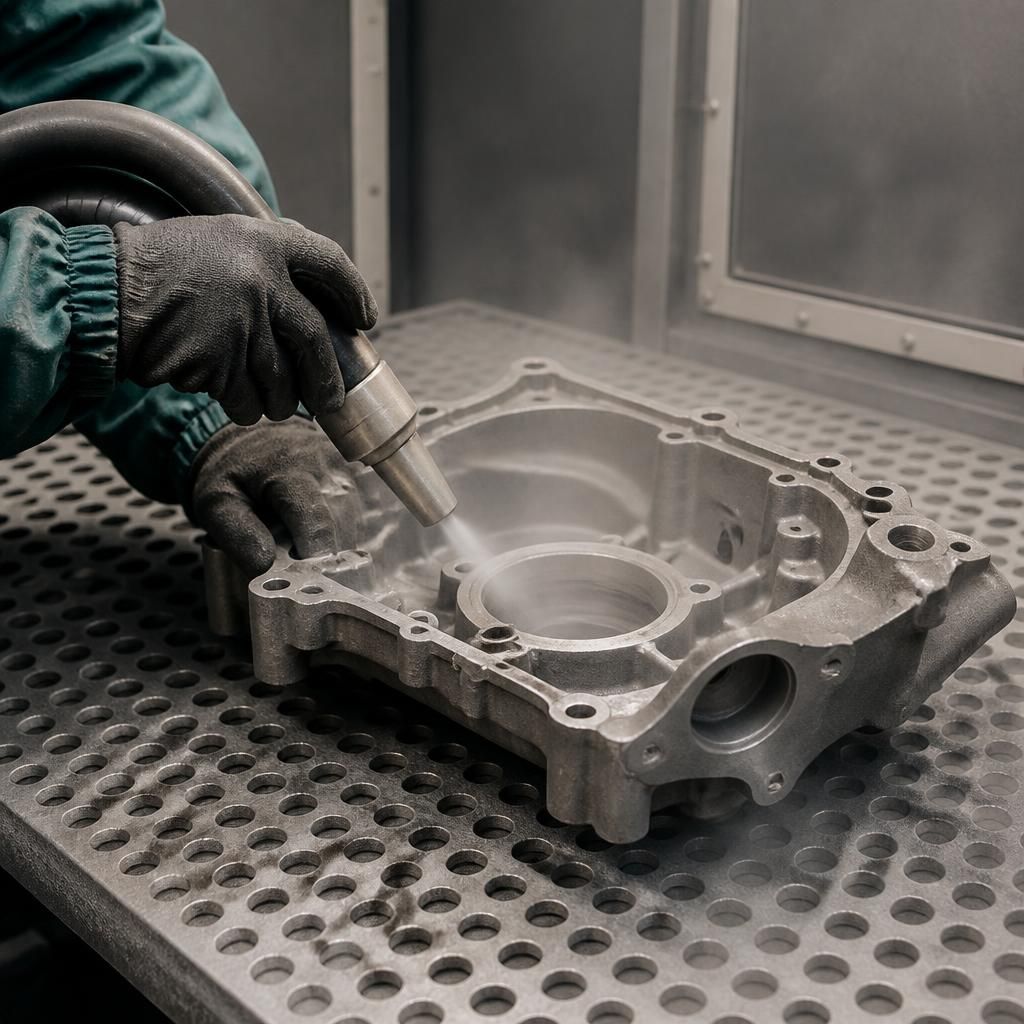
A further advantage of stainless steel shot is its stability where blasting conditions place greater demands on the abrasive. Unlike plastic media, it does not soften or deform under ordinary industrial blasting temperatures, so its impact characteristics remain more consistent when preparing robust metal components or processing repeated batches.
This makes it suitable for applications where a softer medium may lose effectiveness or require a change in operating conditions. The benefit depends on the component and equipment: thin sections, delicate profiles and heat-sensitive parts may still require a less aggressive medium, with shot size, air pressure and exposure time selected accordingly.
Discuss Your Stainless Steel Shot Blasting Requirements
Discuss your stainless steel shot blasting requirements with the powder coating team, providing details of the metal, component geometry and required finish. This helps establish whether stainless steel shot is suitable and identify the appropriate preparation approach.