

What types of sand are most effective for shot blasting in industrial applications?
There is no single most effective sand for every industrial shot-blasting job: garnet and aluminium oxide are commonly selected for strong, controlled cleaning and coating removal, while glass bead is better suited to gentler cleaning and surface finishing. Natural silica sand is generally avoided because airborne respirable crystalline silica presents a serious health hazard, so the abrasive should be chosen according to the metal, coating, required profile and blasting equipment.
For most industrial shot-blasting applications, garnet and aluminium oxide are the most effective abrasive choices when the work requires controlled removal of corrosion, mill scale, old coatings or contamination from metal. Crushed glass and glass bead are useful alternatives where a lower-impact clean or particular surface appearance is required, while steel shot and steel grit suit compatible equipment and applications requiring repeated abrasive recovery. The best selection depends on the substrate, existing coating, required surface profile and blasting system rather than on abrasive hardness alone.
Garnet is an angular mineral abrasive that provides effective cutting action with comparatively controlled surface roughening. It is suitable for removing rust, scale and weathered coatings from steel and other robust metal components. Garnet can be a practical choice where the surface needs to be prepared for a subsequent protective coating, because its angular particles can create a useful mechanical key without relying solely on prolonged blasting. The operator must still control pressure, stand-off distance and dwell time to avoid unnecessarily deep profiling or distortion on thinner sections.
Aluminium oxide is a hard, angular abrasive used for demanding cleaning and coating-removal work. It is particularly effective where firmly bonded paint, oxidation or surface contamination needs to be removed from durable metal parts. Its cutting action makes it suitable for producing a pronounced, consistent profile, but that same aggressiveness means it should be matched carefully to softer alloys, thin sheet and accurately machined areas. Excessive blasting can alter edges, dimensions or the finish of components that require close tolerances.
Crushed glass offers a sharp-edged abrasive option for general cleaning, paint removal and light surface preparation. It can be considered where a lower-cost expendable abrasive is appropriate, although its suitability depends on the blasting plant, extraction arrangements and the required finish. Glass bead is different: its rounded particles tend to clean and peen the surface rather than cut deeply into it. It is therefore better suited to light contamination, cosmetic finishing and applications where a less pronounced profile is wanted. It may be unsuitable for thick, strongly adherent coatings or heavy corrosion.
Steel shot and steel grit are reusable metallic media rather than sand. Steel shot has rounded particles and is commonly associated with cleaning, peening and producing a relatively uniform finish. Steel grit has angular particles and provides a more cutting action for removing scale, rust and coatings. Both require equipment designed for metallic media, effective separation of debris and suitable control of the abrasive cycle. They are generally considered where recovery and repeated use form part of the production process, rather than for every open or expendable-media application.
Other specialist media, including ceramic, plastic and vegetable-based abrasives, may be appropriate for sensitive components, non-ferrous alloys or selective coating removal. These are not interchangeable with mineral sand. Softer media can reduce the risk of damaging a substrate, but may be too slow or too gentle for heavy corrosion and thick industrial coatings. Media selection should therefore begin with the least aggressive option capable of achieving the required level of cleanliness and profile.
When comparing abrasives, assess the following factors:
- Substrate: robust carbon steel can tolerate a more aggressive abrasive than aluminium, zinc-coated parts or thin fabricated sections.
- Contamination: loose rust, mill scale, powdery residue and firmly bonded coating each require different levels of cutting action.
- Surface profile: the abrasive’s particle shape and size influence the peaks and valleys left for a primer or powder coating to grip.
- Component geometry: recesses, welds, edges and delicate machined areas may need lower pressure or a less aggressive medium.
- Required finish: cleaning, coating removal, keying, peening and cosmetic finishing are separate objectives and should not be treated as the same operation.
- Equipment: nozzle size, blast pressure, extraction, recovery systems and abrasive metering must all be compatible with the selected media.
- Contamination control: abrasive residue, dust, embedded particles or previous material from the blast system can interfere with subsequent coating adhesion.
Natural silica sand should not be treated as the default simply because the process is called sand blasting. Airborne respirable crystalline silica is a serious occupational hazard, so industrial operations must use a suitable non-silica abrasive and follow the required risk assessment, extraction and respiratory-protection controls. The media’s safety data and the workplace’s control measures should be reviewed before use.
After blasting, the component should be checked for remaining corrosion, coating residue, abrasive dust and an unsuitable or inconsistent profile. It should then be handled in a way that prevents recontamination before the next preparation or coating stage. For powder-coating work, a clean and appropriately keyed surface is generally more important than choosing the most aggressive abrasive available. A controlled garnet, aluminium oxide, glass or metallic-media process can therefore be more effective than simply increasing blast pressure or extending the blasting time.
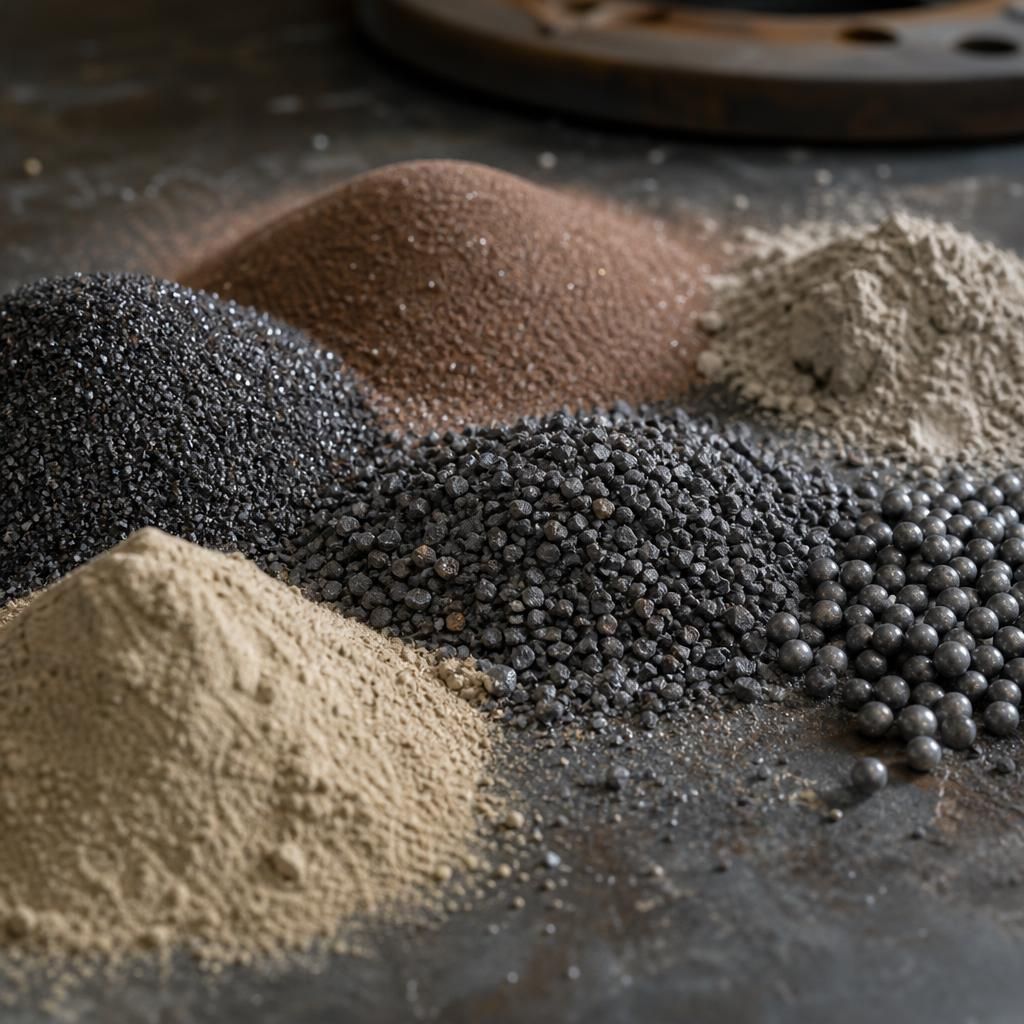
The condition of the abrasive can be as important as its original type. Moisture causes some expendable media to clump, restricts consistent flow and reduces cutting efficiency, while previously used abrasive gradually breaks down into finer particles. These changes can produce uneven cleaning and an inconsistent surface across a batch of components.
Industrial blasting processes should therefore include checks for dampness, excessive dust and worn or contaminated media. Keeping abrasive dry, removing debris through suitable separation equipment and replenishing it when its performance changes helps maintain a more consistent result without simply increasing blast pressure.
Discuss the Right Shot-Blasting Media for Your Application
Discuss your component, existing coating and required finish with our powder-coating specialists to identify a suitable shot-blasting approach. We can advise on preparation requirements for industrial metal parts and arrange collection or delivery across the Midlands and surrounding areas.