

What benefits does using different shot blasting sands and media bring to automotive component finishing?
Different shot blasting sands and media remove corrosion, scale, old coatings and contaminants from automotive components while creating a surface profile suited to the chosen finish. Selecting the correct abrasive for the metal and required result helps control surface texture, preserve component geometry and support consistent coating adhesion and durability.
Using different shot blasting sands and media gives automotive component finishing greater control over the final surface, production rate, component condition and coating appearance. No single abrasive is ideal for every part: the best choice depends on the substrate, component shape, existing surface condition, required visual finish and the powder coating or other finish that will follow.
Steel shot for robust, repeatable processing
Steel shot is a rounded, durable media suited to robust ferrous components such as brackets, chassis-related parts, suspension components and fabricated assemblies. Its repeated impact action can process substantial batches consistently, while the rounded form generally produces a less aggressive surface action than angular grit. This makes it useful where the objective is an even, controlled finish without introducing a heavily cut appearance.
Because steel shot can be recycled within suitable blast equipment, it may also provide practical process consistency over repeated production cycles. Its performance still depends on correct shot size, machine settings and media condition. Worn or contaminated media can alter the finish and make results less predictable, so blast equipment should be monitored and the abrasive maintained appropriately.
Angular grit for cutting action
Angular abrasives such as aluminium oxide or mineral grit have sharp edges that cut into hard, tenacious surface deposits and produce a more pronounced texture. This can be beneficial on heavily scaled steel components, castings or parts with uneven industrial residues where a rounded media would work less efficiently. Different grit sizes allow the operator to balance cutting power against control of the finished surface.
The benefit is not simply greater aggression. Angular media can reduce the need for repeated processing when the component requires a decisive treatment, which may help avoid unnecessary handling. However, using an abrasive that is too coarse or operating it at excessive pressure can create an unnecessarily rough finish, affect fine edges or leave abrasive particles in recesses. The media should therefore be matched to the component rather than selected solely for maximum cutting power.
Glass bead for a uniform cosmetic finish
Glass bead produces a fine, rounded impact that is often selected where the appearance of the bare metal matters before the final finish is applied. It can create a more uniform satin or softly textured appearance on suitable aluminium, stainless steel and other non-ferrous components. This is valuable for visible automotive parts, trim-related items and components where an aggressively cut finish would be undesirable.
Glass bead is generally better suited to light surface conditioning and cosmetic consistency than to severe industrial build-up. Its main benefit is control: it can improve visual uniformity while helping retain a relatively refined appearance. It should not be treated as interchangeable with an angular abrasive when substantial cutting action is required.
Media selection for aluminium and other softer metals
Aluminium automotive components need particular care because their surface can mark, distort or become embedded with unsuitable abrasive. Finer glass bead, plastic media or other less aggressive options may offer a safer route where the component is thin, detailed or visually important. These media can reduce the risk of an overly harsh appearance and help maintain the definition of machined features, ribs and recesses.
For aluminium castings, the correct choice also helps manage the contrast between broad faces and intricate areas. A process that is too aggressive may make the surface look uneven, while one that is too gentle may leave inconsistent areas for the subsequent finish. Trials on representative components are often useful when the alloy, shape or required appearance is unfamiliar.
Benefits on complex automotive components
Automotive parts commonly include holes, channels, returns, welds, corners and recessed sections. Media size affects how effectively the abrasive can enter these areas. Smaller media can reach narrower features, whereas larger shot may process exposed faces more efficiently. Selecting a suitable combination can make the finish more consistent across the whole component rather than concentrating the treatment on easily accessible surfaces.
Different media can also support different levels of edge treatment. A rounded shot may produce a more blended result, while angular grit can give sharper localised cutting. The correct balance helps avoid a visibly mismatched finish between flat panels, welded areas and cast sections.
Improved control of the finished appearance
Media choice influences whether the final component looks smooth, satin, visibly textured or strongly keyed. That control is important where multiple parts must match, where only selected areas will remain visible, or where a powder coating has a specified appearance. The abrasive, blast pressure, stand-off distance, exposure time and media condition all contribute to the result, so changing media without reviewing the process settings may produce inconsistent panels or batches.
For powder-coated automotive components, the selected blast finish should be considered alongside the coating specification. A coarse texture can affect the visual character of a smooth coating, while an unsuitable or contaminated abrasive can compromise the cleanliness of the prepared part. Media should be kept free from oil, moisture and residues that could transfer to the metal.
How to choose between media types
- Choose rounded steel shot for durable ferrous parts where repeatable, controlled processing is required.
- Choose angular grit where a stronger cutting action is needed on hard deposits, cast surfaces or robust steel components.
- Choose glass bead where a refined, uniform satin appearance is more important than aggressive cutting.
- Choose finer or softer media for delicate, thin-walled or non-ferrous components that could be marked by a harsher abrasive.
- Choose smaller media when access to holes, grooves and recessed features is a priority.
The most effective approach is to assess the actual component and desired finish together. Material hardness, thickness, geometry, previous processing, visibility of the part and the requirements of the next coating stage should all be considered. In automotive production, a carefully selected media specification can make the finishing process more repeatable and reduce variation between different component types, without treating every metal part as though it requires the same blast treatment.
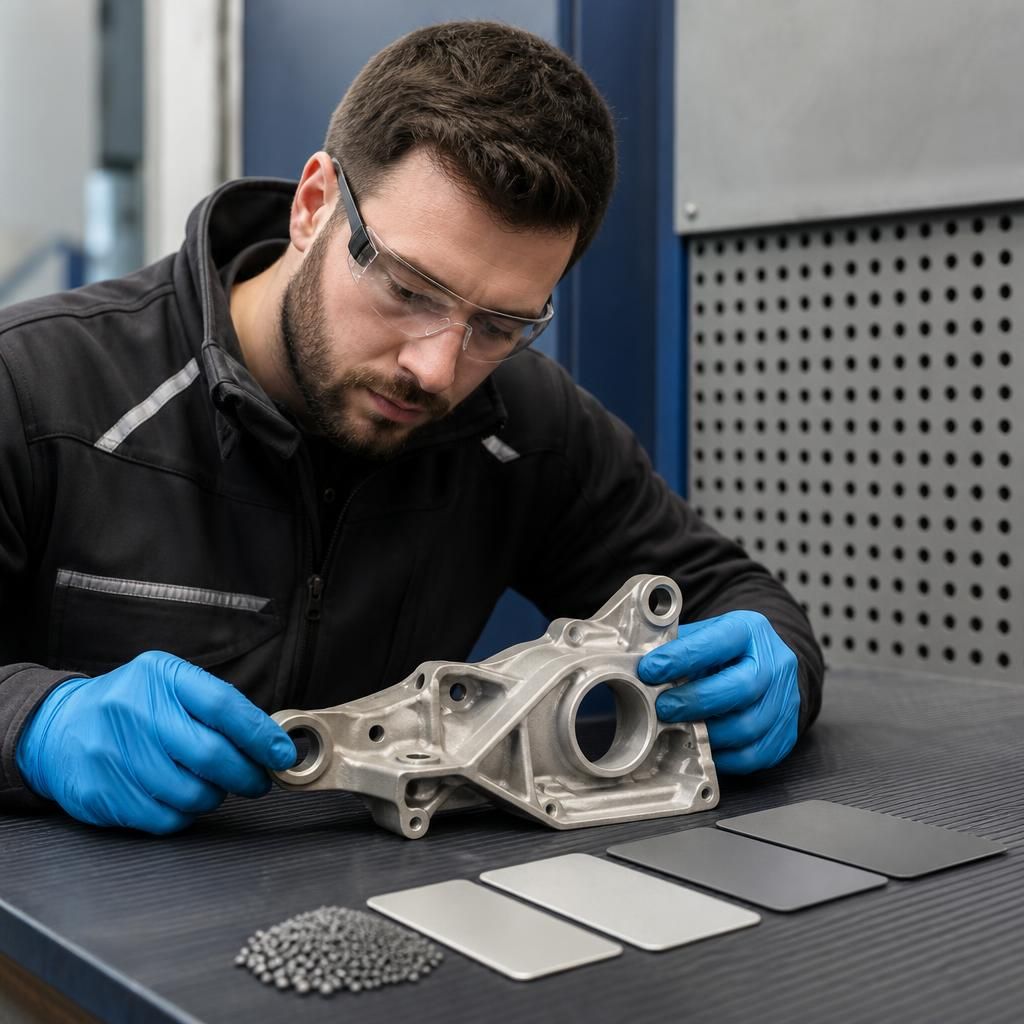
A key benefit of using different shot blasting media is the ability to qualify a finishing process for a particular automotive component before full production. Rather than judging the bare metal alone, a trial part or representative test panel can be blasted, coated and inspected to confirm that the selected media produces the required result without affecting functional surfaces.
This validation can assess coating coverage, visual consistency and the condition of areas such as machined faces, mounting points and sealing interfaces. Once the suitable media and operating conditions have been established, they can be recorded as part of the component’s finishing specification. That makes future batches easier to reproduce and helps identify whether a variation has come from the abrasive, the blast process or the subsequent coating stage.