

What are the potential risks and common misconceptions to avoid when choosing shot blasting sand and media for industrial powder coating projects?
Common risks include choosing an abrasive that creates an unsuitable surface profile, embeds contaminants or damages the metal, leading to poor powder-coating adhesion and an inconsistent finish. A key misconception is that the most aggressive or cheapest shot blasting sand and media is automatically best; selection should instead match the substrate, existing coating, required surface preparation and the coating system.
Choosing shot blasting sand or other abrasive media for an industrial powder coating project involves balancing surface preparation, substrate protection, operator safety, equipment compatibility and waste control. The wrong choice can create hazards or introduce process variation before the powder is applied, so media should be selected from the component material, the existing finish, the required cleanliness and the blasting equipment rather than from price or habit alone.
Do not treat “sand” as a precise media description. In everyday use, shot blasting sand may refer to a range of abrasive materials with very different particle shapes, hardnesses, dust levels and recycling characteristics. A rounded particle behaves differently from an angular one, while a hard abrasive may cut through a coating more readily but place greater demands on the substrate and machinery. Ask for the abrasive specification, including its composition, grading, shape and intended application, rather than relying on a general product name.
Silica exposure is a serious misconception to avoid. Ordinary sand is not automatically a suitable or safe blasting abrasive. Respirable crystalline silica can be generated as dust during blasting and during the handling or clean-up of spent material. The fact that an abrasive is natural, inexpensive or familiar does not remove the risk. Businesses should assess the material under applicable UK workplace health and safety requirements, obtain current safety information and use suitable containment, extraction, respiratory protection and cleaning procedures. Dry sweeping or compressed-air cleaning can redistribute fine dust and should not be treated as a harmless housekeeping method.
Particle size is not simply a measure of cleaning power. A coarse grade may remove a thick or firmly bonded coating efficiently, but it can be unsuitable for thin sheet, edges, threads, machined faces or detailed fabrications. A fine grade may provide better control on delicate areas, yet it can be slow against a heavy coating or become ineffective if the abrasive breaks down quickly. Using one grade for every component can therefore create unnecessary rework. The grade should be matched to the coating being removed, the geometry and thickness of the part, the required finish and the capabilities of the blast cabinet or room.
Excessive blasting is not a substitute for correct preparation. Longer exposure, higher pressure or repeated passes can heat the workpiece, round sharp details, alter dimensions and expose areas that need protection. Particular care is needed around holes, threads, welded transitions, folded edges, bearings, seals and precision-machined surfaces. Masking, plugs or alternative preparation methods may be necessary where abrasive access or impact could affect function. Operators should use controlled trials and inspect representative parts instead of assuming that more aggressive treatment will compensate for an unsuitable process.
Media condition can be as important as media type. Abrasive that has become damp, mixed with another grade or heavily loaded with removed paint and metal fines can behave unpredictably. Moisture may encourage clumping, interfere with consistent delivery and contribute to flash rust on susceptible steel after preparation. Recycled media also changes over time as particles fracture and become contaminated. A documented system for storage, screening, replenishment and disposal helps prevent an apparently correct specification from producing inconsistent results.
Equipment compatibility is often overlooked. The abrasive must suit the blast nozzle, pressure system, wheel, hoses, recovery equipment and dust extraction arrangement. An abrasive that is too hard, too coarse or poorly graded can accelerate wear, block feed systems or overload recovery and filtration equipment. Conversely, a soft or friable material may generate excessive dust and lose its cutting action rapidly. Check the equipment manufacturer’s operating limits and the abrasive supplier’s technical information before introducing a new media type.
Visual cleanliness does not prove that a component is ready for powder coating. A part can appear uniformly blasted while still having residues from old coatings, oil, handling, moisture or abrasive breakdown. Hidden recesses and weld areas deserve particular attention. Inspection should consider the whole preparation process, including degreasing, drying, masking removal and handling after blasting. Prepared metal should be protected from unnecessary contact and assessed for flash rust or other changes before powder is applied.
Several common assumptions are therefore unreliable:
- “The cheapest abrasive gives the lowest process cost.” Purchase price does not account for media consumption, dust control, equipment wear, waste handling, labour, rework or rejected components.
- “A harder abrasive is always better.” Hardness must be considered alongside particle shape, size, substrate sensitivity and the finish that the coating system requires.
- “Abrasive can be reused indefinitely.” Reuse depends on cleanliness, breakdown, recovery design and the quality needed from the prepared surface. Some media require regular replacement or controlled blending.
- “One specification suits every metal.” Steel, aluminium, galvanised surfaces and other alloys can respond differently to impact, heat and abrasive action. The process should be validated on the actual substrate and component design.
- “A good-looking blast proves the process is under control.” Consistency also depends on pressure, nozzle distance, angle, dwell time, media flow, part presentation and the interval between preparation and coating.
A practical selection process starts with a written component brief. Record the substrate, dimensions, vulnerable features, current coating or corrosion, required level of preparation, powder coating system and any areas that must remain unblasted. Then identify suitable media candidates, review their safety data and equipment requirements, and carry out a controlled test on representative parts. Inspect both the prepared surface and the finished powder coating, while recording media condition and operating settings. This approach separates a genuine media problem from issues caused by degreasing, handling, curing or application.
For industrial work, traceability is also valuable. Keep the abrasive specification, batch or delivery information where available, inspection findings, equipment settings and replenishment records with the job documentation. If adhesion, appearance or corrosion protection later becomes inconsistent, these records make it easier to identify whether the cause was media degradation, process drift, substrate variation or a coating-stage issue. Selecting shot blasting media in this controlled way reduces health, quality, equipment and environmental risks without assuming that the most forceful or familiar option is the right one.
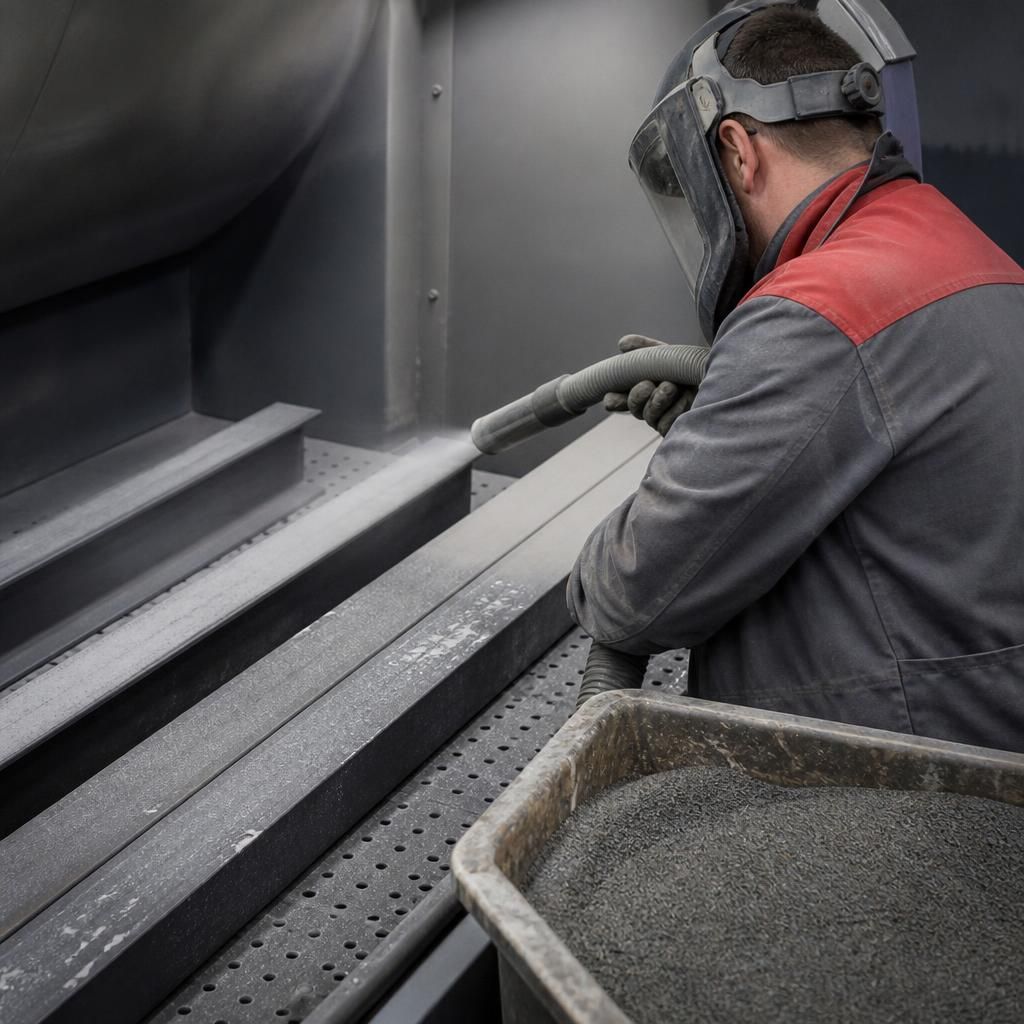
A further risk is cross-contamination between substrates. Media previously used on carbon steel can carry ferrous particles into aluminium, stainless steel or galvanised components. Those particles may become embedded in the surface or later contribute to staining and corrosion, even when the blasted part appears clean.
For projects involving different metals, keep media streams separate where practical and confirm whether the abrasive is suitable for the substrate. Clean recovery equipment between materials, prevent mixed loads and include contamination checks in the preparation specification. This avoids treating an apparently uniform blast finish as proof that the surface is chemically suitable for powder coating.