

What are the environmental considerations when using shot blasting sand and media?
The main environmental considerations when using shot blasting sand and media are dust emissions, spent abrasive waste, material disposal and the potential for media recycling. Responsible practice involves selecting an appropriate, less hazardous medium, containing and filtering dust, separating contaminated waste, and reusing or recycling abrasive where its condition and site controls allow.
Environmental considerations for shot blasting sand and media extend beyond the abrasive itself. A responsible assessment covers the complete process: how the media is manufactured or extracted, the energy and water used during blasting, the substances removed from the component, the condition of the resulting material, and the transport and treatment required at the end of its service life.
Choose media with its full lifecycle in mind. Natural mineral abrasives may involve extraction and processing, while manufactured or metallic media require raw materials and energy during production. A media that lasts longer can reduce the frequency of replacement, but this advantage should be considered alongside its composition, production method and eventual disposal requirements. The most suitable option is not necessarily the one with the lowest purchase price; it is the one that achieves the required surface preparation with an appropriate service life and manageable environmental impact.
Silica-containing sand requires particular care. Blasting materials that generate respirable crystalline silica can create serious airborne exposure risks and may also require stringent controls under workplace health and environmental procedures. Substituting a suitable non-silica abrasive is generally preferable where the process and substrate allow it. This decision should be based on the coating or corrosion being removed, the required surface profile, the equipment and the manufacturer’s technical information rather than on the word “sand” alone.
Consider what the abrasive is removing. Media used on clean steel have a different environmental profile from media used to remove lead-containing paint, chromates, old powder coatings, oil, grease or other industrial residues. The coating and contamination can alter the classification of the resulting material, even where the abrasive itself is relatively inert. Before work begins, identify the existing finish and any likely hazardous substances. Where the history of a component is uncertain, testing or documented information from the client may be needed before selecting a treatment route.
- Review previous coatings, primers and corrosion treatments.
- Prevent incompatible or contaminated materials from being combined unnecessarily.
- Keep records describing the component, coating removed and media used.
- Use the resulting waste classification to determine the appropriate authorised treatment route.
Water use is another consideration. Wet blasting or water-assisted processes can reduce airborne dust in some applications, but they create a liquid stream that may contain abrasive particles, oils, coating residues or dissolved contaminants. That water must not be discharged to drains or ground without suitable controls and authorisation. Reusing process water, where technically appropriate, can reduce consumption, but filtration and monitoring are needed to prevent accumulated contaminants being carried back onto components or into the surrounding environment.
Dry blasting usually has a different resource profile because it avoids process water, but it may require extraction, filtration and compressed air. Compressed-air systems can be energy-intensive, particularly where leaks, poor maintenance or an unsuitable nozzle reduce efficiency. Environmental performance can therefore be improved through correctly sized equipment, maintained air lines, effective blast pressure settings and avoiding over-treatment. The objective is to remove the unwanted layer and achieve the specified surface profile without unnecessarily consuming media or energy.
Noise and vibration should also form part of the environmental assessment, particularly where blasting takes place near other businesses or sensitive premises. Enclosures, acoustic treatment, equipment maintenance and sensible operating controls can limit nuisance. These measures should be designed with airflow and extraction requirements in mind so that reducing noise does not compromise containment or filtration performance.
Transport can influence the overall impact of a project. Selecting a media that is suitable for the job but available through a practical supply chain may reduce unnecessary movement of heavy material. The same principle applies to removed components and resulting residues: planned collection, consolidated loads and accurate documentation can avoid failed deliveries and unnecessary journeys. This is particularly relevant to regional industrial work where components and consumables may travel between the customer, preparation facility and finishing operation.
Environmental compliance depends on more than the choice of abrasive. Operators should check the conditions attached to their premises, waste arrangements and equipment, and should use appropriately authorised contractors where specialist treatment is required. The relevant requirements may include workplace controls for hazardous substances, environmental permitting, waste transfer documentation and rules governing hazardous waste. These obligations vary according to the material removed, the process used and the location, so a site-specific assessment is more reliable than treating every blasting residue in the same way.
For a powder-coating project, the most useful information to provide before blasting includes the base metal, existing coating, likely contaminants, required surface finish and whether the component has previously been exposed to chemicals or industrial residues. This allows the preparation method to be assessed before work starts and reduces the risk of choosing a media that is unsuitable for the substrate or creates an avoidable treatment problem. The environmental decision should therefore be made together with the technical specification, not after blasting has already taken place.
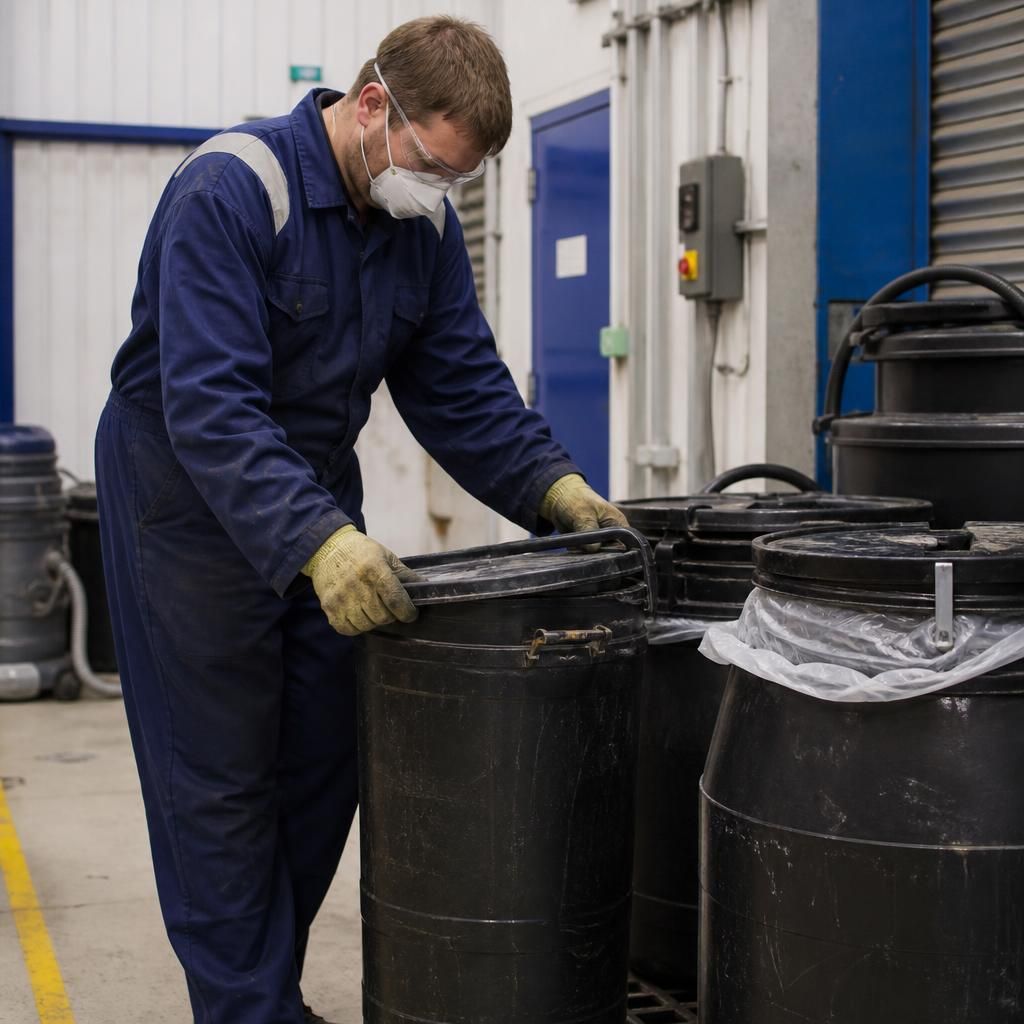
Preventing secondary release is an important environmental consideration after blasting has finished. Spent abrasive and removed coating residue should be collected in sealed, clearly labelled containers and stored under cover on an impermeable surface, away from drains, soil and rainwater. This reduces the risk of contaminated particles being dispersed during handling or being carried into surface water.
- Inspect containers, extraction units and transfer points for leaks or damaged seals.
- Use industrial vacuum equipment suited to the residue rather than dry sweeping or blowing material into the surrounding area.
- Keep used media separate from unused abrasive and from other waste streams until its classification is confirmed.
- Record any spill, equipment failure or unusual residue so the cause can be corrected and the material dealt with through the appropriate route.