

What factors should be considered when choosing shot blasting media for powder coating metal components?
Choosing shot blasting media for powder coating metal components depends on the substrate, existing contamination, required surface profile and the component’s geometry. Media type, size and hardness should provide effective cleaning and suitable roughness without deforming thin sections, leaving a consistent surface for powder adhesion and the required finish durability.
Choosing shot blasting media for powder coating means matching the abrasive and blasting process to the required preparation standard, component tolerances, coating specification and production method. The most aggressive option is not automatically the best: media that removes material too quickly can create an unsuitable surface, excessive dust or avoidable rework, while media that is too mild may leave residues or an uneven preparation.
Consider the required surface condition. The powder coating specification should determine how the blasted surface is assessed before coating. Where appearance is important, the chosen media should produce an even visual texture rather than random deep marks, sharp ridges or areas of differing reflectivity. A more uniform preparation is particularly important on visible panels and components that will be assembled together, as variations can remain noticeable after powder application.
Match the abrasive to the blasting equipment. Wheel-blast systems, pressure blasting and suction systems place different demands on media flow, recovery and impact energy. The abrasive must feed consistently through the equipment, remain within the machine’s operating range and be suitable for the available separation or recovery system. A medium that performs well in one installation may be inefficient in another if it causes blockages, excessive wear or unstable delivery through the nozzle.
Assess media breakdown and reusability. Some abrasives retain their shape over repeated cycles, whereas others fracture into finer particles. Breakdown can alter the blasting result during a batch and increase airborne dust. Reusable media may reduce waste, but only if it is regularly cleaned and graded so that spent particles, removed coatings and other debris do not circulate back onto the work. Single-use media can be appropriate where cross-contamination must be tightly controlled, although disposal and handling requirements then become part of the decision.
Check the risk of embedded particles. Certain materials can become lodged in softer metals or remain in recesses, holes and joints. Any residue may affect subsequent cleaning, conversion treatment or powder application. The media should therefore be compatible with the metal and with any later pre-treatment stages. Components with enclosed sections may also require a practical method for removing loose abrasive before they move to the coating process.
Take account of masking and protected areas. Blasting may not be suitable for every surface on a component. Machined fits, electrical contact points, threaded features, identification marks and sealing faces can require temporary protection or a separate preparation method. The media choice should work with that masking plan and should not make it difficult to distinguish prepared areas from surfaces that must remain untouched.
Consider dust, waste and workplace controls. Abrasive selection affects visibility in the blast area, extraction demand, housekeeping and the classification of waste after use. The operator should consider the material being removed as well as the abrasive itself, especially where old coatings, oil residues or corrosion products are present. Suitable extraction, personal protective equipment and waste procedures remain necessary regardless of which media is selected.
Review the effect on downstream coating and assembly. The prepared surface should be compatible with the specified pre-treatment, powder type and final appearance. A media that leaves excessive roughness may influence powder coverage on edges and recesses, while a surface that is too smooth or inconsistent may require additional processing. The decision should also reflect whether the component will later be bent, machined, joined or assembled, since preparation must not create avoidable problems at those stages.
Use trials and inspection criteria. For unfamiliar parts or a new powder system, a controlled trial is preferable to selecting media solely from a general abrasive description. The trial should examine the cleaned surface, profile consistency, dust generation, media recovery and the appearance of the finished coating. Inspection may include visual comparison, surface-profile checks and tests for residual abrasive or dust, depending on the component and its specification. Results should be recorded so the same preparation standard can be reproduced across later batches.
In practice, the final choice is a balance between preparation quality, process control, equipment compatibility, waste management and the requirements of the finished component. A specialist powder coater can review the part drawing, coating specification and production volume before confirming the most suitable media and blasting method for the job.
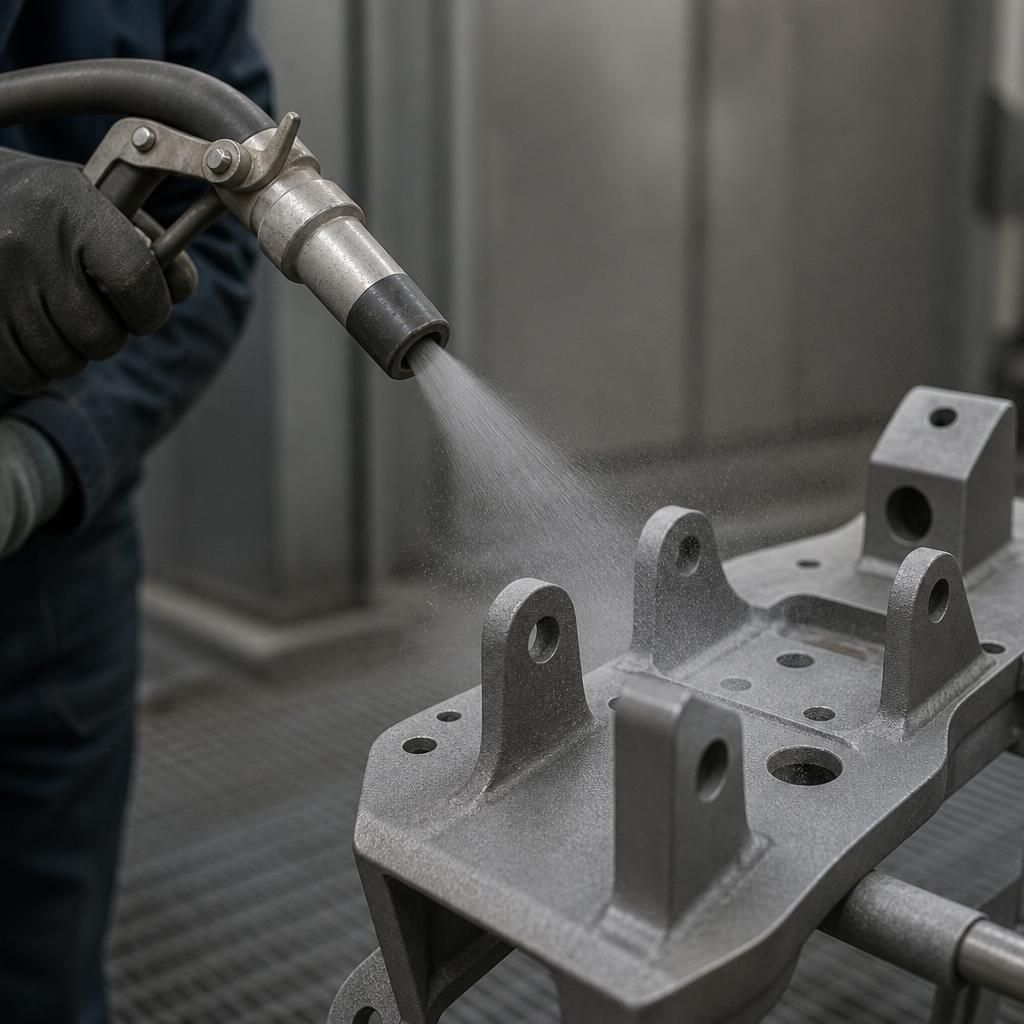
The shape and composition of the blasting media influence how the metal surface is cleaned. Angular grit cuts into rust, mill scale and old coatings, making it suitable where firmly bonded contamination must be removed. Spherical shot delivers a peening action and may be preferable for robust components where a less cutting preparation is appropriate, but it can be unsuitable for thin or easily distorted sections. Non-metallic media can be considered where ferrous contamination must be avoided, although its wear rate and resulting surface condition need to be checked. The selected media should therefore reflect both the condition of the component and the cleanliness requirements of the powder coating system.
Discuss your shot blasting media requirements
Discuss your shot blasting media requirements with our team and provide the component material, dimensions, contamination and coating specification for assessment. This helps establish a preparation approach suited to the part and its intended powder-coated finish.