

How does the choice of blasting media affect the final powder coating result?
The blasting media determines the surface profile, cleanliness and texture created on the metal, which directly affects powder adhesion, coverage and the appearance of the finished coating. Choosing media suited to the substrate and required finish helps avoid excessive roughness, embedded contamination or insufficient keying.
The choice of blasting media affects the powder coating result by controlling how the metal surface is cleaned, roughened and shaped before coating. The correct media creates a consistent mechanical key without damaging the substrate; the wrong choice can leave an uneven surface, introduce contamination or alter the appearance of the finished component.
Media shape has a direct effect on the surface created. Angular grit cuts into the metal and produces a more pronounced texture, which can be useful where firmly bonded scale, corrosion or previous coatings must be removed. Rounded shot tends to peen the surface rather than cut it, producing a different profile and potentially closing or deforming small surface features. Glass bead produces a comparatively uniform, lower-aggression finish and may be appropriate where a less heavily textured appearance is required, although the process still needs to provide a suitable key for the powder system.
Particle size influences both preparation intensity and uniformity. Coarser media can remove tenacious contamination more quickly but may create an excessively deep or irregular profile, particularly on thin sheet, edges and machined areas. Finer media provides more controlled preparation but may be unsuitable for heavy scale or firmly bonded residues. A mixture containing worn or inconsistent particles can produce variable results across one batch, so media condition and grading need to be controlled.
The substrate must be considered before selecting the abrasive. Carbon steel, stainless steel, aluminium and zinc-coated components do not respond in the same way. A media that is suitable for robust steel may mark, distort or excessively roughen aluminium and thin sections. Media containing ferrous material can also create an unacceptable contamination risk on non-ferrous or stainless components if equipment is not suitably segregated. Galvanised or zinc-coated surfaces require particular care because aggressive blasting may remove protective material rather than simply prepare it.
Component geometry changes the practical result. Flat faces are usually easier to treat consistently than folded sections, recesses, drilled holes and welded joints. Abrasive can strike exposed edges more aggressively, while sheltered areas may receive less effective preparation. Excessive blasting around threads, precision fits and sealing faces can affect tolerances or assembly. For this reason, the preparation specification should identify areas that need protection or a different treatment rather than applying one setting indiscriminately to every surface.
Media selection also affects the risk of residues becoming part of the coating system. Broken-down abrasive, dust, oil, old paint, salts and other contaminants must be removed before powder application. If blasting media is reused, it needs suitable separation and maintenance so that accumulated debris is not redistributed over later components. Cross-contamination is especially important when the same preparation equipment handles different metals or coating residues.
Blasting parameters work with the media rather than replacing it. Air pressure, nozzle distance, angle, traverse speed and exposure time all alter the amount of energy reaching the component. Increasing pressure or dwelling on one area can make an otherwise suitable abrasive too aggressive. Conversely, insufficient energy may leave tightly adhered contamination or create an inconsistent surface. The final result therefore depends on the combination of abrasive type, particle size, equipment condition and operator control.
These differences can be seen after powder coating in several ways:
- an inconsistent preparation pattern can appear as variation in gloss or texture across the component;
- an overly rough profile can remain visible through a thin powder film or require additional coating build;
- damage to edges or delicate features can affect fit, function and visual definition;
- residual dust or foreign material can contribute to pinholes, inclusions or local coating defects;
- insufficient removal of corrosion or old coating can leave weak areas beneath the new finish.
The intended end use should guide the balance between cleaning power and surface control. Structural or heavily contaminated steelwork may require a more aggressive angular abrasive, whereas thin fabricated parts or visually prominent components may need a gentler, more closely controlled treatment. Components with tight tolerances may require selective masking, reduced exposure or an alternative preparation method for critical areas.
A practical selection process begins with identifying the base metal, the condition of the surface, the required appearance and the dimensional sensitivity of the part. The preparation method should then be checked on a representative area or sample component. This allows the operator to assess cleanliness, texture, edge condition, dust removal and the appearance of the powder finish before processing a full batch. Where the specification is demanding, the prepared surface can also be assessed against the required profile and cleanliness standard rather than judged by appearance alone.
For industrial work, the most reliable result comes from treating media choice as part of the complete coating specification. The abrasive, blasting settings, cleaning stage, powder system, film build and curing process must be compatible. A specialist powder coating provider can review the metal type, component design and required finish before deciding whether shot, grit, bead or another media is appropriate, including collection and delivery arrangements for businesses across the Midlands and surrounding areas.
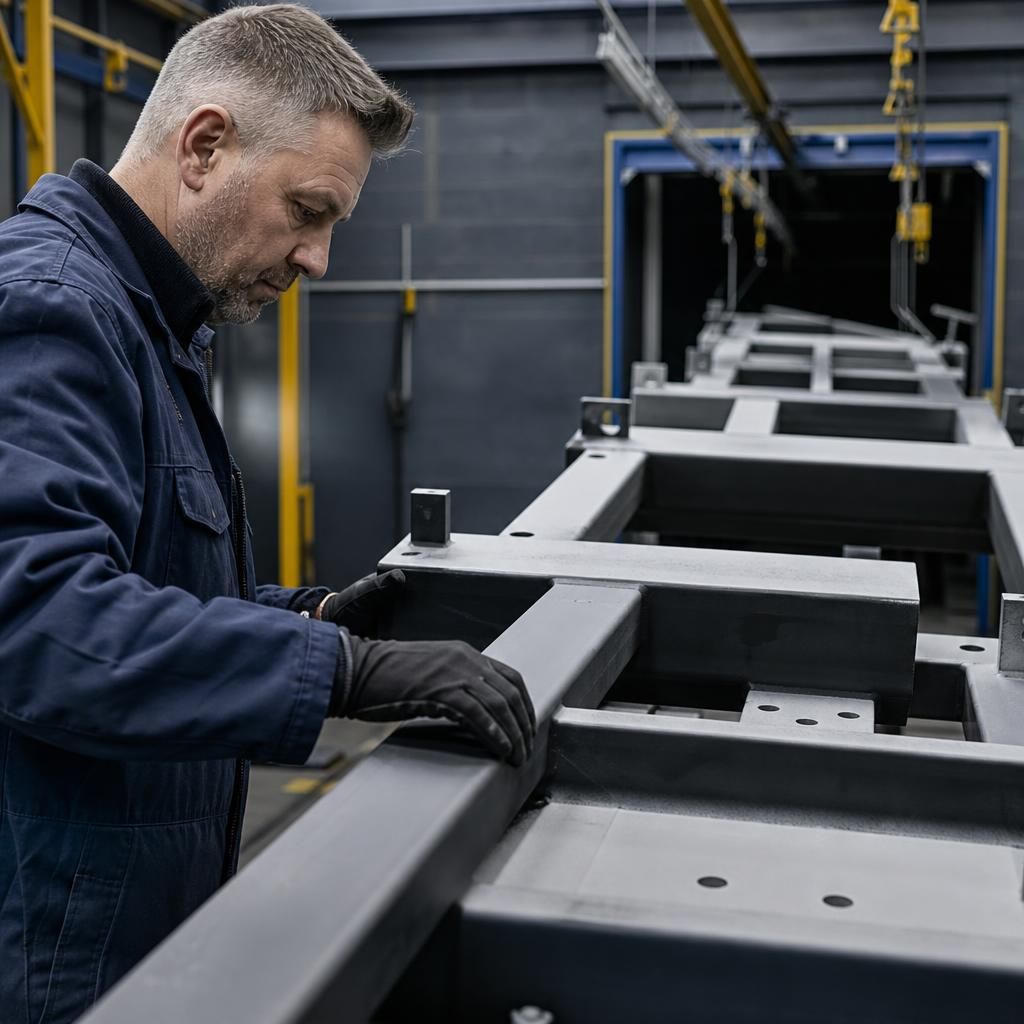
The blasting media can produce a suitable profile, but the prepared surface must also be protected before powder is applied. Once contamination, moisture or handling marks reach the freshly blasted metal, the final coating may show local adhesion problems, discolouration or visible defects.
After blasting, components should be checked for residual abrasive, dust, corrosion products and embedded debris. They should be kept dry and handled in a way that avoids transferring oil or salts from hands, lifting equipment or nearby processes. Any area showing flash rust or renewed contamination may require further preparation before coating.
This is particularly important for complex fabrications, where recesses, joints and internal corners can retain abrasive dust. Effective extraction, inspection and controlled movement between blasting and powder application help ensure that the surface created by the selected media is still clean when the coating is applied.