

What factors should I consider when selecting shot blasting media for powder coating?
When selecting shot blasting media for powder coating, consider the metal substrate, the contamination to be removed, the surface profile required for adhesion, and the media’s size, shape and hardness. Also assess whether the media is compatible with the component and blasting equipment, can be recovered efficiently, and supports the required finish without causing distortion or excessive roughness.
The best shot blasting media is the one that provides the required pre-treatment without compromising the component, the powder coating specification or the production process. Selection should therefore be based on the complete coating system: the part’s design and tolerances, the required service environment, the blasting equipment, the planned production volume and the way the prepared surface will be inspected before coating.
Start with the coating specification. A component exposed to moisture, road salt, chemicals, abrasion or outdoor weathering may need a more carefully controlled surface preparation than an indoor item with limited wear. The required level of adhesion and corrosion protection should be agreed before selecting media. If a particular coating system, primer or pre-treatment is specified, check its preparation requirements rather than choosing media solely on the basis of appearance.
Consider the component’s geometry and dimensional tolerances. Recesses, holes, folded sections, welds and narrow edges can receive the blast stream differently from broad flat faces. Media must reach the areas that need preparation without becoming trapped in cavities or leaving unprepared shadows. Pay particular attention to mating faces, threaded holes, bearing seats and precision edges, where even a small change in condition can affect assembly. Masking, plugs or a modified blasting angle may be preferable to using a more aggressive process across the whole component.
Match the media to the equipment and operating method. Pressure blasting, suction blasting, automated wheel blasting and manual cabinets place different demands on media flow and impact behaviour. Check that the selected material feeds consistently, passes through the equipment correctly and does not create excessive wear in nozzles, hoses, wheels, seals or recovery systems. The machine’s air supply, blast pressure, nozzle arrangement and extraction capacity also affect the result, so media selection should be tested under the actual operating conditions rather than assessed in isolation.
Assess process repeatability. A suitable medium should support a consistent result across the whole batch, not just produce an acceptable finish on one test piece. Establish controls for media condition, machine settings, blasting distance, exposure time and part presentation. Operators should be able to identify when the media has become worn, overloaded or otherwise unsuitable. Consistent preparation is particularly important where parts are supplied in batches and must receive the same powder coating system.
Take account of production volume and handling. Manual work may allow close control of complex or low-volume parts, while automated equipment may require media that circulates predictably through a larger process. Consider loading patterns, access to all faces, masking and the time needed to turn or reposition components. The most technically suitable media may not be practical if it creates bottlenecks or requires excessive manual handling.
Check cleanliness before coating. After blasting, the component must be free from loose residues and suitable for the next preparation stage. Media breakdown, dust generation and carry-over can affect extraction, cleaning and powder application. A trial should examine the blasted surface under appropriate lighting and, where required by the coating specification, use a recognised cleanliness or surface-profile assessment method. Do not rely on visual appearance alone: a bright, uniform surface does not by itself confirm that the preparation is suitable for the intended coating.
Consider media life and total operating cost. Purchase price is only one part of the calculation. Include consumption, replacement frequency, disposal, storage, equipment wear, extraction requirements, cleaning and labour. Media that breaks down quickly may increase dust and maintenance, while media that remains in circulation can require effective separation of debris and regular checks. The relevant comparison is the cost of achieving a repeatable prepared surface, not the cost per bag or initial load.
Review environmental and workplace requirements. Dust control, noise, ventilation, spent-media handling and operator protection must be considered before approval. Consult the supplier’s safety data and risk information, and ensure the chosen medium is suitable for the equipment’s extraction and filtration arrangements. Waste should be managed according to its composition, particularly where removed coatings, oils or other residues have entered the blast stream. A lower-waste option may still be unsuitable if it cannot be controlled safely in the available installation.
Use a controlled trial before committing to a full production run. Test representative components, including welds, edges, recesses and any critical contact surfaces. Record the media specification, machine settings, exposure conditions and inspection results. Then apply the intended powder coating system and assess adhesion and appearance after curing. This trial helps reveal problems such as poor access, excessive cleaning, coating interference or dimensional change that may not be apparent immediately after blasting.
For a repeatable specification, document the approved media and the conditions under which it was tested. Any change in media, equipment, component design or coating system should trigger a review rather than being treated as an equivalent substitution. This approach links media selection to measurable coating requirements and reduces the risk of choosing a material that appears suitable but performs inconsistently in production.
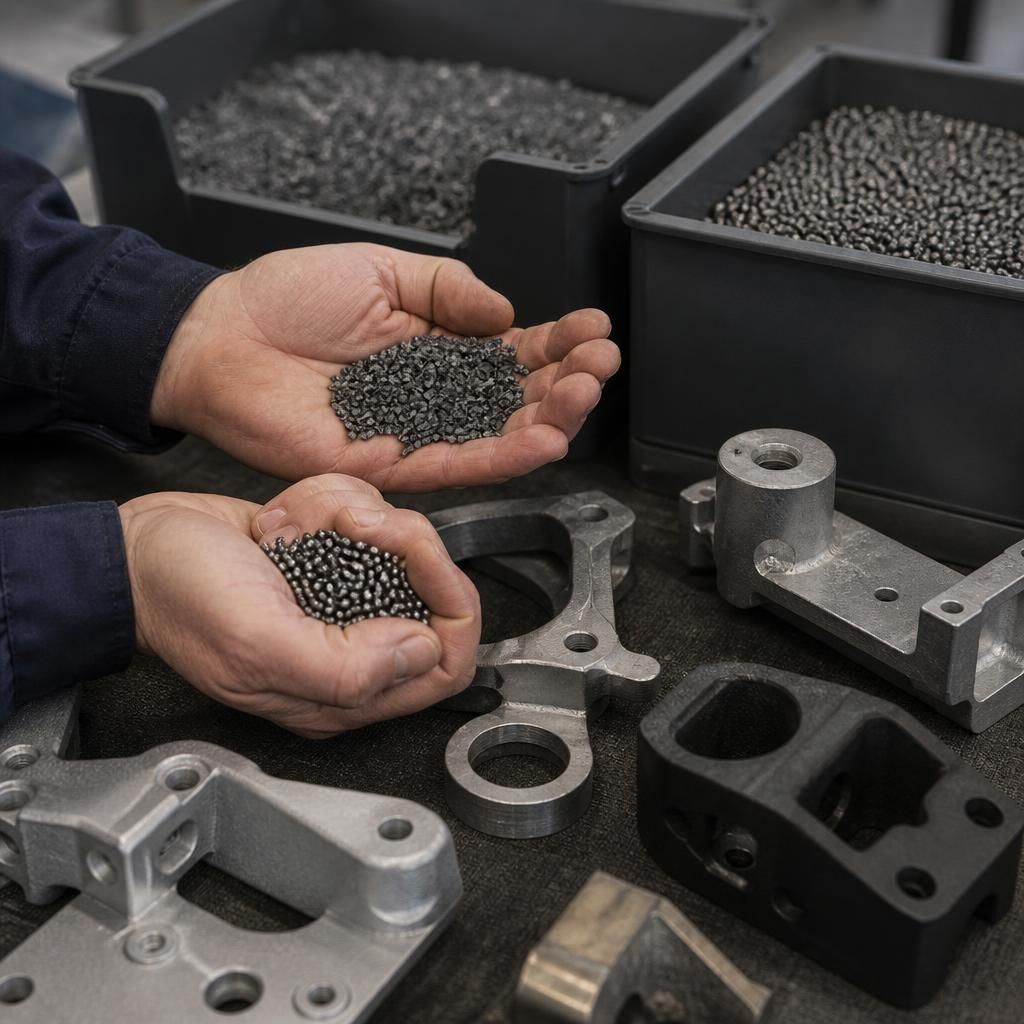
When a batch contains different metals, select shot blasting media for the most sensitive substrate rather than treating every component identically. Steel, aluminium and other non-ferrous metals respond differently to impact; a setting that cleans steel effectively may alter the surface of a softer alloy, affect sharp edges or leave an unsuitable profile for the powder coating.
Where practical, separate substrates or use clearly defined media and machine settings for each material. This also helps prevent unwanted transfer of particles between metal types. Record the approved combination of media and settings for each substrate so that preparation remains controlled when components are processed repeatedly.