

How does selecting the correct shot blasting media contribute to the longevity and quality of powder coated surfaces?
Selecting the correct shot blasting media prepares the metal surface without causing excessive profile, distortion or contamination, giving powder coating a sound, consistent base. The resulting surface profile and cleanliness improve coating adhesion, finish uniformity and resistance to premature breakdown.
Selecting the correct shot blasting media contributes to long-lasting, high-quality powder coating by controlling how the metal surface is prepared without compromising the substrate. The media must be appropriate for the metal, the existing surface condition and the required coating system; otherwise, blasting can create avoidable defects that remain visible or reduce service performance after curing.
Media hardness is one of the main considerations. A hard abrasive can remove firmly bonded mill scale, corrosion and previous coatings from robust steel components, but may be unnecessarily aggressive on aluminium, thin sections or intricate fabrications. If the media deforms the substrate, rounds edges or produces excessive impact marks, the powder coating may reproduce those imperfections rather than conceal them. A softer or less aggressive option may be more suitable where dimensional accuracy and the original form of the component must be preserved.
The shape of the media also affects the condition of the blasted surface. Angular particles cut into contamination and create a more pronounced mechanical key, whereas rounded shot delivers a peening action and can produce a smoother, more uniform effect. Neither type is automatically correct for every application. The choice depends on whether the priority is coating removal, corrosion preparation, controlled texturing or protection of a relatively delicate surface.
Particle size affects both the intensity and the consistency of the treatment. Larger particles may be useful for heavy contamination or substantial scale, while smaller media can reach recesses and provide more even coverage on detailed components. Using a size that is poorly matched to the part can leave inaccessible areas insufficiently prepared, overwork exposed faces or make it difficult to achieve a consistent appearance across a batch. The result may be variation in coating texture, gloss or visual uniformity, even where the same powder has been used.
Media condition is equally important. As abrasive breaks down through repeated use, it produces fines and dust and its cutting performance changes. This can affect the balance between cleaning and texturing, increase the risk of residue on the workpiece and make results less predictable. Regular separation of worn material, removal of accumulated dust and replenishment with suitable media help maintain a stable blasting process. Media should also be kept free from oil, moisture and other contaminants that could be transferred to the metal.
Correct selection helps protect the features that matter during coating and service, including edges, holes, threads, folds and mating faces. Excessive blasting can alter tolerances or leave abrasive lodged in recesses. Insufficient treatment can leave unstable material beneath the powder layer. Both situations can lead to localised coating problems, particularly where components are exposed to handling, weather, industrial pollutants or repeated movement.
A suitable blasting specification should therefore consider:
- the metal grade, thickness, hardness and sensitivity to distortion;
- the type and thickness of scale, corrosion, paint or other existing material;
- the component’s geometry, including recesses, welds, edges and threaded areas;
- the required surface texture and the powder coating system to be applied;
- the acceptable level of dimensional change and visual variation; and
- the cleanliness and condition of the media throughout production.
Trial treatment on a representative component or test panel is often useful before processing a full production batch. The surface can then be assessed for uniformity, residue, visible damage and compatibility with the intended powder finish. If necessary, the media type, particle size, blasting pressure, angle, distance or dwell time can be adjusted as a combined process rather than treating media selection in isolation.
Inspection should continue after blasting and after curing. A prepared part should be checked for missed areas, embedded particles, excessive roughness, distortion and contamination before powder is applied. After curing, visual checks and any specified performance testing can help identify whether the selected preparation method is producing the required quality consistently. In this way, the media choice supports not only the initial appearance of the powder coating but also its ability to remain intact and perform as intended throughout the component’s service life.
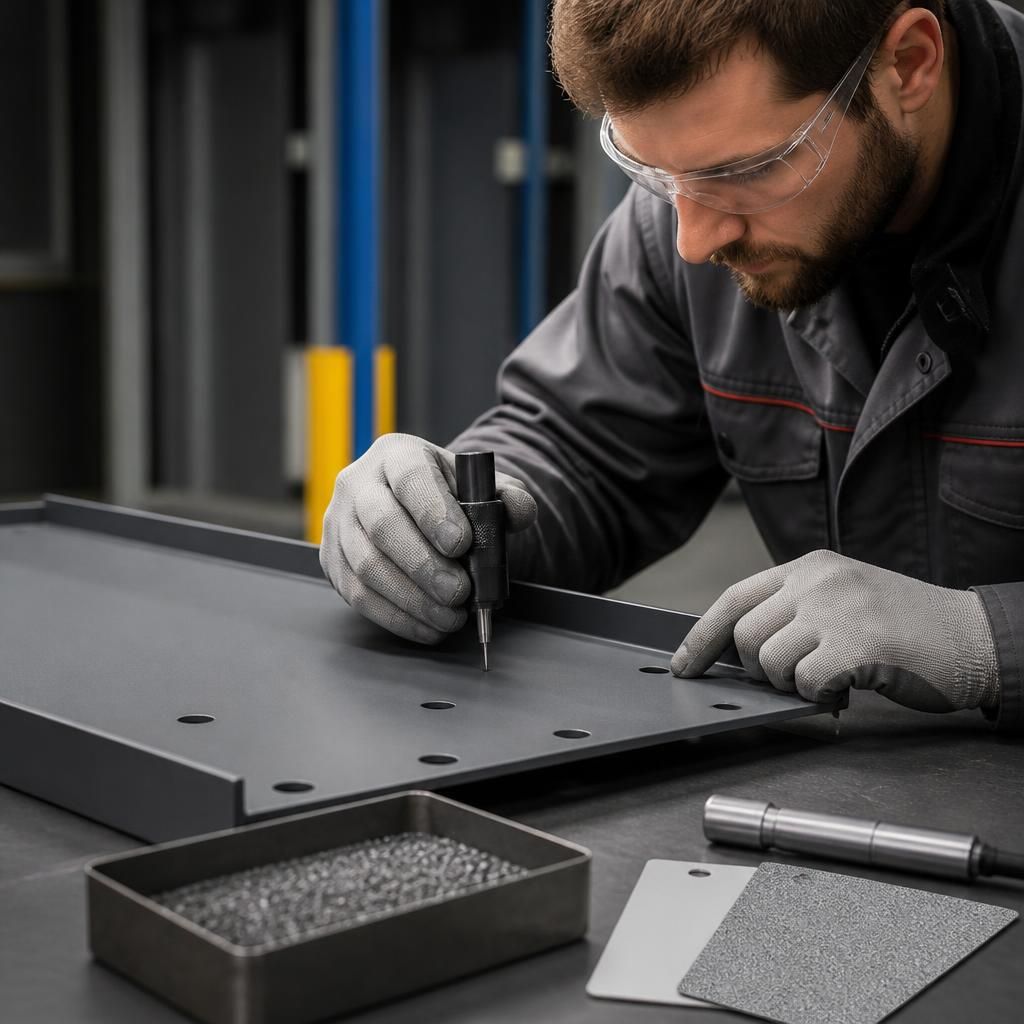
A key link between shot blasting media and powder coating longevity is the relationship between the blasted surface profile and the thickness of the applied coating. The profile should provide enough texture for the powder to anchor securely, but not create peaks that remain inadequately covered after curing.
If the media produces an unnecessarily deep or uneven profile, the coating film may be thinner over exposed peaks and thicker in the surrounding valleys. This can affect visual uniformity and leave high points more vulnerable to wear, handling damage or exposure. A suitably controlled profile allows the powder to cover the surface consistently, helping the cured finish protect the substrate as intended.
Profile checks on representative parts or test panels can confirm that the selected media and blasting settings are compatible with the coating specification. This is particularly useful where the finish has defined appearance requirements or where the coated component will face abrasion, weathering or repeated contact in service.