

What are the potential risks if I choose the wrong shot blasting method for my powder coating applications?
Choosing the wrong shot blasting method can leave contaminants or an unsuitable surface profile, causing poor powder adhesion, uneven finish quality and premature coating failure. Excessive or poorly controlled blasting may also distort or damage components, leading to additional preparation, rework and unnecessary cost.
Choosing an unsuitable shot blasting method can compromise the component before powder is applied, even when the surface appears clean. The main risks are loss of dimensional accuracy, contamination of the substrate, an unsuitable surface profile, damage to critical features and an unreliable coating process. The correct method depends on the base metal, component geometry, existing finish and the performance requirements of the finished part.
Dimensional and functional problems
Blasting removes material as well as dirt, oxidation and existing coatings. An abrasive that is too aggressive, operated at excessive pressure or applied for too long can alter fine edges, mating faces, holes and other close-tolerance features. This may affect how parts assemble or how accurately they locate against adjoining components.
Particular care is needed around threads, bearing seats, sealing faces, machined bores and folded edges. Abrasive entering a threaded hole or recess can be difficult to remove and may interfere with fasteners. Blasting can also round sharp details, open small surface defects or leave abrasive trapped in cavities. These problems may not become apparent until the component is assembled or placed in service.
Substrate-specific damage
Different metals respond differently to impact. A method suitable for robust steelwork may be inappropriate for aluminium, thin sheet, castings or fabricated assemblies with delicate sections. Softer substrates can develop excessive roughness or visible impact marks, while thin panels may be more vulnerable to localised heat and stress during preparation.
Cast components can contain pores, inclusions or residues that become exposed during blasting. Welded fabrications may have different hardnesses and surface conditions across the same part, so a uniform setting may not be appropriate for every area. If the method is selected without considering these variations, the resulting surface can be inconsistent from one component or zone to another.
Contamination and coating defects
Incorrectly selected or poorly controlled abrasive can introduce unwanted material to the surface. For example, ferrous particles transferred onto a non-ferrous component may later contribute to staining or corrosion-related defects. Reused media can also carry oil, moisture, old coating residues or other contaminants if it has not been properly managed.
Residual abrasive in blind holes, seams and complex profiles can become dislodged during handling or coating. It may create isolated particles, pinholes or localised inclusions in the powder film. Contamination can also interfere with subsequent cleaning and pretreatment, making it harder to achieve a chemically suitable surface for powder application.
Blasted steel should be protected from moisture and handled appropriately after preparation. Surface oxidation can begin before coating, particularly where the prepared component is exposed to humid conditions or contaminated handling. The blast method itself cannot compensate for poor storage, unclean gloves, unsuitable lifting equipment or delays between preparation and coating.
Unsuitable surface texture
The blast profile must be compatible with the powder system and the required appearance. A profile that is too deep can remain visible through the coating, require greater film build to cover peaks and valleys, or create sharp points that are more difficult to coat consistently. A profile that is too shallow may not provide the mechanical key required by the specified coating system.
Surface texture should therefore be assessed rather than judged solely by appearance. Relevant checks can include visual comparison, surface cleanliness inspection and measurement of the profile where the specification requires it. Test pieces or a representative component can help establish whether the chosen media and settings produce the intended result without overworking the substrate.
Problems caused by poor process selection
The wrong equipment or technique can create uneven preparation across large, recessed or irregular components. Areas that receive too little impact may retain oxidation or previous coating, while exposed edges and accessible faces may receive far more treatment than sheltered sections. Manual blasting can introduce operator-dependent variation, whereas an automated process may not reach complex geometry effectively.
Incorrect nozzle distance, angle, traverse speed, pressure or media flow can compound these issues. A method should be defined around the component rather than selected as a general treatment for every job. Masking may be necessary for precision surfaces, holes or areas that must remain free from abrasive impact, but masks must also withstand the preparation process without leaving contamination.
How to reduce the risk
- Identify the substrate, thickness, hardness, existing coating and any sensitive machined features before selecting the method.
- Set acceptable limits for cleanliness, surface profile, dimensional change and areas requiring protection.
- Use clean, suitable media and control its condition so that spent abrasive and contaminants are not transferred to the component.
- Carry out a trial on a representative area or sample where the metal, geometry or existing finish presents uncertainty.
- Inspect recesses, holes, welds, edges and masked areas after blasting, not just the most visible faces.
- Keep prepared parts clean and dry, and move them into the next preparation stage using handling methods that do not recontaminate the surface.
A specialist powder coating provider will normally review the component requirements before deciding whether abrasive blasting, a particular media type or a controlled combination of preparation methods is appropriate. Sharing drawings, material details, dimensional tolerances and the intended service environment helps ensure that the blasting process supports the powder coating specification rather than creating a separate set of defects.
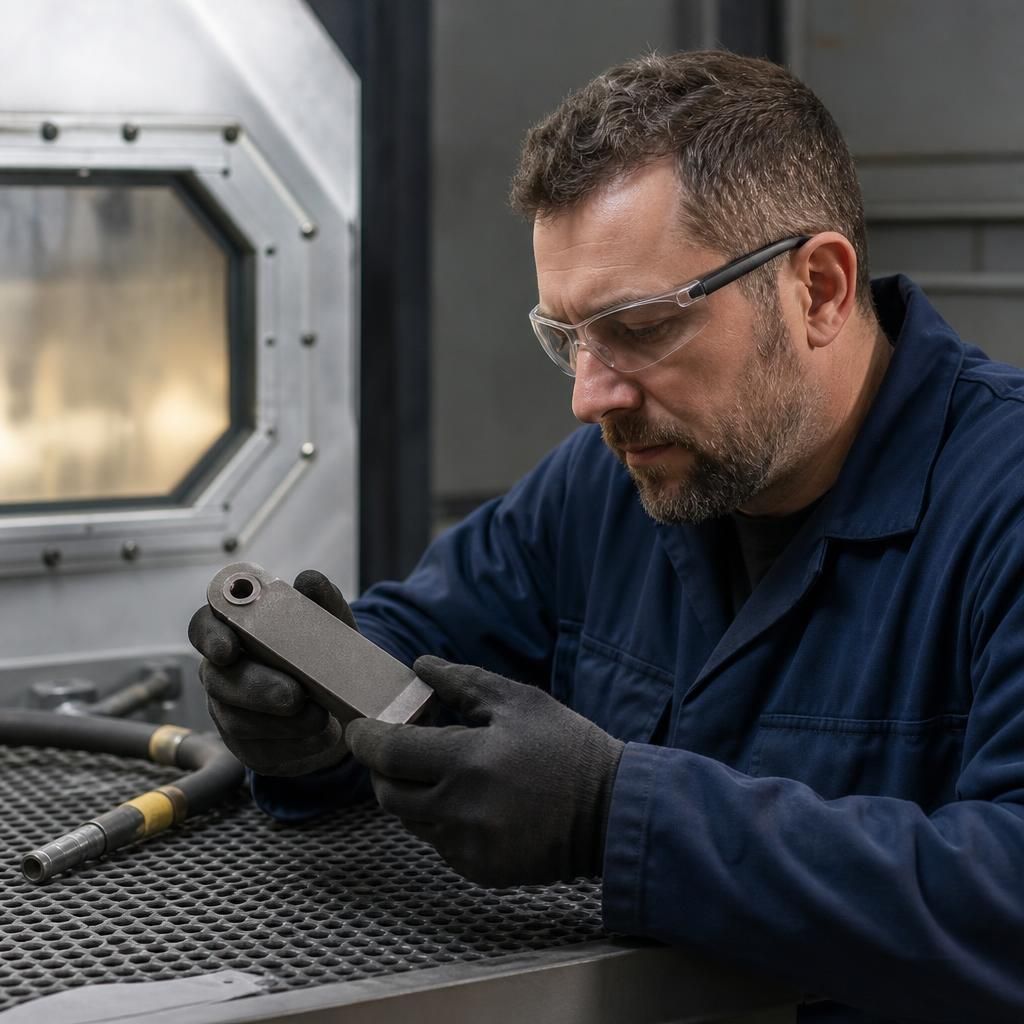
A representative trial piece can reveal problems that are difficult to predict from the component specification alone. It allows the blasting method to be assessed against the actual metal, geometry and existing finish before the full batch is processed. The result can then be checked for edge retention, surface texture and the way the powder film covers the prepared surface.
This is particularly useful where a component combines machined areas, welds, recesses or different material thicknesses. If the trial exposes excessive roughness, uneven preparation or damage to a functional feature, the media or operating settings can be revised before those risks are repeated across production parts.