

How does shot blasting contribute to the longevity of powder coating on metal components?
Shot blasting extends the service life of powder coating by removing rust, scale, old coatings and other contaminants while creating a clean, keyed metal surface. This improves coating adhesion and helps limit moisture-related corrosion, reducing the risk of premature peeling, blistering and underfilm breakdown.
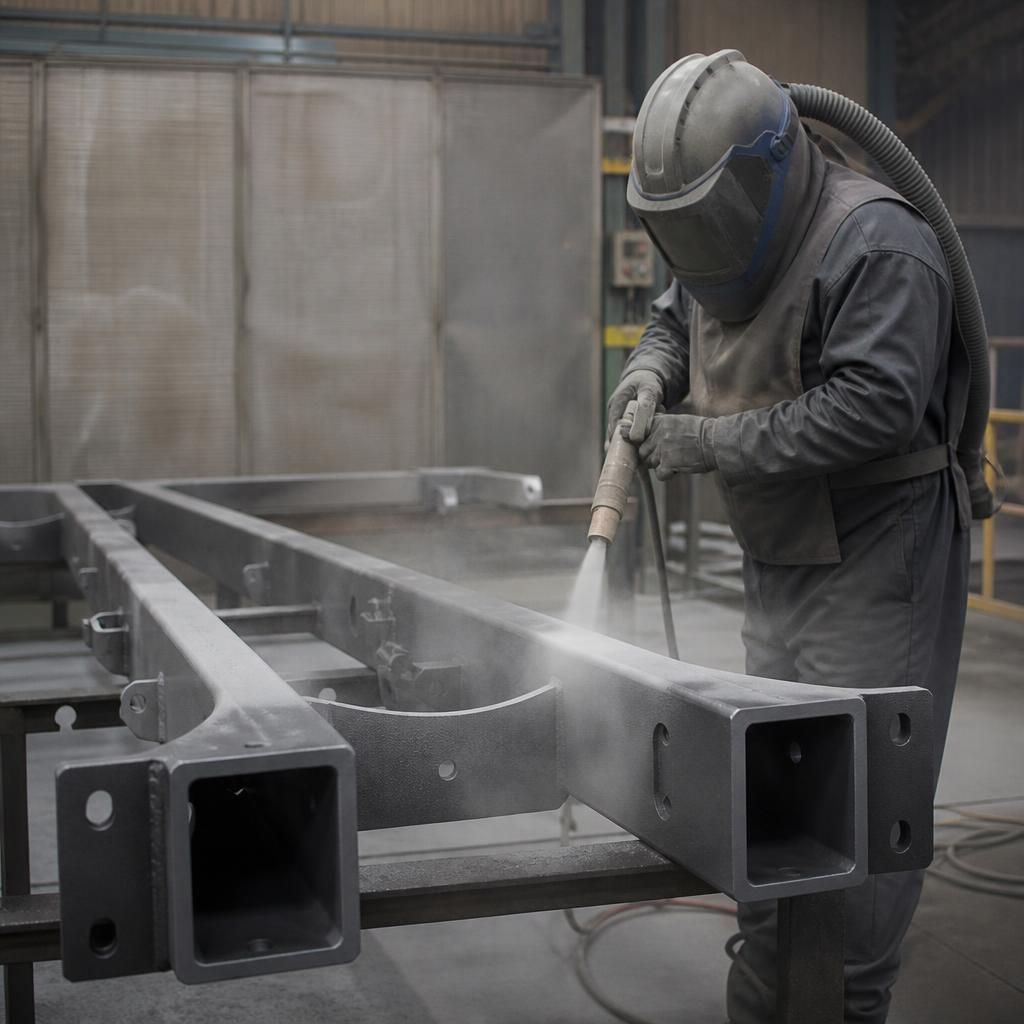
Shot blasting contributes to longer-lasting powder coating by creating a consistent, stable substrate that allows the complete coating system to perform reliably during service. Its long-term value is not limited to the initial appearance of a component; controlled preparation helps reduce variations in surface condition, coating thickness and mechanical performance that can lead to premature deterioration.
A consistent blasted surface supports more even powder deposition across the component. This is particularly important on fabricated parts with welds, corners, brackets, recessed areas and changes in section. If preparation varies between these areas, the finished film may be thinner or less uniform in places that are already exposed to handling, impact, abrasion or water retention. Shot blasting helps establish a more predictable starting condition, provided the process is matched to the metal and component geometry.
Longevity also depends on removing weak or unstable surface layers rather than coating over them. Rust scale, mill scale and remnants of previous finishes can continue to change beneath a new coating if they are not properly addressed. Although shot blasting is not a repair method for damaged metal, it can reveal pitting, porous welds, sharp edges and other defects that need correcting before powder application. Identifying these issues at the preparation stage prevents the coating from concealing problems that may later affect service performance.
The blasting specification should be selected according to the component. Media type, size, hardness, blast pressure, nozzle distance, angle and dwell time all influence the resulting surface. Excessive treatment can produce an unnecessarily coarse profile, round or distort delicate edges, embed abrasive residue or alter thin sections. Insufficient treatment may leave inconsistent areas that affect coating uniformity. The objective is therefore controlled preparation, not the most aggressive blasting possible.
Good process control is especially important where components are produced in batches. Parts should be presented consistently, with attention to areas that receive less direct blast impact. Complex fabrications may require changes in orientation or technique so that recessed surfaces, weld zones and internal faces receive appropriate treatment. Consistency between parts makes it easier to achieve repeatable powder coverage and identify deviations during inspection.
Timing after blasting also affects the eventual service life. Prepared metal should be protected from handling contamination and environmental exposure before powder is applied. Any flash rust, dust or residue that develops after blasting needs to be assessed and dealt with rather than sealed beneath the coating. The prepared surface, powder application and curing process should be treated as linked stages of one coating specification.
Assessment should consider more than visual appearance. Suitable checks may include:
- visual inspection for remaining scale, residue, pitting or missed areas;
- verification that the surface profile is appropriate for the specified powder system;
- checks for dust or abrasive residue after preparation;
- inspection of edges, welds, recesses and other locations where film coverage may vary; and
- confirmation that the powder has been applied and cured in accordance with its technical requirements.
Shot blasting cannot compensate for unsuitable metal, poor fabrication, incorrect powder selection or inadequate curing. It is one part of a controlled system. When the blasting method is appropriate and followed by correct powder application and curing, it gives the coating a more reliable foundation and reduces preparation-related variability that could otherwise shorten the useful life of the finished component.
Shot blasting does not remove every form of contamination. Soluble salts such as chlorides and sulphates can remain on metal even when the surface looks clean, particularly on components exposed to marine, chemical or industrial environments. If these residues are trapped beneath powder coating, they can attract moisture and contribute to blistering or corrosion beneath the film.
For this reason, long-term coating performance may require more than abrasive cleaning alone. Where salt contamination is possible, the preparation specification should include suitable cleaning and verification before blasting or powder application. This prevents a visually clean surface from concealing a chemical contamination problem that could shorten the coating’s service life.