

How does the choice of sandblasting media impact the quality and efficiency of the powder coating process?
The choice of sandblasting media affects the surface profile, cleanliness and texture of the metal, which in turn influence powder coating adhesion and the uniformity of the finished surface. Selecting an abrasive suited to the substrate and required finish improves process efficiency by reducing rework, contamination and unnecessary substrate damage.
The choice of sandblasting media directly affects how much material is removed, how the metal responds to blasting, how much residue is produced and how consistently the next coating stage can be carried out. The most suitable abrasive is determined by the metal substrate, existing contamination, component geometry, required finish and the production method being used. Choosing correctly helps achieve repeatable preparation while avoiding excessive consumption, equipment wear and avoidable rework.
Media hardness and impact energy are important starting points. A hard abrasive cuts into corrosion, mill scale, old coatings and other tightly bonded contaminants efficiently. This can be appropriate for robust steel components, but an excessively aggressive medium may erode edges, alter fine details or damage thinner sections. Softer media remove lighter contamination with less risk of distortion, although they may require more passes or a different blasting setting.
The abrasive’s shape also changes the way it works. Angular particles tend to cut into deposits and break them away, making them useful where corrosion or firmly adhered coatings need to be removed. Rounded or less angular particles impart energy more evenly and can be preferable where reducing sharp impact marks or protecting a relatively delicate component is important. The distinction is not simply cosmetic: particle geometry affects removal rate, equipment settings and the appearance of the prepared metal.
Particle size influences both control and productivity. Coarser media can remove substantial contamination quickly and may be suitable for larger, heavily soiled parts. Finer media provide greater control around smaller features, recesses and detailed fabrications, but can be slower when significant build-up must be removed. A mixed or poorly controlled particle range can produce inconsistent results, particularly where components are processed in batches and need to receive the same preparation.
Compatibility with the substrate is essential. Steel, stainless steel, aluminium and other non-ferrous metals do not respond identically to the same abrasive or blasting pressure. A method that is suitable for a heavy steel bracket may be unnecessarily harsh for a thin aluminium enclosure. The component’s thickness, edges, welds, holes, threads and machined surfaces should be considered before selecting the medium. Trial work on a representative area or sample component can help establish suitable pressure, nozzle distance and media size without risking the whole batch.
Media contamination can reduce coating quality even when the blasting operation appears uniform. Reused abrasive may collect oil, moisture, old coating particles or fragments of the substrate. These contaminants can be transferred to the workpiece or interfere with subsequent cleaning and coating. Abrasive storage should therefore protect the material from damp conditions, while reclaim systems and blast cabinets need appropriate separation and maintenance. Fresh media may be necessary where contamination control is particularly important.
Moisture is a further consideration. Damp abrasive can clog equipment, interrupt flow and leave the substrate vulnerable to flash rusting after preparation. Moisture in compressed air can create similar problems. Air filtration, drainage and suitable handling procedures support a steadier blasting process and reduce interruptions between preparation and powder application.
Efficiency is not only the speed of material removal. A media that removes contamination rapidly may still be inefficient if it causes excessive dust, rapid nozzle wear, frequent equipment cleaning or additional inspection and rework. The practical assessment should include:
- abrasive consumption and the possibility of safe reclamation;
- dust generation and the capacity of extraction equipment;
- wear on nozzles, hoses, cabinets and recovery systems;
- the ease of maintaining a consistent abrasive grade;
- the amount of secondary cleaning required before powder coating; and
- the time needed to inspect and correct variable areas.
Component geometry can make one medium more effective than another. Recesses, folded sections, perforations and welded joints may retain abrasive or contamination after blasting. Fine details may also be difficult to inspect visually. Media selection should therefore be considered alongside nozzle access, blasting angle, component rotation and extraction. A suitable abrasive cannot compensate for areas that the equipment cannot reach or for residue that is not removed afterwards.
The relationship between blasting and powder coating also depends on the interval between the two operations. Once preparation is complete, parts should be handled in a way that avoids fingerprints, oil transfer and airborne contamination. Where the substrate is susceptible to oxidation, the production sequence and storage conditions become especially important. Media selection may reduce the risk of unwanted residue, but it does not remove the need for controlled handling before powder is applied.
Quality checks should assess more than whether the component looks evenly blasted. Operators can examine representative areas for remaining corrosion, coating remnants, embedded abrasive, excessive erosion and damage to edges or threads. If a batch contains different material thicknesses or levels of contamination, inspection should cover those variations rather than relying on one easily accessible area.
For industrial work, the most reliable approach is to specify the abrasive and operating conditions as part of a repeatable process rather than choosing media by name alone. The specification may include the abrasive type, grade, blasting pressure, equipment arrangement, cleanliness checks, media-change criteria and post-blast handling requirements. A powder coating specialist can review the substrate and component design, carry out controlled trial preparation where appropriate and recommend a process that balances coating quality with practical production efficiency.
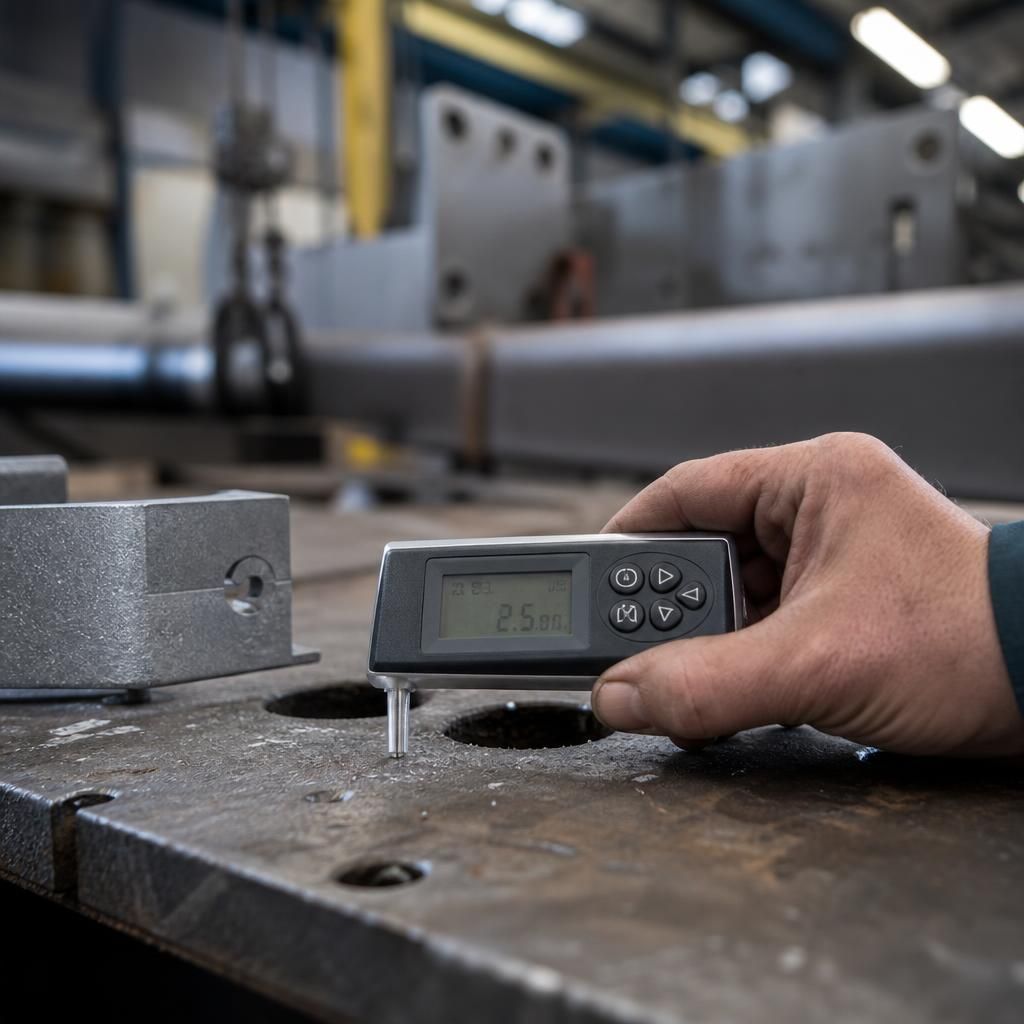
The blast profile should be proportionate to the powder coating film that will cover it. A profile that is too pronounced can remain visible through the finish, increase surface roughness and make uniform coverage more difficult. If the profile is insufficient, the coating has less mechanical key into the metal. The correct balance depends on the specified finish, coating system and component use rather than on abrasive selection alone.
Profile checks should form part of process control, particularly when changing abrasive grade, blasting pressure or equipment. Inspecting representative areas helps confirm that the prepared surface is consistent without relying solely on visual appearance. This prevents a media change intended to improve cleaning speed from unintentionally creating a surface texture that affects powder coverage, appearance or subsequent inspection.
Discuss the right sandblasting media for your powder coating process
Contact powder-coating.co.uk to discuss the abrasive selection for your components and the preparation requirements for the intended powder coating system. Providing details of the metal type, component design and existing surface condition will help establish a suitable process for review.