

What specific benefits does powder coating offer over traditional liquid painting methods for industrial applications?
For industrial applications, powder coating typically provides a tougher, more uniform and more abrasion-resistant finish than traditional liquid painting, with strong protection for suitably prepared metal components. Its dry application also reduces solvent use and overspray waste, while the cured coating offers consistent coverage and durable performance.
For industrial applications, powder coating can offer advantages over traditional liquid painting in coating efficiency, handling, finish selection and long-term maintenance. The process applies a dry polymer powder to a prepared component before heat curing it into a continuous film, making it particularly suitable for repeatable production work on metal parts that can withstand the curing temperature.
Key benefits compared with liquid painting include:
- Efficient material transfer: Powder is electrostatically attracted to the grounded component, helping the coating adhere to exposed surfaces and reducing the amount that fails to reach the part. Uncured powder can often be collected and reused where the application system and colour control allow, although this depends on the powder type and the equipment used.
- Strong film formation: Once cured, powder forms a coherent coating with good resistance to chipping, impact, scuffing and general handling. This can be valuable for brackets, frames, enclosures, machine components and other parts that face regular contact during manufacture, transport or use.
- Reduced handling risk after curing: Liquid-painted components may require drying and careful handling while the coating reaches its final condition. A correctly cured powder coating is dry and ready for subsequent handling, packing or assembly, subject to the coating specification and the part having cooled sufficiently.
- Repeatable production results: Powder coating lends itself to controlled batch processing. Application settings, oven conditions, coating thickness checks and visual inspection can be monitored as part of a defined production process. This helps manufacturers and fabricators maintain a similar appearance across multiple components and production runs.
- Wide choice of finishes: Powder systems are available in numerous colours, gloss levels, textures and special-effect finishes. The selected specification can therefore support functional requirements, visual identification or a particular design standard without relying solely on a wet-paint system.
- Useful edge and profile coverage: Electrostatic application can help coat complex profiles, corners and recessed areas, although it does not eliminate the need for correct gun positioning and suitable surface preparation. Deep recesses, sharp internal corners and Faraday-cage areas may need specific application techniques.
- Durable appearance: A suitable powder formulation can help the component retain its specified appearance under the conditions for which it was selected. For outdoor or corrosive environments, the powder type, substrate preparation, coating thickness and curing conditions must all match the exposure expected in service.
Powder coating can also simplify the specification of a component’s protective system. Rather than assessing only the paint colour, an industrial coating specification can define the preparation standard, powder chemistry, finish, thickness range, cure requirements and inspection criteria. This gives the purchaser clearer points to check when comparing coating results between batches or suppliers.
There are, however, circumstances in which liquid painting may be more suitable. Powder coating normally requires the component to enter an oven, so the substrate must tolerate the curing temperature and the part must fit the available equipment. Liquid coatings may be preferable for heat-sensitive materials, very large fixed structures, on-site work or applications requiring an especially thin film or a particular repair method. Liquid paint can also be more practical where colours need to be changed very frequently in small quantities.
The comparison should therefore be based on the component and its service conditions rather than on coating type alone. Consider the substrate, component dimensions, expected exposure, impact and abrasion risks, required appearance, production volume, permitted coating thickness and whether the item can be heated. Powder coating is often the stronger choice for repeatable industrial batches and robust metal components, while liquid painting remains useful where temperature, size, access or application flexibility is the controlling factor.
Whichever method is selected, the result depends on preparation and process control. Oil, rust, scale and other contamination must be removed, the surface must be suitable for the specified coating system, and the powder must be cured according to its technical requirements. A coating that is incorrectly prepared or under-cured can fail prematurely, so the powder’s advantages should always be assessed alongside the quality of the preparation, application and inspection process.
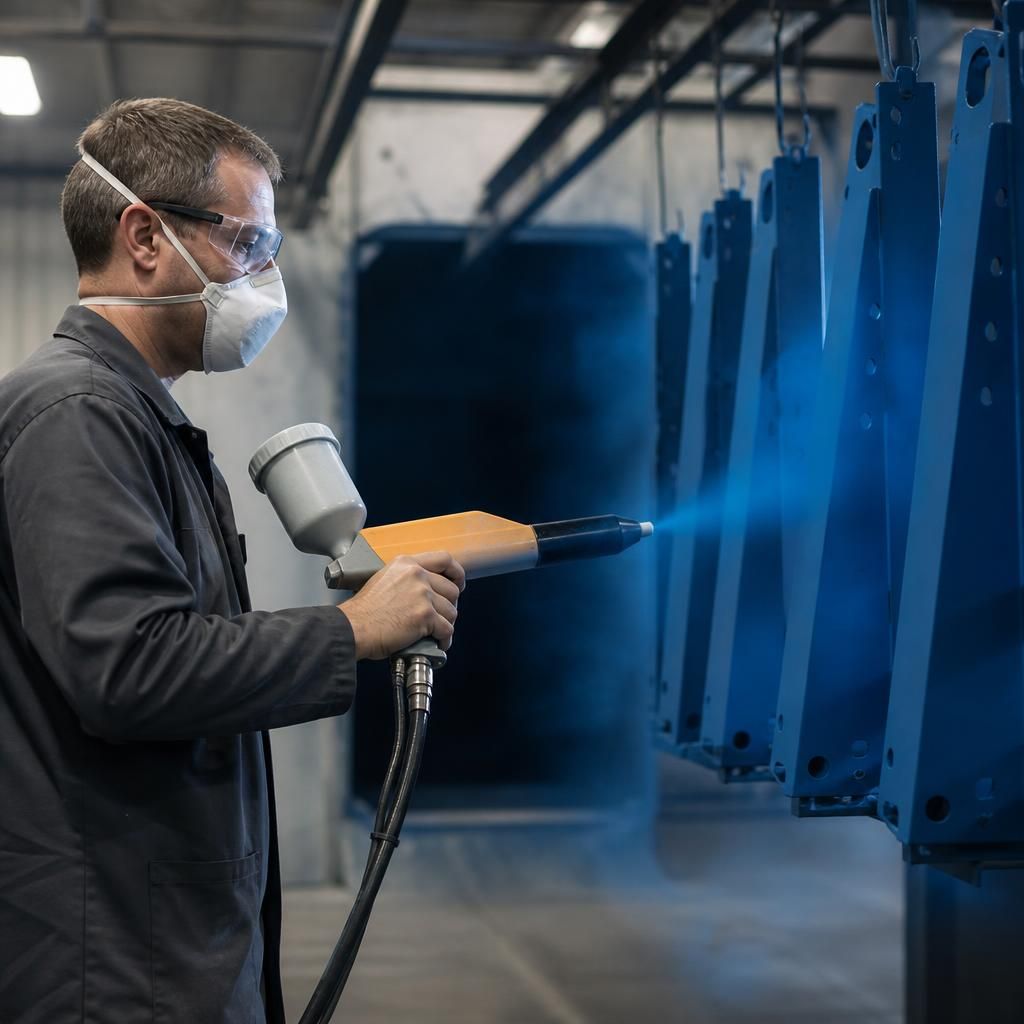
One practical advantage of powder coating is that it can achieve the specified film build in a single application and cure cycle, depending on the powder system and component design. Traditional liquid painting may require several coats to reach the required protection or appearance, with drying or flash-off stages between applications.
Fewer application stages can simplify production planning and reduce the opportunity for defects such as dust settling between coats, uneven overlap or inconsistent intercoat adhesion. The coating specification must still define the required thickness and cure conditions, but this single-layer approach can be valuable for repeatable industrial batches where process control and consistent coverage are important.
Discuss your industrial powder coating requirements
Discuss your industrial powder coating requirements with the team, including the component material, dimensions, operating environment and finish specification. This information helps determine whether powder coating is suitable for your application and what preparation and process controls are required.