

What are the advantages of using sandblasting before powder coating?
Sandblasting removes rust, mill scale, old coatings and surface contamination while creating a textured profile for the powder coat to grip. This improves adhesion, supports a more uniform finish and helps protect metal components from premature coating failure.
Sandblasting before powder coating improves the reliability of the complete finishing system by giving the coater a more predictable substrate to work with. Its advantages extend beyond preparing the metal for coating: it can expose defects, improve process control, support difficult component geometries and reduce the risk of rework caused by an unsuitable surface.
One important benefit is that abrasive blasting makes the condition of the component easier to assess. Once the surface has been prepared, issues such as pitting, weld irregularities, sharp edges, laminations and areas of previous repair may be more apparent. These defects can then be addressed before powder is applied, rather than being concealed beneath the finish. This is particularly useful for fabricated parts where the quality of the welds, edges and joints affects the final appearance and performance.
Sandblasting can also provide a consistent starting point across components made at different times or supplied in different conditions. A batch may contain parts with varying levels of oxidation, handling residue or previous finishing. Preparing them using a controlled blasting process helps reduce these differences before coating, making the subsequent application more predictable. For manufacturers and fabricators, this can simplify inspection and reduce the likelihood that individual parts will need to be stripped and processed again.
The process is especially useful for components with complex fabrication details. Abrasive blasting can reach many external faces, weld zones, corners and recessed areas that are difficult to prepare effectively by hand. It is not a substitute for good blasting technique: narrow cavities, enclosed sections and areas hidden from the abrasive stream may still need specific treatment. However, when the part is accessible, blasting can provide a more practical and repeatable preparation method than manual abrasion alone.
Another advantage is better control over the specification for the coating system. The substrate condition, required surface profile, type of metal and intended service environment all influence the appropriate preparation method and powder coating sequence. A professional coater can use the prepared surface to check whether the component is suitable for the planned finish and whether additional work, masking or a different treatment is needed. This helps avoid applying powder to a surface that has not been properly assessed.
For larger components and production batches, the process can also make quality control more systematic. Preparation can be checked before coating by examining the surface visually and, where relevant, assessing its profile, cleanliness and remaining dust. This creates a defined inspection stage between blasting and powder application. If a problem is identified at this point, it can be corrected before powder is used, rather than becoming part of a finished coating that requires removal.
- Improved inspection: surface defects and fabrication issues are easier to identify before they are hidden by the powder finish.
- More consistent batches: components with different starting conditions can be brought to a more comparable preparation standard.
- Better access to fabricated areas: welds, corners and accessible recesses can be treated more effectively than with limited hand preparation.
- More controlled quality checks: the prepared substrate can be inspected before the coating stage begins.
- Reduced rework risk: unsuitable surfaces or visible defects can be dealt with before powder is applied.
- Support for specification-led work: preparation can be matched to the metal, component design and intended operating conditions.
Sandblasting is not automatically the correct preparation for every metal component. The abrasive, pressure and technique must be appropriate to the substrate and the component’s dimensions. Excessive treatment can alter delicate edges, affect thin sections or leave an unsuitable profile. Some parts may also require masking, chemical preparation or another method for areas that abrasive blasting cannot safely reach. The blasting process should therefore be selected as part of the complete powder coating specification, rather than treated as an identical operation for every job.
Timing after preparation also matters. Prepared steel should not be left exposed unnecessarily, because moisture or handling can affect the surface before powder is applied. Components should be kept clean and handled in a way that avoids introducing oils, dust or other residues. The coating stage should follow the agreed preparation process so that the condition achieved by blasting is maintained.
For industrial components, the main value of sandblasting is therefore process control. It provides a defined preparation stage, makes the substrate easier to inspect and allows the powder coating system to be applied to a surface whose condition is understood. When the abrasive method and coating specification are matched to the component, it supports a more repeatable result across individual parts and larger batches.
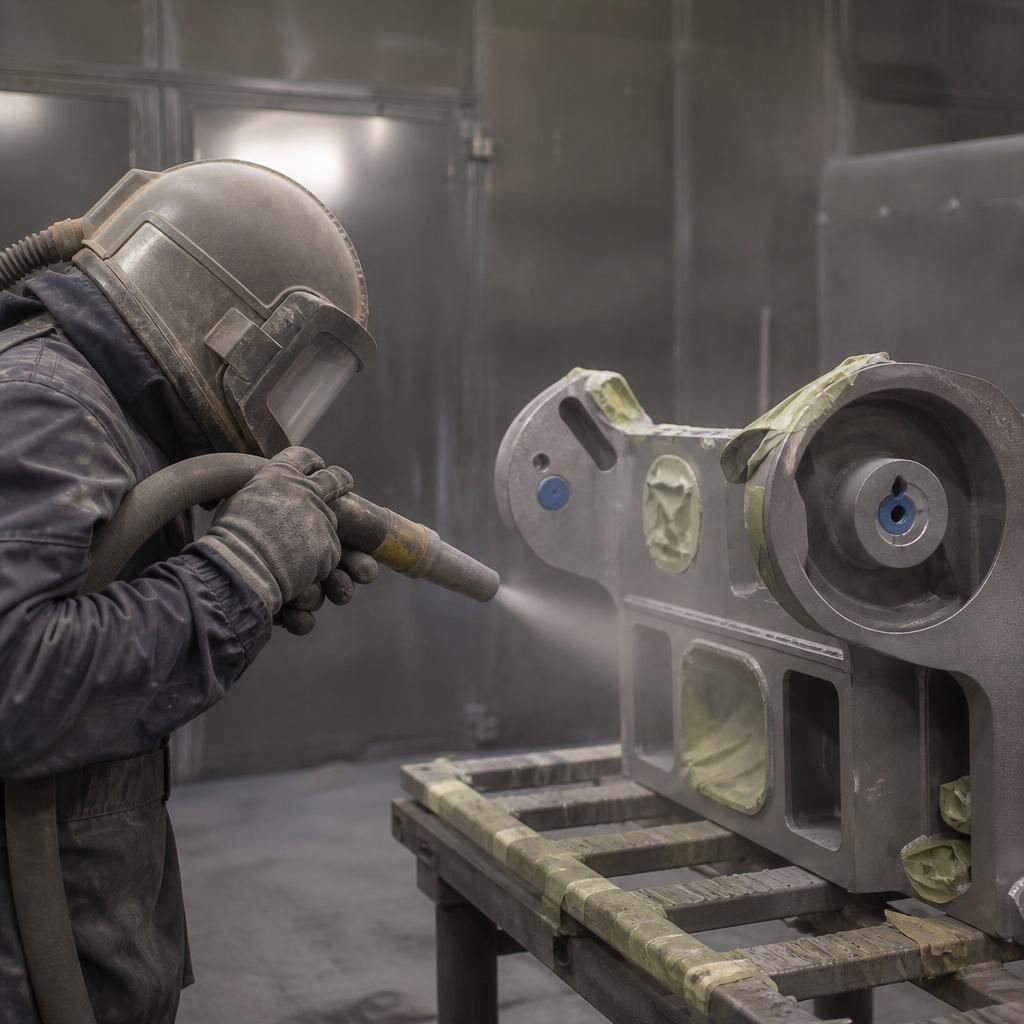
Sandblasting can help protect the function of a coated component by allowing preparation to be planned around its critical areas. Faces that must remain smooth, threaded sections, mating surfaces and identification marks can be masked or treated separately, while exposed areas receive the abrasive preparation required for powder coating. This reduces the risk of coating being applied where it could affect assembly, clearance or identification.
For fabricated metalwork, this is an important practical advantage: surface preparation is considered alongside the component’s final use, rather than applied uniformly without regard to its design. The coater can therefore identify masking requirements and preparation limits before the powder coating stage begins.
Ask about sandblasting before powder coating
If you are assessing a metal component for powder coating, discuss its material, condition and intended use with the team before choosing a preparation method. This helps establish whether sandblasting is suitable and whether any masking or additional treatment should be included.