

How does the curing process in powder coating contribute to its durability?
In powder coating, curing heats the applied powder until it melts, flows and chemically cross-links into a continuous film. This bonded structure gives the coating its hardness, adhesion and resistance to impact, abrasion, moisture and corrosion, helping protect the metal component during service.
The curing stage is the controlled heating period that converts deposited powder into a stable, finished coating. Its contribution to durability depends not simply on reaching a high temperature, but on achieving the correct combination of coating formulation, part temperature and dwell time so that the coating develops its intended physical and chemical properties throughout the film.
Powder coatings contain resin, curing agents, pigments and other additives. During curing, the resin and curing agent react to form a tightly linked polymer structure. If this reaction is incomplete, the coating may remain comparatively soft, lose adhesion or show reduced resistance to chemicals and wear. Correct curing allows the coating to reach the performance level specified for the powder system.
- Improved film integrity: the coating becomes a continuous, coherent layer rather than a collection of loosely bonded powder particles.
- Better adhesion: a properly cured film is more likely to remain firmly attached to correctly prepared metal when exposed to handling, vibration and changing conditions.
- Resistance to service conditions: the finished film is better able to withstand contact with moisture, cleaning products, oils, abrasion and moderate impact, subject to the coating specification and the environment.
- Stable appearance: correct curing helps the coating achieve its specified colour, gloss and texture. Insufficient or excessive heat can alter the appearance even where the surface initially looks acceptable.
One of the most important technical points is that the specified cure schedule generally relates to the temperature of the metal component, not merely the temperature shown by the oven control. A heavy steel fabrication takes longer to reach the required temperature than a thin bracket. Complex assemblies may also contain areas that heat at different rates. The oven process therefore needs to account for the component’s material, thickness, shape, loading arrangement and the powder manufacturer’s technical requirements.
Dwell time normally starts once the relevant part of the component has reached the required metal temperature. Removing a part too soon can leave sections under-cured, particularly around heavy welds, folds, enclosed areas or other heat sinks. Conversely, unnecessary exposure to excessive heat can damage the coating, change its colour or reduce the suitability of the finish for its intended use. A reliable process matches the powder system to the substrate and controls both temperature and time rather than relying on a visual judgement of whether the surface appears melted.
Surface preparation remains closely connected with curing performance. Curing cannot compensate for oil, rust, dust, mill scale or unsuitable pretreatment beneath the powder. Contamination can interrupt contact between the coating and the metal, while trapped moisture or residues may cause blistering, pinholing or loss of adhesion later. The substrate must therefore be appropriately cleaned and prepared before powder application and heating.
Part design and preparation can also affect the result. Drainage and venting may be needed for hollow sections, while threaded areas, machined faces and mating surfaces may require suitable masking. Sharp edges, recesses and joints can receive a different film build from broad flat faces. These areas need consideration during application and inspection because an apparently correct oven cycle does not automatically produce uniform protection on every part of a complicated assembly.
For batch and industrial work, curing is best treated as a controlled process rather than a single oven setting. Useful checks can include:
- confirming the powder system and its recommended cure range;
- considering the metal thickness and thermal mass of the parts;
- checking that the oven provides sufficiently even heat around the load;
- allowing for the time needed for the component itself to reach the target temperature;
- inspecting the cured film for uniform appearance, defects and signs of inadequate flow; and
- carrying out appropriate coating checks where the specification requires them, such as film-thickness, adhesion or hardness assessment.
These controls matter because durability is influenced by consistency across the whole component and across the batch. A finish that is correctly cured on one face but under-cured in a shaded or heavy section may develop uneven performance in service. Likewise, inconsistent loading or changing component thicknesses can produce different thermal results if the process is not reviewed for each job.
For metal components used indoors, outdoors or in demanding industrial environments, the curing schedule should be selected alongside the required powder chemistry, film thickness, preparation method and exposure conditions. The most durable result comes from treating these factors as one specification: the powder must be suitable for the application, the metal must be properly prepared, and the applied film must receive a controlled and verifiable cure.
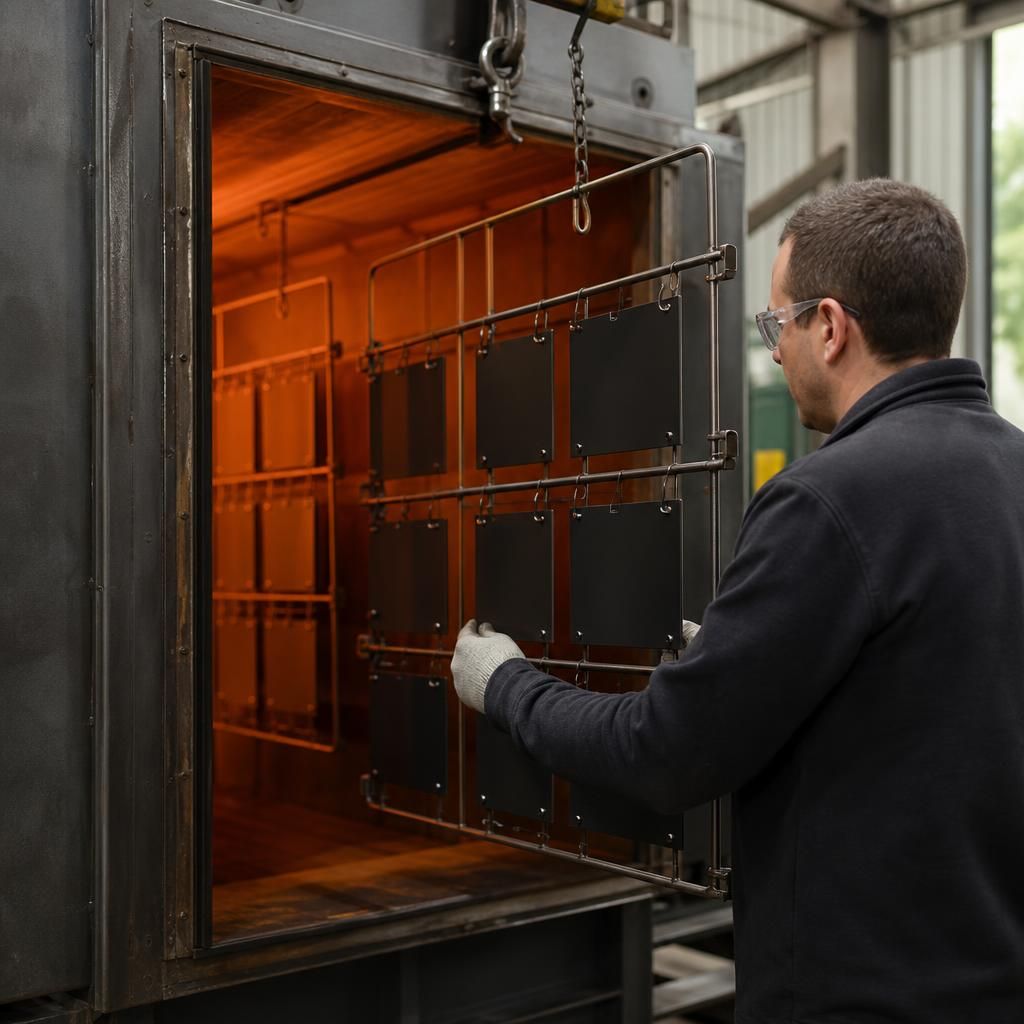
Powder coating is cured rather than simply dried. No solvent is evaporated to leave a film; heat triggers a chemical reaction that permanently sets the resin into a thermoset coating. Once this structure has formed, the finish will not soften and flow again in the way an uncured powder layer can, which helps it retain its shape and protective properties during normal service conditions.
This is why the cure schedule must match the powder system and the component being coated. The correct heat exposure develops the coating’s designed resistance without relying on excessive oven temperature, making the finished film more stable during handling, use and maintenance.