

What type of abrasive media is most suitable for my industrial components?
There is no single abrasive media suitable for every industrial component: the correct choice depends on the metal substrate, existing coating or corrosion, required surface profile and the powder coating system to follow. Aluminium oxide or garnet can provide an effective profile for robust steel components, while glass bead is better suited to gentler cleaning and finishing where preserving the substrate is important.
The most suitable abrasive media is the one that removes contamination and unwanted coatings without damaging the component or creating a surface profile that is too deep for the planned finish. In practice, the choice is based on the component’s material, the condition of its surface, the type of residue present and the level of preparation required before powder coating.
Aluminium oxide is a hard, angular abrasive suitable for removing firmly adhered coatings, corrosion and mill scale from robust steel parts. It cuts efficiently and produces a pronounced key for coating adhesion. Because it is aggressive, blasting pressure and dwell time must be controlled on thinner sections, sharp edges and softer metals.
Garnet is another angular medium used where strong cleaning and effective surface preparation are required. It can be appropriate for steel fabrications and components with substantial oxidation or previous coating. Its cutting action should still be matched to the thickness and geometry of the part, particularly around welds, apertures and machined faces.
Glass bead provides a gentler, rounded impact than angular abrasives. It is useful for light cleaning, removing surface discolouration and producing a more uniform satin appearance where retaining the underlying shape and dimensions matters. It is generally less suitable for heavy rust or thick, tightly bonded coatings because it may smooth or peen the surface rather than remove the contamination fully.
Other media may be selected for particular component requirements:
- Steel shot or steel grit: appropriate for suitably robust steel components where a controlled, productive blast is needed. The chosen grade must be compatible with the required profile and the part’s geometry.
- Plastic or other low-aggression media: useful where the substrate or a delicate feature could be damaged by harder mineral abrasives. These options are normally considered for controlled coating removal rather than heavy corrosion.
- Fine mineral media: useful when a less aggressive cleaning action is needed, although the exact selection depends on the coating residue and the finish specification.
The abrasive must also suit the component’s shape. Internal corners, drilled holes, threads and narrow recesses can retain residue or receive uneven impact. A media that works well on a flat steel plate may be unsuitable for a thin bracket, detailed casting or assembly with close tolerances. Parts with machined or sealing faces may require masking, reduced pressure or a less aggressive medium to prevent dimensional or functional damage.
Surface cleanliness after blasting is as important as the initial media choice. Loose abrasive, dust and displaced corrosion should be removed before the component proceeds to powder coating. Any residue left in recesses can interfere with coating coverage, while contamination from unsuitable equipment or media can affect the appearance and performance of the finished surface. Components should also be handled in a way that prevents oils, fingerprints and workshop debris from being reintroduced.
For a batch of industrial components, the preparation method should be agreed alongside the coating specification. Relevant details include the base metal, areas requiring a particular finish, existing paint or corrosion, dimensional tolerances and whether a defined surface profile is required. Test preparation on a representative component can help confirm that the selected abrasive removes the unwanted material while leaving a suitable surface for the powder system.
Professional sand blasting services can assess these factors before preparing metal parts for industrial powder coating. This is particularly useful where a batch contains varied component sizes or where the condition of the existing surface is inconsistent, as the media and blasting method can be adjusted to protect the substrate and maintain a consistent preparation standard.
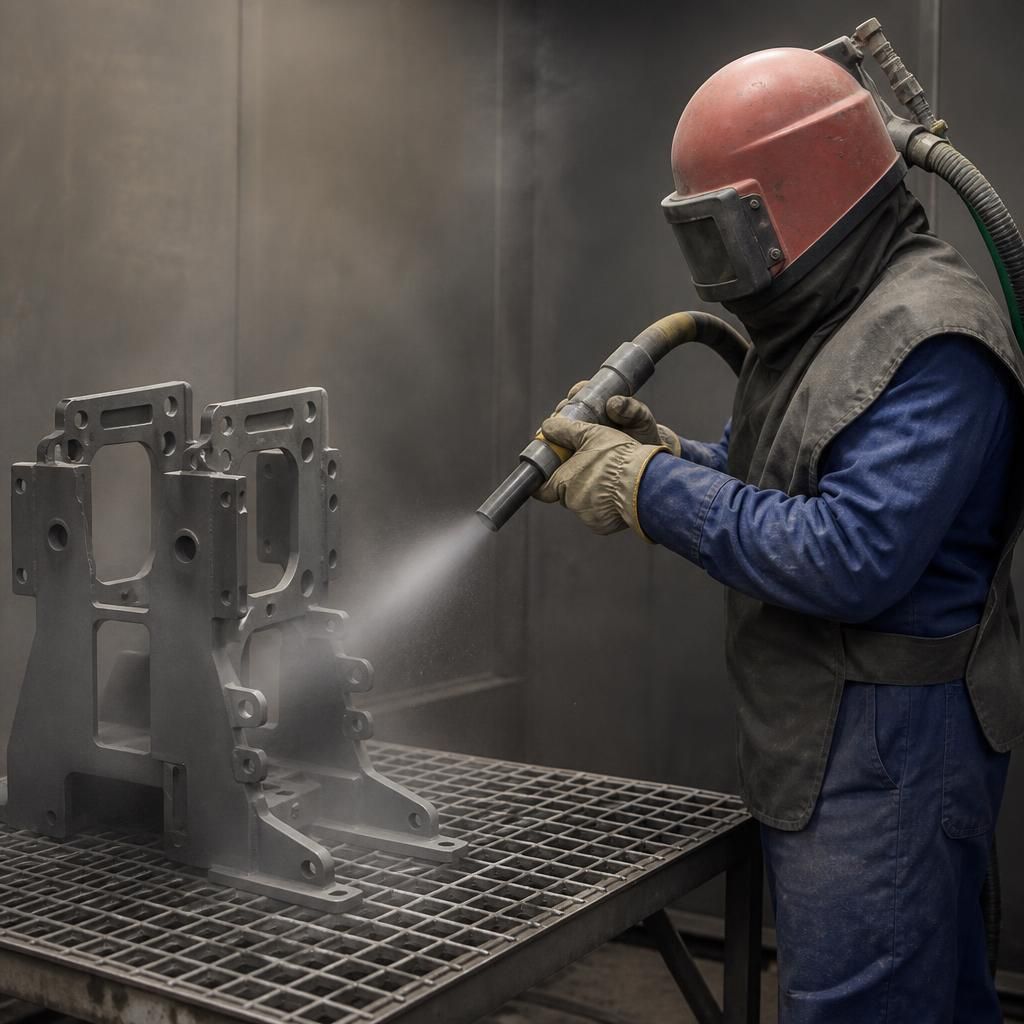
Abrasive media should also be selected with the blasting equipment and working method in mind. Nozzle distance, impact angle, air pressure and media flow all affect how aggressively the component is treated, so the same abrasive can produce different results when operating conditions change. Media that has broken down, become contaminated or mixed with another grade can also behave less predictably.
For repeat production work, recording the chosen media grade and blasting settings helps maintain a consistent preparation standard between batches. The prepared surface should be checked before coating so that any change in cutting action, coverage or surface texture can be addressed before the components proceed to powder coating.