

What safety measures are in place during the sand blasting process?
Sand blasting safety measures include suitable personal protective equipment, controlled blasting areas, effective dust extraction and equipment checks before work begins. Operators also manage abrasive materials and waste responsibly to reduce exposure risks, protect surrounding areas and support compliant surface preparation for metal components.
Safe sand blasting depends on controlling the risks created by abrasive particles, compressed air, noise, flying debris and contaminated coatings. A professional process therefore combines a documented risk assessment with trained operation, suitable abrasive selection, physical separation from other activities, safe equipment operation and controlled handling of residues.
Risk assessment and work planning
Before blasting begins, the work should be assessed according to the component, existing coating, abrasive medium, operating pressure, enclosure and likely contaminants. Old coatings may contain substances that require additional controls, particularly where the coating is damaged, unknown or suspected of containing hazardous metals. The condition and shape of the component are also considered, since thin sections, sharp edges and enclosed sections can create different risks from heavy structural parts.
The assessment should identify who may be exposed, including operators, maintenance personnel, visitors and anyone working nearby. It should also define the order of work, access restrictions, emergency arrangements and the method for dealing with spent abrasive and removed coating. This planning prevents unsuitable items or unidentified coatings from entering the blasting process.
Training and operator competence
Sand blasting should be carried out only by people who understand the blasting plant, abrasive characteristics, surface risks and emergency controls. Training covers safe start-up and shutdown, correct handling of the blast hose, recognising abnormal pressure or air flow, preventing unintended discharge and responding to a damaged hose or nozzle. Operators also need to understand how blasting affects different metals so that excessive abrasion does not create avoidable component defects.
Instructions should be available for the specific equipment and process, with supervision appropriate to the operator’s experience. Refresher training is important when the abrasive, component type, plant or work method changes.
Control of abrasive and coating hazards
The blasting medium must be selected for both the required surface profile and its health and environmental risk. Silica-containing materials can generate respirable crystalline silica, so they should not be used casually. Where a different medium can achieve the required preparation, a lower-risk alternative is generally considered. Abrasives are stored in a way that prevents contamination, moisture-related problems and accidental mixing of incompatible materials.
Removed coatings and used abrasive are treated according to their known or suspected composition. Waste is kept separate where necessary, placed in suitable containers and prevented from spreading into clean areas or drainage systems. If analysis or further assessment is needed before disposal, the material should remain identified and contained until its classification is clear.
Safe operation of blasting equipment
Blasting systems should incorporate appropriate safeguards, such as a dead-man control that stops abrasive discharge when the operator releases the control. Hoses, couplings, nozzles and connections must be secured so that a failure cannot cause uncontrolled movement or release. Air lines should be routed to reduce trip and snagging hazards, while pressure settings are matched to the equipment, abrasive and component rather than increased without justification.
Maintenance and adjustment are carried out with the system isolated from its energy source. This includes releasing stored compressed air before disconnecting hoses or opening parts of the plant. Suitable isolation procedures reduce the risk of unexpected discharge during cleaning, nozzle changes, clearing blockages or maintenance work.
Noise, visibility and physical safety
Blasting can produce high noise levels, vibration and reduced visibility within the working area. Noise exposure should be assessed, and work arrangements should limit unnecessary time near operating equipment. Clear communication methods are needed where ordinary speech is difficult to hear. Lighting and visibility must be sufficient for safe positioning, inspection and movement, without directing dust or debris towards adjoining work areas.
Components are secured before blasting so that they cannot move, overturn or swing under the force of the abrasive stream. Heavy or awkward items are positioned using suitable lifting methods, with hands kept clear of pinch points. Floors and access routes are kept free from accumulated abrasive and residue so that slips, trips and falls do not add to the process risks.
Emergency response and monitoring
Operators should know how to stop the process quickly, raise an alarm and obtain assistance following a hose failure, injury, fire, loss of containment or unexpected exposure. First-aid arrangements, emergency access and reporting procedures should be established before work starts. Any incident, near miss or equipment fault is reviewed so that the method can be corrected rather than simply returning to work.
Good practice also involves checking that controls remain effective as work progresses. Supervisors can monitor the condition of the enclosure, the spread of residue, operator behaviour and the performance of the process, while records provide evidence of the assessment, training, maintenance and waste-handling decisions. These measures help protect workers, surrounding operations and the environment while producing a properly prepared surface for subsequent coating.
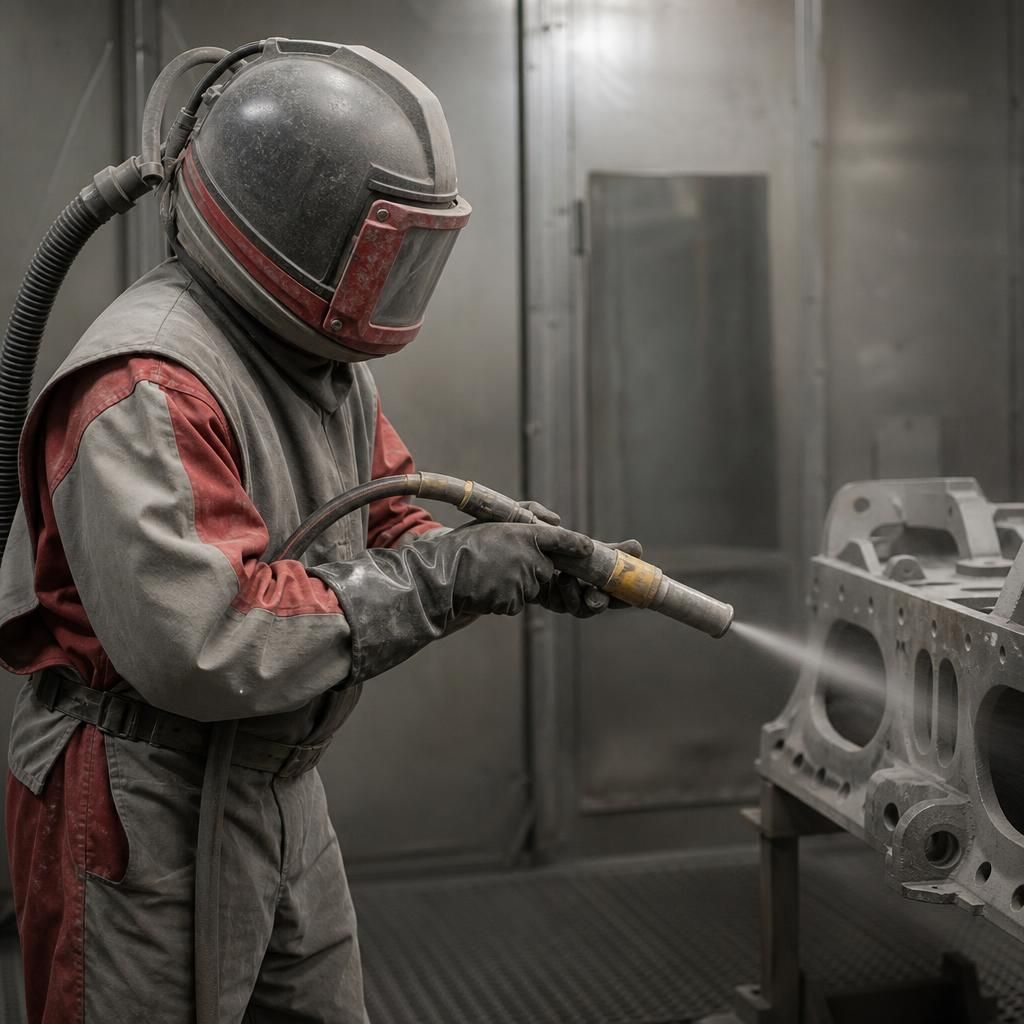
Personal protective equipment is a final layer of control during sand blasting, not a substitute for enclosure and dust extraction. Operators should use a suitable blasting helmet or respiratory protection selected for the abrasive and coating being removed, together with protective clothing, gloves, safety footwear and hearing protection. Equipment must fit correctly, be inspected before use and be maintained in accordance with the manufacturer’s instructions.
Protective clothing should be removed in a controlled area to prevent abrasive dust and coating residues being carried into clean spaces. Good hygiene arrangements, including hand washing and suitable storage of workwear, further reduce the risk of transferring contaminants. PPE requirements should be reviewed whenever the abrasive, component coating or blasting method changes.