

What is the significance of choosing the right blasting media for specific metal substrates?
Choosing the right blasting media for a specific metal substrate controls how thoroughly contaminants are removed and how the surface profile is formed for coating adhesion. The correct abrasive also helps avoid excessive erosion, distortion or damage to softer metals, supporting a more consistent and durable powder coating finish.
Choosing the right blasting media is significant because each metal substrate has a different hardness, thickness, surface condition and tolerance for impact. Media that is suitable for carbon steel may be unnecessarily aggressive for aluminium, stainless steel or thin sheet, while an abrasive that is too mild may leave a surface unsuitable for the planned coating system. The choice therefore affects the condition, cleanliness and uniformity of the component before powder coating begins.
The main considerations are the substrate material, the required surface finish, the component’s geometry and the contaminants present. A blasting specification should also take account of whether the part is solid, thin-walled, cast, machined, galvanised or previously coated. Selecting media by appearance alone is unreliable, as two abrasives can produce visibly similar results while exerting very different levels of impact and leaving different residues.
- Carbon and mild steel: Angular aluminium oxide, garnet or steel grit can be appropriate where firmly bonded scale, corrosion or old coating needs to be removed. Steel shot may be selected for suitable robust components where a more rounded impact is acceptable, but its effect on the surface differs from that of an angular cutting abrasive.
- Stainless steel: Media selection must prevent contamination from ordinary carbon-steel particles. Dedicated non-ferrous or appropriately controlled abrasive is normally considered where maintaining corrosion resistance and a clean surface is important.
- Aluminium: Aluminium is relatively soft and can be marked, eroded or distorted by an abrasive that is too hard, too coarse or applied too aggressively. Finer or less aggressive media, controlled pressure and careful treatment of thin sections are often more suitable.
- Galvanised or zinc-coated steel: The objective may be to prepare the surface without unnecessarily removing the protective zinc layer. A gentler approach may be required, particularly around edges, welds and areas where the coating is already thin.
- Castings: Cast iron and other cast metals can contain porosity, inclusions and uneven surface features. The media must remove mould residue and contamination without driving debris into surface defects or producing an inconsistent result across varying densities.
Media shape is as important as media hardness. Angular particles cut into contamination and can create a more pronounced mechanical key, whereas rounded particles tend to clean and peen the surface with less cutting action. Glass bead, for example, is generally associated with a smoother, more uniform appearance than a coarse angular abrasive. That may be useful where visual uniformity matters, but it is not automatically the best choice for every powder coating preparation requirement.
Particle size also needs to match the component. Coarse media can be efficient on heavy structural parts but may be unsuitable for fine details, threads, sharp edges or small recesses. Fine media can reach tighter areas and provide greater control, although it may be less effective against heavy scale. The blasting nozzle, working distance, angle and air pressure are part of the same decision: media cannot be assessed separately from the way it will be applied.
Incorrect media can create several practical problems. Excessive impact may round edges, alter close-fitting dimensions, expose weak areas in castings or deform thin sections. Media can also become lodged in grooves, holes or porous surfaces. If ferrous particles remain on stainless steel or a non-ferrous component, they may later contribute to staining or corrosion that is wrongly attributed to the powder coating. Reused abrasive can introduce additional contamination if it has picked up oils, paint residues or particles from a different metal.
For this reason, professional preparation normally involves identifying the substrate before work starts, isolating incompatible materials and checking the condition of the abrasive. A small test area or representative sample can help establish whether the chosen media gives the required result without unacceptable marking or dimensional change. Inspection should consider edges, welds, recesses and previously damaged areas rather than relying only on the broad faces of the part.
The most suitable media is therefore the one that meets the preparation requirement with the least unnecessary effect on the underlying metal. For a powder coating project, the decision should be agreed alongside the coating specification, the component’s end use and any requirements relating to appearance, corrosion protection or dimensional accuracy. Where parts are being prepared in batches, consistent media control and separation of different substrate types help keep the pre-treatment result uniform from one component to the next.
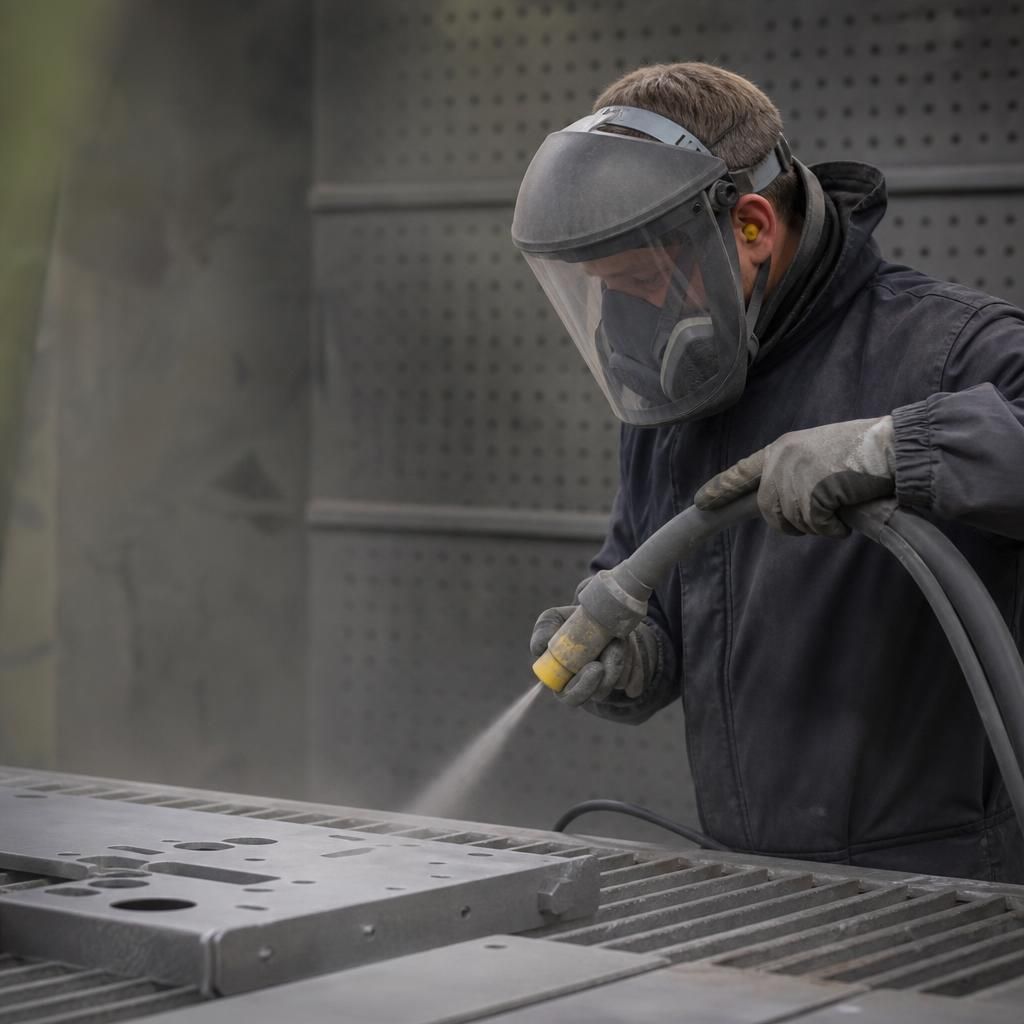
The correct blasting media should be selected with the intended powder coating appearance in mind, not solely by how clean the metal looks immediately after preparation. A surface that appears uniform after blasting may still produce visible texture, directional marks or uneven light reflection beneath a smooth or high-gloss finish. These effects can be more noticeable on broad flat panels, machined faces and components viewed at close range.
Media selection therefore needs to consider the coating’s expected texture, gloss level and film build. A controlled, consistent blast pattern is particularly important where several parts must match visually. Inspecting representative areas under suitable lighting can reveal differences between edges, welds and open faces before the full batch is processed. This helps confirm that the abrasive is achieving the required preparation without creating a surface appearance that conflicts with the final powder coating specification.