

How does the sand blasting process enhance the durability of powder coatings?
Sand blasting enhances powder coating durability by removing rust, scale, old coatings and other contaminants from the metal surface before coating. It also creates a controlled surface profile that gives the powder coating a stronger mechanical key, helping the finished layer resist lifting, corrosion and premature wear.
Sand blasting enhances the durability of powder coatings by preparing a consistent, chemically suitable foundation for the full coating system. Its contribution is not limited to making metal look clean: controlled abrasive treatment helps expose defects, standardise the substrate condition and reduce the risk of weak areas that can develop into corrosion, flaking or premature wear.
A durable finish depends on continuity across the entire component. Abrasive preparation can reach recessed sections, weld zones, edges and irregular profiles that may otherwise receive inconsistent preparation. Treating these areas as part of the same process helps the powder coating form a more uniform protective barrier, provided the component is subsequently handled and coated without introducing new contamination.
The blasting specification must be matched to the metal and its previous condition. Excessive pressure, an unsuitable abrasive or prolonged treatment can erode thin sections, round sharp features or create an unnecessarily deep profile. Insufficient treatment may leave areas that behave differently from the rest of the component. Professional preparation therefore considers the substrate, existing corrosion or coating, component geometry and the powder coating system before selecting the process settings.
Surface preparation also supports corrosion protection at vulnerable details. Welds, joints, cut edges and areas around fixings can retain residues or have a different surface texture from the surrounding metal. If these locations are not prepared consistently, moisture can exploit the discontinuity beneath the coating. Thorough, controlled blasting followed by suitable coating application helps create a more continuous barrier across the component.
Process control after blasting is equally important. The prepared metal should be checked for remaining residue, embedded abrasive, visible oxidation and areas that have not been treated evenly. It must also be protected from handling contamination and moisture before powder application. If a prepared surface begins to oxidise or is touched with dirty equipment, the benefit of the blasting stage can be reduced even when the original treatment was effective.
For batch work, repeatable blasting conditions are particularly valuable. Components that enter the coating stage with broadly consistent surface conditions are less likely to develop variations in adhesion, texture or corrosion resistance. This makes preparation records, visual checks and agreed acceptance standards useful parts of quality control, especially where coated parts will be exposed to outdoor conditions, industrial handling or repeated cleaning.
The durability improvement can be assessed through the performance of the complete system rather than the blasting stage alone. Relevant considerations include:
- the type and condition of the metal substrate;
- the consistency of abrasive treatment across faces, edges, welds and recesses;
- the absence of residual dust, grease, moisture and loose material before coating;
- the compatibility between the prepared surface and the specified powder coating;
- correct powder coverage, curing and handling after application; and
- the environment in which the finished component will be used.
Sand blasting cannot compensate for an unsuitable powder, incorrect curing or damage caused after coating. It is one stage in a linked process, but an important one: when the preparation is controlled and followed by appropriate application, the powder coating has a more reliable foundation for resisting corrosion, impact and general service wear.
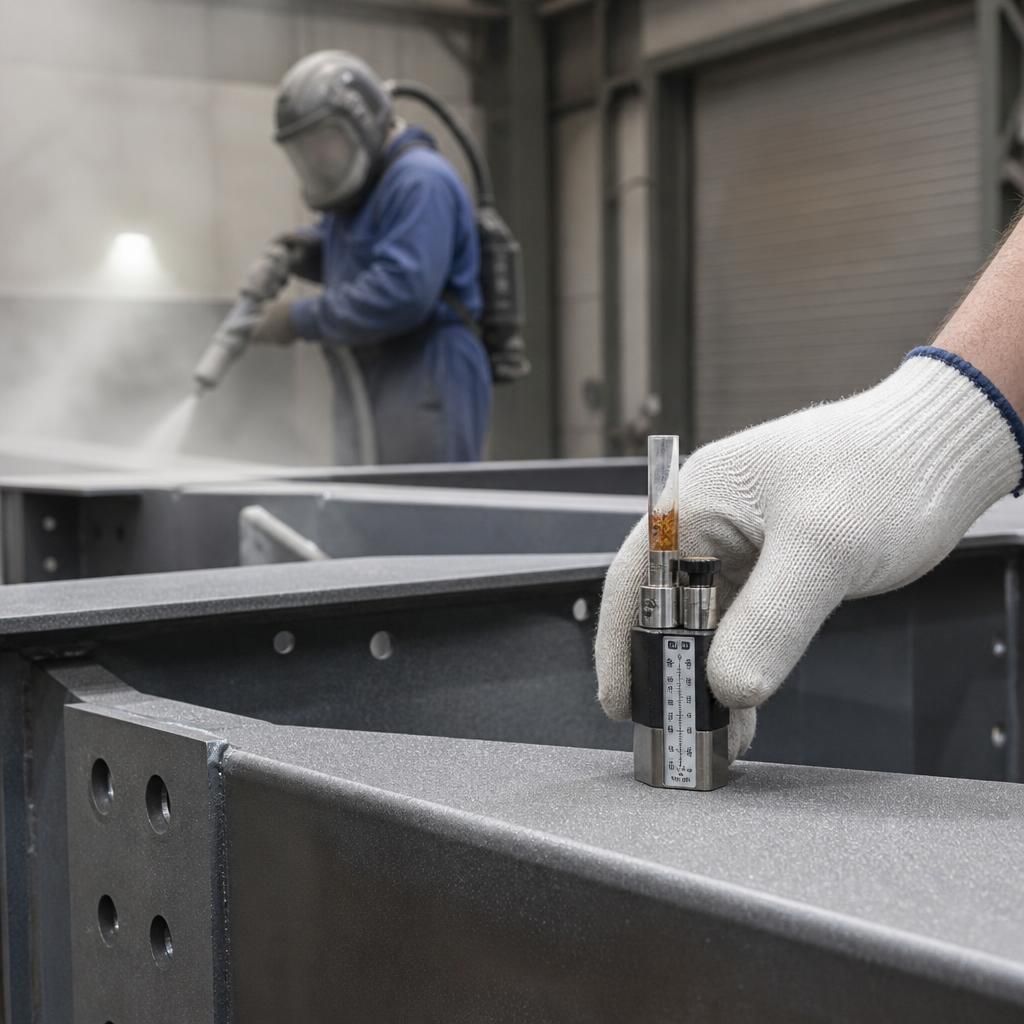
A key durability benefit of sand blasting is that it helps expose and control soluble contamination that may not be visible on the metal surface. Chloride, sulphate and other residues can attract moisture beneath a powder coating, increasing the risk of blistering, under-film corrosion and localised loss of adhesion.
For components exposed to condensation, outdoor conditions or industrial environments, the prepared surface should therefore be checked for more than visible rust and loose material. Appropriate cleaning and inspection can identify contamination that abrasive action alone may not fully remove. Where necessary, additional preparation is completed before powder application so that residues are not sealed beneath the finish.
This is particularly relevant to steelwork that has been stored, handled or exposed before coating. Controlling invisible contamination gives the powder coating a cleaner barrier against moisture ingress and helps prevent isolated defects from developing into wider coating failure.
Discuss Your Sand Blasting and Powder Coating Requirements
If you are assessing how abrasive preparation could support a more durable powder-coated finish, discuss your component, substrate and coating requirements with our team. We can help identify the appropriate sand blasting approach for your application.