

How does effective sandblasting contribute to the lifespan of powder-coated finishes?
Effective sandblasting removes rust, scale, old coating and contaminants while creating a consistent surface profile for the powder coating to grip. This stronger adhesion helps reduce flaking, premature breakdown and corrosion beneath the finish, extending the serviceable life of the coated component.
Effective sandblasting extends the life of a powder-coated finish by making the substrate cleaner, more uniform and easier to assess before coating. Its contribution is not limited to preparing the surface for application; it also helps identify defects, control potential failure points and ensure that the chosen powder-coating system is suitable for the component’s condition and intended environment.
It exposes problems before they become coating failures. Abrasive preparation can reveal corrosion pits, weld irregularities, burrs, laminations, porous areas and other defects that may otherwise remain hidden beneath a coating. These features can create thin areas, voids or local stress points. Identifying them allows the component to be repaired, dressed or assessed before powder is applied, rather than allowing a concealed defect to compromise the finish later.
It improves consistency across complex components. Metalwork often includes welds, corners, recesses, brackets and changes in section. If these areas are prepared unevenly, they may weather differently from the main faces. Careful blasting technique considers the shape of the part, the accessibility of each area and the behaviour of the substrate. This supports a more consistent coating system across the component instead of leaving vulnerable transition zones around joints and edges.
Media selection helps prevent new defects. The abrasive must be appropriate for the metal and the required finish. Excessive impact can distort thin sections, alter delicate features or create an unsuitable surface condition, while an inappropriate medium may become embedded or leave residues. Correct selection of media, pressure and blast angle reduces the risk of damaging the substrate during preparation. It also helps avoid contamination that could interfere with powder application or contribute to premature deterioration.
Cleanliness after blasting is equally important. Abrasive dust and loose particles must be removed, and the prepared surface must be protected from handling contamination, moisture and renewed oxidation before coating. A carefully prepared part can still develop defects if it is touched with dirty equipment, stored in damp conditions or exposed to contaminants between preparation and coating. Process control therefore includes inspection and appropriate handling, not just the blasting operation itself.
Blasting supports corrosion protection, but it is one part of the coating system. Long-term performance also depends on the metal substrate, powder formulation, film build, curing conditions, component design and exposure to moisture, chemicals, abrasion or ultraviolet light. For example, a component used outdoors or in an aggressive industrial environment may require a different coating specification from an indoor item. Effective preparation gives that specification a sound basis, but it cannot compensate for an unsuitable powder or incorrect curing.
For powder-coated metalwork, a sound preparation process generally involves:
- assessing the substrate and identifying areas that need repair or further treatment;
- choosing an abrasive and operating method suited to the metal, thickness and geometry;
- preparing welds, edges and recessed sections consistently;
- checking that abrasive residue, dust and other contamination have been removed;
- inspecting the prepared surface before powder application; and
- maintaining suitable handling and storage conditions between preparation and coating.
The practical result is a more controlled coating process with fewer hidden weaknesses. When blasting, inspection, powder selection and curing are treated as connected stages, the finished coating is better placed to resist the conditions for which it was specified and to retain its protective function for longer.
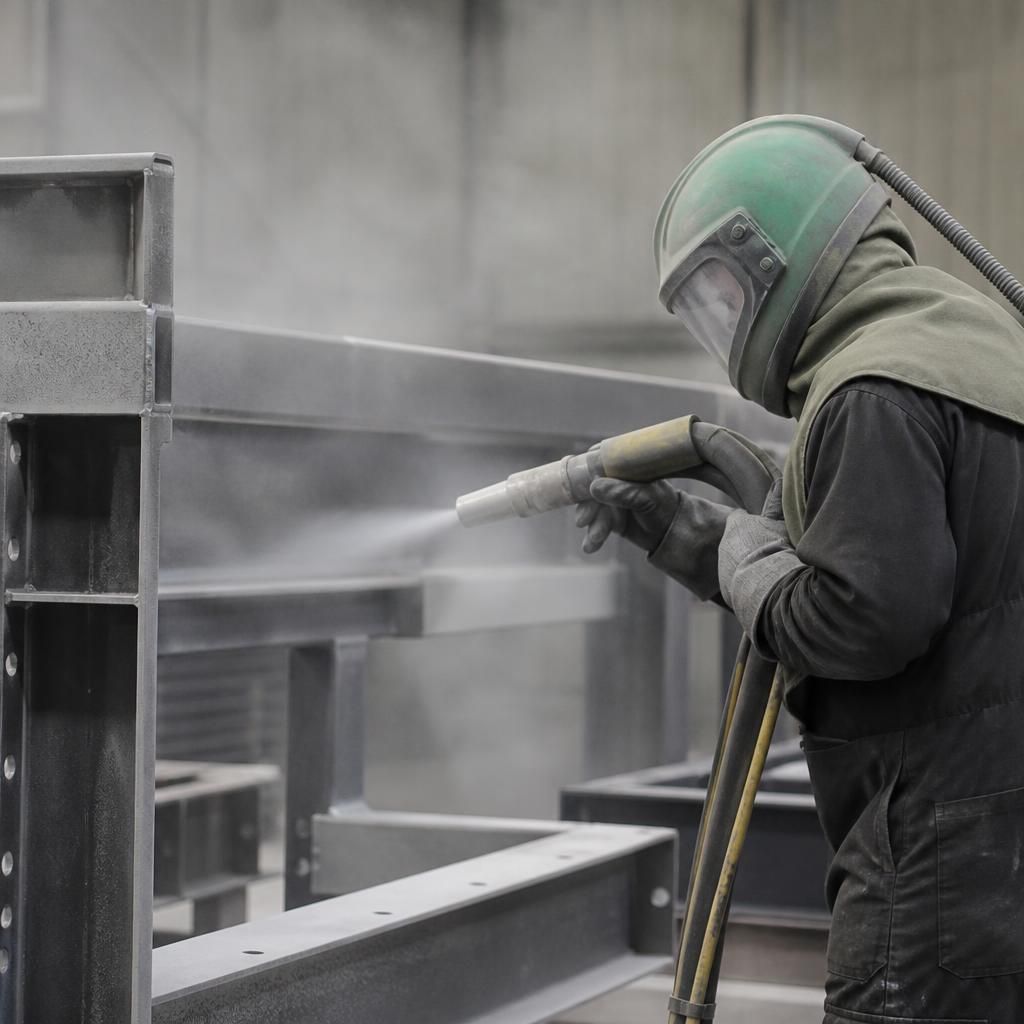
Effective sandblasting also helps prevent premature failure at the boundary between the powder coating and the metal substrate. A coating may appear sound initially but deteriorate if it is applied over weakly bonded material, tightly attached oxidation or remnants of an incompatible finish. Removing these unstable layers gives the powder-coating system a more dependable base, so deterioration is less likely to begin beneath an apparently intact surface.
This is particularly important where components will experience repeated handling, vibration or contact with other metalwork. A finish applied over a mechanically weak surface can chip or lift when the component is stressed, exposing the substrate to further damage. Proper abrasive preparation does not make the powder coating immune to impact, but it removes avoidable weaknesses at the coating interface and helps the finish perform for longer under its specified conditions.