

How do professional sand blaster services improve the application process of different coatings?
Professional sand blasting improves the application of different coatings by removing rust, scale, old finishes and other contaminants while creating a consistent surface profile. This gives powder, paint and protective coatings a cleaner, more suitable substrate for adhesion and a more uniform finish.
Professional sand blasting improves the application of different coatings by matching the preparation method to the substrate, component design and coating system. The result is a controlled starting condition for powder coating, wet paint, nylon and other protective finishes, rather than a one-size-fits-all treatment.
Preparation is adjusted to the coating specification. Different coating systems have different requirements for surface condition, texture and cleanliness. A professional operator considers the coating manufacturer’s preparation guidance, the metal type, the condition of the component and the intended service environment before selecting the blasting approach. This helps avoid preparing a component too aggressively for a finish that needs a finer surface, or too lightly for a system requiring a more substantial key.
Controlled blasting protects the component itself. Industrial parts may include thin sections, machined faces, threaded holes, sharp edges, welds, recesses and areas with close tolerances. Experienced blasting helps limit unnecessary impact on vulnerable features while providing suitable treatment to the areas that will be coated. Components can also be positioned and handled according to their shape, reducing the risk of missed areas, trapped abrasive or damage caused by unsuitable handling.
Masking and protection improve coating accuracy. Some parts require specific areas to remain uncoated, including threads, mating faces, bearing seats, electrical contact points and machined surfaces. Professional preparation includes identifying these requirements before blasting and protecting them where appropriate. This is particularly important when the component will later be assembled, as excess coating on a functional surface can affect fit or performance.
Consistent preparation supports a more even application. Powder and liquid coatings are applied over the prepared surface, so variations in preparation can contribute to differences in appearance, coverage and edge behaviour. A controlled blasting process helps create a more consistent condition across batches and between different areas of the same component. That gives the coating applicator a more predictable surface on which to work, which is important for fabricated parts, repeat production and assemblies containing several metal components.
The sequence between blasting and coating matters. After blasting, components need to be inspected, handled correctly and transferred into the next preparation or coating stage without introducing new contamination. Professional services take account of the transition between processes, including the removal or control of residual abrasive and the protection of prepared surfaces during handling. This reduces the risk that preparation work is undermined before the coating is applied.
Professional assessment is also useful where a component has previously been coated, repaired or exposed to demanding conditions. The operator can identify whether the part needs more extensive preparation, whether certain areas need separate treatment and whether the proposed coating is suitable for the substrate and its condition. Where a component combines different metals or includes weld repairs, these details can affect how preparation and coating should be planned.
For B2B coating work, the benefits extend beyond an individual part. A defined preparation method can be applied consistently across batches, while component drawings, masking requirements and coating specifications can be considered together. This makes it easier to coordinate blasting with subsequent powder coating, painting or protective treatment and to identify preparation issues before they affect a larger production run.
- Powder coatings: controlled preparation provides a suitable base for the electrostatic application and subsequent curing process.
- Wet paint systems: preparation can be selected to support the specified primer and topcoat arrangement without unnecessarily altering the component.
- Nylon coatings: the substrate condition and component geometry need careful consideration because the coating process and required finish differ from standard powder coating.
- Protective coatings: preparation is planned in relation to the exposure conditions and the level of protection required from the finished system.
Before arranging professional sand blasting, it is useful to provide details of the metal substrate, component dimensions, previous finishes, areas that must remain uncoated, the intended coating and any relevant drawings or specification. These details allow the preparation process to be chosen around the finished application, helping the coating stage proceed on a controlled and suitable basis.
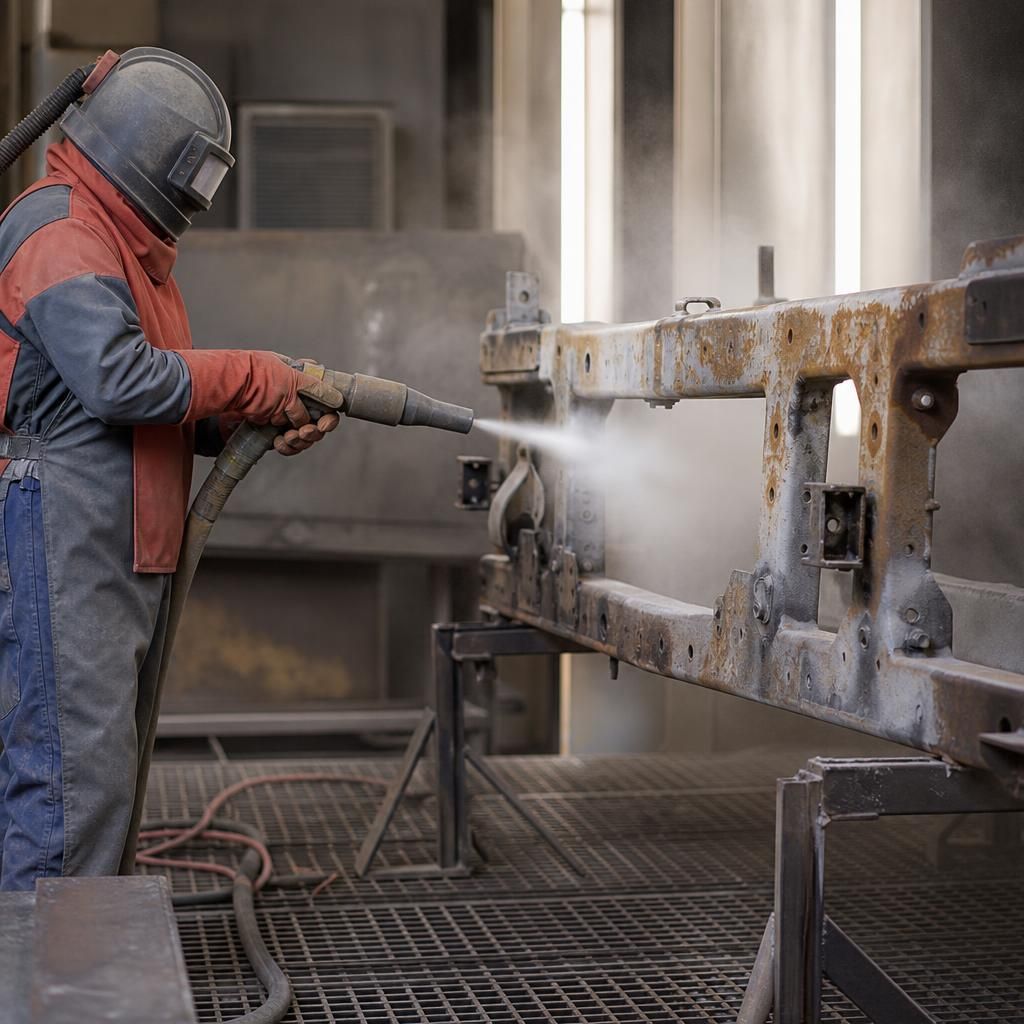
Professional sand blasting can reveal defects that would otherwise remain hidden beneath a coating. Once rust, scale and old finishes have been removed, pits, weld spatter, sharp projections and areas of damaged metal are easier to identify before powder, paint or protective coating is applied.
This creates an important quality-control stage in the application process. Defects can be corrected, edges can be assessed and unsuitable components can be reviewed before coating materials are committed. Addressing these issues at the preparation stage helps prevent visible imperfections, localised coating weakness and problems with the finished component’s fit or function.