

What types of blasting techniques are used in your powder coating facilities?
Powder coating facilities typically use abrasive blasting techniques such as shot blasting, grit blasting and glass-bead blasting to remove rust, mill scale, old coatings and surface contaminants from metal components. The choice of media and blasting method depends on the metal, component geometry and required surface profile for powder adhesion.
The principal blasting techniques used in powder coating facilities are compressed-air blasting and mechanical wheel blasting, selected according to the component’s material, size, geometry and required surface condition. Each technique controls the way abrasive reaches the metal, allowing operators to remove contamination without unnecessarily altering the component.
Compressed-air abrasive blasting uses a pressurised air stream to propel abrasive towards the workpiece through a nozzle. It provides precise control over blasting distance, angle and intensity, making it suitable for fabricated parts, weld areas, edges, recesses and components with irregular shapes. Operators can vary the nozzle position and concentrate treatment on specific areas rather than processing the whole component uniformly.
Mechanical wheel blasting accelerates abrasive using a rotating wheel rather than compressed air. It is generally suited to batches of robust components with accessible surfaces, where consistent exposure and efficient processing are important. The workpiece must be positioned and loaded correctly so that faces, corners and sheltered areas receive suitable treatment.
Steel shot blasting uses rounded steel particles to clean and condition durable ferrous components. The relatively spherical shape produces an impact effect that can remove scale and corrosion while creating a controlled profile. It is commonly considered for substantial parts that can tolerate repeated impact.
Steel grit blasting uses angular particles that cut into the surface more aggressively than shot. This can be useful where heavy oxidation, firmly bonded scale or previous coatings need to be removed. The resulting profile must be controlled carefully: an overly deep or uneven profile can increase powder consumption and may remain visible through a thin coating.
Glass-bead blasting provides a gentler cleaning action and is often used where the surface needs conditioning with less aggressive cutting. It can produce a more refined appearance on suitable metals, but it is not automatically appropriate for heavily corroded or thickly coated components. The chosen pressure and exposure time are important in preventing unnecessary distortion of the surface.
Aluminium oxide and other angular mineral abrasives may be selected when a sharper cleaning action or a particular surface key is required. The correct abrasive depends on the substrate and the coating specification. Harder media can remove difficult contamination effectively, but they also demand tighter control of pressure, dwell time and nozzle distance.
Blasting technique is also determined by the component itself:
- Flat, open surfaces: can usually be treated with a consistent traverse pattern, helping produce an even level of cleaning and surface profile.
- Welds and fabricated joints: need attention to weld spatter, heat-affected areas and crevices where residues may remain.
- Hollow sections and recesses: require suitable nozzle access and an appropriate blasting angle; inaccessible areas may need to be identified before processing.
- Thin or delicate parts: require lower impact energy and controlled exposure to reduce the risk of distortion or excessive roughening.
- Large or heavy components: may be processed in sections or positioned for safe access to all required faces.
Before blasting, components are assessed for oil, grease, moisture, weld contamination, existing coatings and areas that must be protected. Blasting is not a substitute for removing heavy grease, because oily contamination can interfere with abrasive action and remain on the metal. Openings, threads, machined faces and other surfaces that should not be blasted may require suitable protection.
After treatment, the surface is checked for remaining rust, scale, coating residue and embedded abrasive. Loose dust must be removed before powder application, since particles left on the metal can affect appearance and adhesion. The prepared component should also be kept free from handling contamination between blasting and coating.
Media condition matters as much as the basic blasting method. Abrasive that has broken down, become contaminated or accumulated excessive fines can alter cleaning performance and surface texture. Facilities therefore need controlled media handling, suitable extraction and regular checks of the blast equipment. The aim is not simply to make the metal look clean, but to create a stable, consistently prepared surface for the subsequent powder coating process.
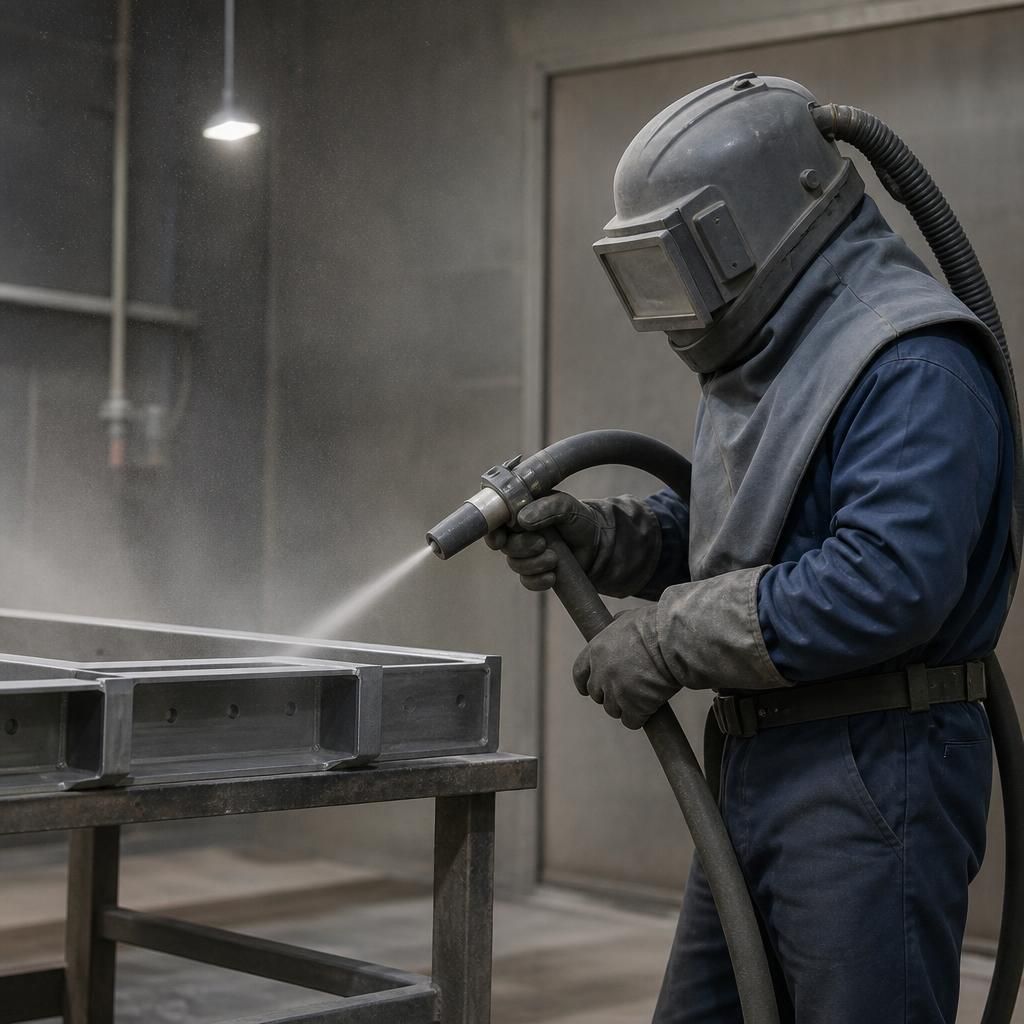
Blasting non-ferrous metals such as aluminium requires different controls from blasting steel. Steel shot or grit can become embedded in a softer surface or transfer ferrous contamination, so a facility may use glass beads, aluminium oxide or other suitable media instead. The selected abrasive must clean the component without introducing particles that could affect the coating specification or final appearance.
Equipment and media segregation are also important where different metals are processed. Using suitable blast equipment, clean abrasive and controlled settings helps prevent cross-contamination between ferrous and non-ferrous components. This is particularly relevant for visible aluminium parts, where an inappropriate abrasive can alter the surface texture or leave marks that remain apparent after powder coating.
Discuss the right blasting technique for your components
Discuss your component’s material, geometry, existing surface condition and required finish with our team to identify a suitable blasting technique and abrasive. Powder-coatings.co.uk can advise on preparation requirements for projects across the Midlands, with collection and delivery options available.